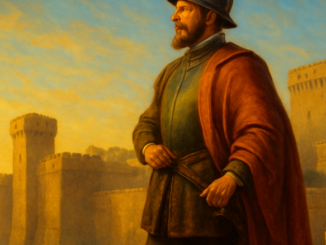
Stone fortress wall symbolizing Masonic steadfastness and inner strength
Freemasonry & Connection

When Your Walls Fall: Montaigne and the Art of Steadfastness

Imagine you’re under pressure. Maybe it’s a conflict at work, a fracture in a friendship, or a season when everything seems to be crumbling around you. You feel besieged — surrounded by circumstances you can’t fully control. In moments like these, a single question emerges: how do you stand your ground without losing yourself? Michel de Montaigne, the sixteenth-century philosopher, wrestled with exactly this question in his short but powerful essay on the commander of a besieged fortress. His reflections offer surprisingly practical guidance for anyone seeking steadfastness and human connection in times of adversity. The Heart of the Dilemma In this essay, Montaigne describes a situation that appears military on the surface but is universal at its core. A commander of a besieged fortress must choose: when do you negotiate, when do you hold firm, and when do you yield? It’s not just about walls of stone — it’s about the inner walls we build when we feel threatened. The philosopher asks what honor, courage, and wisdom truly mean when the pressure becomes unbearable. You may never have commanded a garrison, but you’ve almost certainly faced your own version of this dilemma. Think of a moment when you had […]
Open book with Montaigne essays and Masonic square and compasses symbol
Michel de Montaigne – The Essays

Montaigne on Negotiation: Philosophical Sources Explored

When you face a difficult choice, where do you turn for guidance? In the sixteenth century, a French nobleman asked himself the very same question. Michel de Montaigne wrote his fifth essay about military commanders who had to decide whether to negotiate during a siege. Behind this seemingly practical question lies a rich philosophical tradition that remains surprisingly useful today — not least for those who walk the path of self-improvement and moral reflection. The Question Beneath the Question At first glance, Montaigne is dealing with a military problem: is it honorable for a commander to launch a sortie while negotiations are underway? But read a little deeper, and you discover a timeless ethical puzzle. How do you act with integrity when circumstances are uncertain? When does caution become wisdom, and when does it slide into cowardice? These questions connect directly to everyday life. Imagine you are in conversation with someone about a conflict, and you suddenly discover new information that changes the game entirely. Do you use that knowledge? Do you hold back? The dilemma of the besieged commander is recognizable to anyone who has ever had to choose between tactical advantage and personal integrity. Stoic Roots of the […]

Ancient fortress commander contemplating a difficult decision at the walls
Content & Summary

Montaigne on the Besieged Commander: Courage and Trust

Imagine standing at the head of a fortress, surrounded by enemy troops. The walls are crumbling, supplies are dwindling, and your men look to you for guidance. What do you do? Negotiate? Fight to the bitter end? Seek an honorable way out? In his fifth essay from the first book, Michel de Montaigne examines exactly this dilemma — and in doing so, he offers surprisingly practical wisdom for anyone who has ever faced a difficult choice. The Central Question of the Essay Montaigne opens with a deceptively simple question: is it permissible for the commander of a besieged fortress to negotiate with the besieging enemy? In his era, this was a burning issue. The code of military honor demanded that a commander hold out to the last. But Montaigne, ever the clear-headed thinker, questions whether that rule is truly as absolute as it was claimed to be. At the heart of the essay lies the tension between rigid rules and practical judgment. Montaigne argues that circumstances determine what is fair and wise. A commander who negotiates from a position of weakness acts very differently from one who negotiates from strength and secures favorable terms. It is not the act itself […]

Montaigne philosophy and Freemasonry symbolism representing self-knowledge
Freemasonry & Connection

Montaigne and Freemasonry: Passions and True Connection

Why do we sometimes direct our deepest emotions at things that don’t actually matter? And more importantly, how do we recognize the moment our passions deceive us? These are questions the sixteenth-century philosopher Michel de Montaigne posed in his essay on how the soul projects its emotions onto false objects. They are also questions that resonate powerfully within the ritual space of the Masonic lodge, where brethren gather to examine themselves and seek authentic human connection. What Did Montaigne Mean by “False Objects”? Montaigne identified a peculiar yet universal human tendency. When we are overwhelmed by powerful emotions — anger, grief, frustration — we instinctively seek an outlet that has nothing to do with the real source of our distress. A man who receives bad news kicks a chair. A person in mourning lashes out at the messenger. The soul, Montaigne argued, simply cannot bear the full intensity of its passions, and so it desperately searches for something — anything — to direct them toward, even if that target is entirely innocent. This insight is not a judgment but an observation about human vulnerability. Montaigne draws our attention to the fact that we often deceive ourselves by pouring emotional energy […]

Open book with classical philosophy text symbolizing Montaigne and Freemasonry
Michel de Montaigne – The Essays

Montaigne on Passions and False Objects: Philosophical Roots

In the fourth essay of his first book, Michel de Montaigne investigates a curious phenomenon: how the human soul directs its emotions toward objects that are not the true cause of those feelings. This insight did not arise in a vacuum. Montaigne drew deeply from a long philosophical tradition reaching back to Greek and Roman thinkers. The question of how we handle our passions — and why we sometimes aim them at the wrong targets — had occupied philosophers for centuries before Montaigne ever picked up his pen in his tower library in Bordeaux. The Stoic Legacy: Mastery Over Emotion The influence of Stoicism on Montaigne‘s thinking is especially tangible in this essay. The Stoics — notably Seneca and Epictetus — argued that human suffering does not arise from external events, but from the judgments we form about them. When we feel anger toward an object that has hurt us, or when we direct grief at a symbol rather than the real cause, we are demonstrating precisely what the Stoics meant: our passions are often misplaced. Seneca wrote at length about how anger can seduce us into irrational behavior. In his treatise On Anger, he gave countless examples of people […]

Montaigne essay on misdirected emotions and Masonic self-knowledge
Content & Summary

Montaigne on False Objects: When Our Emotions Go Astray

Why do we slam a door after stubbing our toe? Why do we shout at a frozen computer as though it were deliberately conspiring against us? In the fourth essay of the first book of his Essays, Michel de Montaigne explores this peculiar human behavior: our tendency to direct emotions at objects that have absolutely nothing to do with what actually troubles us. It is a short but penetrating piece that reveals something essential about the human psyche — and offers surprising insights for anyone committed to genuine self-knowledge. The Core Idea: Emotions Cannot Hang in a Void Montaigne opens with a paradox most of us will recognize immediately. The human soul, he argues, cannot let its passions dangle in empty space. Once an emotion has been aroused, it insists on finding an outlet — a target, a destination, an object. But what happens when the real object of our anger, grief, or frustration is out of reach? The soul invents a surrogate. It fabricates a false object onto which it can project its feelings. Crucially, Montaigne does not treat this as a sign of weakness or irrationality. He suggests it is simply how human emotions work. Our passions demand […]

Symbolic image of hands connecting across time representing Masonic brotherhood
Freemasonry & Connection

Montaigne on Connection: When Our Soul Reaches Beyond

An old man sits in silence beside the bed of his dying friend. No words remain — only the warmth of a hand resting upon a hand. And yet he feels something within himself reaching beyond this moment, beyond this room, beyond his own boundaries. It is precisely this mystery that the sixteenth-century philosopher Michel de Montaigne sought to understand: how our emotions can transcend our bodies and our time, and what that reveals about the nature of human connection. The Question Montaigne Asked In his essay Whether Our Emotions Carry Themselves Beyond Us, Montaigne examines a riddle that every thoughtful person has encountered at some point. Why do we worry about what will happen after we die? Why do we feel sorrow now for future losses, or joy for events we will never live to witness? It seems irrational, yet it is profoundly human. Montaigne suggests that the soul is not imprisoned within the boundaries of the body or a single lifespan. It extends outward — toward others, toward the future, toward ideals larger than ourselves. This insight touches a fundamental truth about human existence: we are not isolated islands. Our emotions, our worries, and our dreams weave themselves […]

Montaigne's tower study with candles and manuscripts symbolizing self-reflection
Michel de Montaigne – The Essays

Montaigne and the Philosophy of Feelings That Transcend Us

It is a cool evening in 1572. In his tower study in Bordeaux, a man sits hunched over yellowed manuscripts. Candle wax drips onto passages of Seneca, the margins filled with his own annotations. He asks himself: why do we grieve for people we barely knew? Why do our feelings reach beyond our immediate experience? This seemingly simple question would grow into one of the most penetrating essays of the Renaissance. Michel de Montaigne drew upon a rich philosophical heritage for this third essay — a heritage that continues to inspire Freemasons in their pursuit of self-knowledge to this day. The Stoic Legacy: Emotions Under the Microscope Montaigne’s inquiry into the reach of human feeling is deeply rooted in Stoic philosophy. Seneca, the Roman philosopher and statesman, was his most important teacher from across the centuries. In his letters to Lucilius, Seneca explored at length how emotions can overwhelm us and how we might deal with them wisely. The Stoic ideal of apatheia — freedom from disruptive passions — fascinated Montaigne, but he did not embrace it fully. Instead, he used it as a starting point for his own, more nuanced view of emotional life. The Stoics taught that our […]

Skull and hourglass as Masonic memento mori symbols on a dark background
Content & Summary

Montaigne on Feelings That Reach Beyond Ourselves

In the sixteenth century, a French nobleman wrote an essay that still challenges the way we think about death, fame, and the memory we leave behind. Michel de Montaigne explored, in the third essay of his first book, how human emotions stretch toward times and places we will never experience. Centuries later, his questions still resonate — perhaps nowhere more deeply than in the symbolic world of Freemasonry, where mortality and eternity stand as central themes of reflection and ritual. The Core Idea of the Essay Montaigne opens with a deceptively simple observation: we concern ourselves with matters that lie far beyond our own existence. We worry about our reputation after death, about what will happen to our bodies, about the memory we leave behind. But can we truly feel anything about events that take place when we no longer exist? This is the central paradox Montaigne investigates. He argues that our emotions extend into domains our consciousness can never reach — and he wonders whether this makes any sense at all. Historical Examples as Mirrors As is typical of his essays, Montaigne draws liberally from classical antiquity. He cites Roman generals and Greek philosophers who were intensely preoccupied with […]

A single tear drop symbolizing grief, vulnerability, and Masonic brotherhood
Freemasonry & Connection

The Tear as Symbol: Montaigne, Grief, and Brotherhood

A tear falls. A single droplet of moisture sliding down a cheek. In everyday life, we might look past it quickly, or avert our gaze out of respect for someone else’s sorrow. But what if we truly considered this tear? What if we paused, as sixteenth-century philosopher Michel de Montaigne did in his essay “Of Sadness,” to reflect on what this small gesture reveals about our humanity and our connection to others? The Tear as a Language Beyond Words In his essay, Montaigne describes how the most intense emotions are sometimes too vast for words. The deepest grief, he observes, exceeds our ability to express it. When sorrow overwhelms us, the body takes over: we weep, we fall silent, we tremble. The tear then becomes more than a physical reaction — it becomes a symbol of everything that language cannot contain. Freemasonry holds a deep understanding of this language beyond words. Rituals, symbols, and gestures carry meanings that the intellect alone cannot fully grasp. Just as the tear speaks where the voice fails, so too do the working tools of the Freemason speak of truths that resist neat definitions. The square does not merely measure angles; it also measures the […]

Open book with Montaigne's Essays beside Masonic square and compasses in soft light
Michel de Montaigne – The Essays

Montaigne on Grief: Philosophical Roots and Masonic Symbolism

There comes a moment when words fail. A moment when the soul is so overwhelmed by sorrow that it freezes, falls silent, or erupts in a flood no one anticipated. Michel de Montaigne wrote about precisely this in his second essay — a brief but deeply penetrating exploration of the limits of human emotion. Beneath its seemingly simple subject lies a rich philosophical inheritance stretching from the Greek Stoics to Renaissance humanism. And for those accustomed to thinking in symbols, it opens a world of meaning that reaches far beyond the surface of everyday experience. The Silent Voice of the Stoics Montaigne‘s reflections on grief are unthinkable without Stoic philosophy. This school of thought, born in third-century Athens, taught that emotions are the result of the judgments we make about reality. Sorrow does not arise from what happens to us, but from how we interpret it. Seneca, the Roman philosopher whom Montaigne so frequently quotes, wrote extensively about the art of dealing with loss and adversity. He insisted that the wise person does not suppress emotions but learns to understand them. In his essay on sadness, however, Montaigne takes a more nuanced position. He observes that extreme emotions sometimes paralyze […]

A veiled figure in silent grief, symbolizing Montaigne's essay on sadness
Content & Summary

Montaigne on Grief: When Words Fall Short

There comes a moment when grief cuts so deep that it turns to silence. Tears refuse to fall, words catch in the throat, and what remains is a stillness that weighs more than any gesture. Michel de Montaigne explored this phenomenon in his brief but penetrating essay ‘On Sadness,’ the second chapter of his monumental Essays. He poses a question that resonates as powerfully today as it did in the sixteenth century: what happens when emotion exceeds the limits of expression? The Core Idea: Emotion Beyond Expression Montaigne opens his essay with a striking claim: he professes to be hardly susceptible to sadness himself. This is not an attempt at Stoic indifference but rather a runway toward his real subject. What fascinates him are those moments when grief becomes so overwhelming that the body simply cannot express it. Instead of releasing us, the sheer intensity of the emotion paralyzes us. This central insight illuminates a paradox most of us recognize: the most intense feelings sometimes manifest as total silence. A mother who loses her child may appear calm while others weep around her. Only later, when the initial shock begins to subside, do the tears come. Montaigne sees in this […]

A symbolic mirror reflecting multiple faces representing Masonic self-knowledge
Freemasonry & Connection

The Mirror with Many Faces: Montaigne and Freemasonry

Imagine a mirror that doesn’t show one reflection, but a hundred. Every time you look, you see a different face — not because the mirror is broken, but because you yourself are constantly changing. This image captures the essence of what sixteenth-century philosopher Michel de Montaigne described in his reflections on the inconsistency of human action. And it is precisely this insight that reveals a striking kinship with the symbolic journey Freemasons undertake in their quest for self-knowledge. The Unstable Ground Beneath Our Feet Montaigne observed something we all recognize but rarely dare to admit: we are not the consistent beings we believe ourselves to be. Yesterday’s hero is today’s coward. The generous hand closes into a fist by morning. This is not a moral failing — it is a fundamental feature of human existence. We do not move in a straight line from birth to death, but in circles, spirals, and sometimes seemingly random patterns. Freemasonry begins from a remarkably similar starting point. The rough ashlar with which every Freemason symbolically begins their journey is not rough because it is flawed. It is rough because it has not yet been worked — because it has not yet become conscious […]