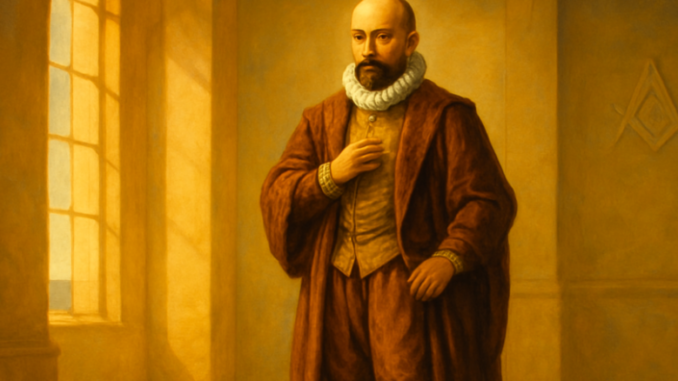
Should we laugh at human folly, or weep over human suffering? With this paradox, Michel de Montaigne opens one of his sharpest and most compact essays. In the fiftieth essay of the first book of his celebrated Essays, he sets two ancient philosophers against each other: Democritus, who laughed at the human condition, and Heraclitus, who wept over it. But Montaigne does far more than paint a philosophical portrait. He examines how we form judgments, why those judgments are so fragile, and which attitude best honours the complexity of existence. This essay is at once a philosophical exercise in humility and an invitation to look at ourselves with unflinching honesty.
The Core Idea: The Fragility of Human Judgment
The essay does not begin with Democritus or Heraclitus, but with a far more fundamental theme: the way human beings arrive at their judgments. Montaigne argues that our opinions are seldom grounded in genuine knowledge or deep understanding. We assess things on the basis of first impressions, habits, and superficial observations. We are quick to condemn or to praise without ever taking the trouble to consider all sides of a question. This makes human judgment, in Montaigne’s view, inherently unreliable — and he is careful to include himself in that verdict. He presents himself explicitly as someone who doubts his own conclusions.
Montaigne emphasises that it is not the facts themselves that lead us to a particular position, but the way we interpret those facts. The same event can be seen as a triumph by one person and as a tragedy by another. This renders all judgment a subjective affair, far more so than we usually care to admit. It is an insight that invites the reader to proceed with caution and to hold personal convictions with a measure of modesty.
Two Philosophers, Two Attitudes Toward the World
Only after laying this groundwork does Montaigne introduce the two Greek philosophers who give the essay its name. Democritus, the natural philosopher from Abdera who is also recognised as a founder of atomic theory, regarded human behaviour as so foolish and absurd that it deserved nothing but laughter. Whenever he ventured among people, he could not help but laugh at their vanity, their ignorance, and their self-deception. Heraclitus of Ephesus, the enigmatic thinker who saw all things as eternal flux, responded to the very same human condition with tears. Where Democritus found folly laughable, Heraclitus found it lamentable.
Montaigne ultimately takes sides, though in his characteristically modest fashion. He favours the attitude of Democritus — laughter. Not out of any lack of compassion, but because he believes that laughter creates greater distance, and distance is necessary for clear thinking. To weep, he reasons, is to assign things more weight than they deserve. To laugh is to acknowledge imperfection without being crushed by it. It is a choice for lightness over gravity, for irony over pathos.
In this, Montaigne teaches us that human judgment is always incomplete, and that the very awareness of this incompleteness is the first step toward genuine wisdom.
The Examples Montaigne Employs
Montaigne illustrates his argument with a wide range of observations about human behaviour. He points to the fickleness of generals and rulers who act with courage one moment and cowardice the next. He invokes the Roman orator and philosopher Marcus Tullius Cicero to show how even the most eloquent minds contradict themselves. And he draws attention to everyday situations in which people hold forth on subjects about which they know almost nothing. Each example serves the same purpose: to reveal the capriciousness of the human mind and the unreliability of our capacity for judgment.
What is striking is that Montaigne never places himself above the fray. He writes with the candour that defines his entire body of work. His own doubts, contradictions, and shifting moods are not, in his eyes, a weakness. They are proof that honesty about our limitations is the only intellectually honourable stance. This makes the essay deeply personal, despite its philosophical subject matter.
Significance for Masonic Thought
This essay by Montaigne touches on a theme that runs deep through the tradition of Freemasonry: the pursuit of self-knowledge as the foundation of personal growth. The Freemason is continually invited to examine his own judgments, to recognise his prejudices, and to cultivate a balanced view of the world. The contrast between Democritus and Heraclitus is more than a philosophical curiosity. It is a mirror that raises the question: with what eyes do I look upon my fellow human beings? Do I respond with compassion, with mockery, or perhaps with a blend of both?
The Masonic tradition carries a profound awareness that truth has many faces and that forming a judgment is a responsibility that does not tolerate carelessness. Montaigne’s plea for intellectual humility aligns seamlessly with the Masonic conviction that true wisdom begins with acknowledging what one does not know. It is the same spirit that animated Socrates when he declared that he knew only that he knew nothing — a spirit that lives on in the lodge as a perpetual invitation to reflection.
What This Essay Offers the Contemporary Reader
In an age when strident opinions assail us from every quarter and public debate rarely leaves room for nuance, Montaigne’s message is more relevant than ever. He reminds us that the capacity to doubt is not a sign of weakness but of strength. It is easy to divide the world into good and evil, into right and wrong. It is far more difficult — and far more valuable — to pause and reflect on the complexity of every situation before rushing to judgment.
Montaigne’s essay invites us to cultivate a philosophical temperament: one that can hold contradictions without anxiety, that can observe folly without rage, and that can engage with the imperfections of others — and of oneself — with grace rather than despair. Whether we ultimately choose to laugh like Democritus or weep like Heraclitus may matter less than the quality of attention we bring to the question itself.
Montaigne’s meditation on Democritus and Heraclitus is far more than an academic exercise in ancient philosophy. It is a living challenge to anyone who seeks to understand themselves and the world with honesty and humility. For Freemasons, it resonates with the fundamental work of the Craft: the patient, ongoing labour of refining the rough stone of the self. In the end, whether we laugh or weep matters less than whether we are willing to look — truly look — at the imperfect, bewildering, and endlessly fascinating spectacle of human life. That willingness, Montaigne suggests, is where wisdom begins.
Copyright text & image: devrijmetselaar.nl
Texts are based on the ideas and content of the author of devrijmetselaar.nl, reviewed, corrected, and supplemented with the assistance of OpenAI. Images are created based on the ideas of the author of devrijmetselaar.nl using OpenAI/DALL-E.
Frequently Asked Questions
What is the main paradox that Montaigne explores in this essay?
Montaigne examines whether we should laugh at human folly or weep over human suffering. He presents this paradox through two ancient Greek philosophers—Democritus, who laughed at the human condition, and Heraclitus, who wept over it—to explore which attitude better honors the complexity of human existence.
According to Montaigne, why are human judgments fragile and unreliable?
Montaigne argues that human judgments are rarely grounded in genuine knowledge or deep understanding. Instead, people form opinions based on first impressions, habits, and superficial observations, often condemning or praising without considering all sides of a question. He emphasizes that the way we interpret facts, rather than the facts themselves, shapes our judgments, making them inherently subjective and unreliable.
How did Democritus and Heraclitus differ in their responses to human behavior?
Democritus regarded human behavior as so foolish and absurd that it deserved only laughter, finding vanity, ignorance, and self-deception laughable. Heraclitus, by contrast, responded to the same human condition with tears, finding human folly lamentable rather than amusing. Both philosophers observed the same human condition but interpreted it through fundamentally different emotional and philosophical responses.



Be the first to comment