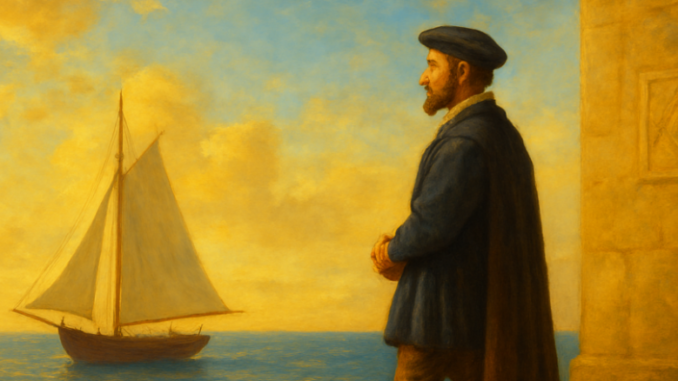
Picture a small group of men gathered in a dimly lit room. One of them reads aloud from a yellowed book, written in the sixteenth-century French of Michel de Montaigne. The passage explores the strange power of custom — how entire peoples cling to habits they never consciously chose. The others listen, nod, and recognize in those centuries-old words something that speaks directly to their own pursuit: the search for truth, connection, and inner growth that lies at the heart of Freemasonry.
An Essay That Holds Up a Mirror
In the forty-ninth essay of the first book of his Essays, Michel de Montaigne takes on a subject that seems simple at first glance: old customs. He describes how peoples across the world maintain the most diverse practices — from eating habits to greeting rituals — and how every community regards its own way of doing things as the only correct one. But beneath that seemingly light surface lies a far deeper question: why do we accept certain practices without ever questioning them? And what does that blind acceptance reveal about our willingness to truly reflect on who we are?
It is precisely this question that connects Montaigne to the tradition of Freemasonry. Not because he was a Freemason himself — organized Freemasonry as we know it did not emerge until more than a century after his death. But because his method of open-minded self-reflection, his refusal to blindly accept what custom dictates, is closely related to the mindset cultivated in the lodge. A Freemason is invited to work on the rough stone of his character, and that work begins with recognizing the unconscious patterns that shape it.
Custom as an Invisible Master
Throughout his essay, Montaigne draws on a rich lineage of classical thinkers. He references Aristotle, who called custom a second nature, and Plato, who warned that upbringing and habit shape a person more powerfully than any law. For Montaigne, custom is a tyrant that seizes power so gradually we never even notice its reign. We eat at certain times, greet each other in certain ways, and regard our own norms as universal — when they rarely are.
This insight plays a distinctive role in Freemasonry. The ritual practiced in the lodge is itself a form of custom — but a deliberately chosen one. Where Montaigne shows how unconscious habits hold us captive, Masonic ritual offers a countermovement: the repeated and conscious performance of actions designed to invite reflection and growth. The difference lies not in the repetition itself, but in the awareness with which that repetition is experienced.
Think of the way a lodge opens and closes, the careful choreography of degree work, the recitation of charges and obligations. These are repeated time and again, meeting after meeting, year after year. Yet a thoughtful Mason does not experience them as mechanical routine. Each repetition offers a new opportunity to discover another layer of meaning — much as rereading a great book reveals insights that escaped us the first time.
Connection Beyond the Boundaries of Custom
One of the most remarkable aspects of Montaigne’s essay is his genuine curiosity about the customs of other cultures. He describes foreign practices without condemnation, with a blend of wonder and respect. He catalogs not to judge, but to understand. In that attitude, we hear an echo of what Freemasonry calls brotherhood: the conviction that people of vastly different backgrounds, beliefs, and habits can still be connected on a deeper level.
True connection does not arise from sharing the same customs. It arises from looking beyond those customs and recognizing the human being behind the practice.
This idea is fundamental to the Craft. In a lodge, men come together from different religions, backgrounds, and worldviews. The lodge does not ask them to abandon their own traditions, but it does ask them to be willing to look beyond the familiar. Just as Montaigne invited his readers to stop regarding their own customs as absolute, Freemasonry invites its members to acknowledge the relativity of their own frame of reference — not as a weakness, but as a precondition for genuine growth.
Self-Reflection as the Foundation of Virtue
Montaigne once wrote that he studied himself more than any other subject. That radical self-reflection is not narcissism — it is a moral discipline. By exposing his own prejudices, assumptions, and automatisms, he tried to become a more honest and virtuous person. Freemasonry pursues the same movement. The working of the rough ashlar is nothing other than the patient and honest examination of one’s own shortcomings — not to condemn oneself, but to draw closer to moral purity.
Montaigne’s essay on old customs adds a specific dimension to this pursuit. It reveals that much of what we consider our personal convictions are in reality ingrained habits absorbed from our surroundings. The search for truth — a core value in Freemasonry — demands that we dare to peel away that layer of learned behavior. Only when we understand how profoundly custom shapes us can we consciously choose who we want to be.
Three Points of Contact Between Montaigne and the Lodge
Self-reflection as a moral duty. Both Montaigne and Freemasonry regard honest self-examination as the first step toward a virtuous life. Without understanding the forces that shape our thinking and behavior, we cannot hope to improve either.
Respect for diversity. Montaigne’s unprejudiced gaze at other cultures mirrors the Masonic ideal of brotherhood across all boundaries. The lodge is a space where differences are not erased but honored, and where the shared commitment to moral growth transcends cultural divides.
Conscious living versus blind habit. Masonic ritual is, in a sense, an answer to precisely the danger Montaigne describes — the unthinking repetition of ingrained patterns. By transforming repetition into a deliberate practice of awareness, the lodge turns custom from a tyrant into a teacher.
Shining Light on the Familiar
The power of Montaigne’s essay lies not in spectacular conclusions but in a simple invitation: look again at what you have always taken for granted. That invitation is timeless. In a world where we are overwhelmed by information and opinions, it is tempting to fall back on what we have always done, always thought, always believed. Montaigne warns us that this path leads not to comfort but to complacency.
Freemasonry offers a structured space in which that invitation can be accepted. The lodge is not a place where old habits are merely replaced by new ones. It is a place where the very nature of habit is examined, where the automatic is made conscious, and where the familiar is illuminated by a light that reveals both its beauty and its limitations.
Montaigne would likely have appreciated the Masonic practice of pausing regularly to reflect on one’s own conduct and convictions. He might even have recognized in the lodge a living embodiment of his own philosophical project: the ongoing, never-finished work of understanding oneself more fully in order to live more wisely and more humanely.
Montaigne’s exploration of custom remains as relevant today as it was in the sixteenth century — perhaps more so. In Freemasonry, his insights find a natural home. The Craft asks us to do exactly what Montaigne championed: to question the unexamined, to look beyond the habitual, and to pursue a deeper connection with ourselves and with one another. When we shine light on the customs we have never thought to question, we do not weaken our foundations — we strengthen them. And in that strengthening, we find what both Montaigne and the lodge have always sought: a more truthful, more connected, and more fully human way of being.
Copyright text & image: devrijmetselaar.nl
Texts are based on the ideas and content of the author of devrijmetselaar.nl, reviewed, corrected, and supplemented with the assistance of OpenAI. Images are created based on the ideas of the author of devrijmetselaar.nl using OpenAI/DALL-E.

Be the first to comment