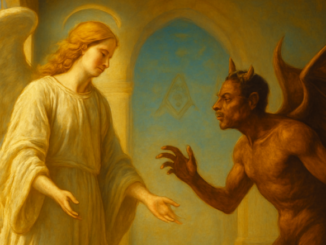
Firefighter helmet and Masonic square and compasses symbolizing brotherhood
Personal Development & Leadership

Arsonist in Uniform: When Brotherhood Fails

The siren wails through the night. A firefighter pulls on his jacket, jumps on the engine, and races toward a blaze he himself has set. Six arrests later — including one of their own — France is left in shock. This isn’t just a story about fire. It’s a story about trust going up in smoke, and about the urgent question of how we protect brotherhood when someone undermines it from within. The Shock of Betrayal From Within When we learn that someone who swore an oath to protect has become the very source of destruction, it shakes our faith in institutions to the core. For most people, the fire service is a symbol of unconditional service. These are the men and women who run into burning buildings while everyone else runs out. They form a tightly knit community — a brotherhood in every sense of the word. And yet, one of them betrayed the trust of colleagues and citizens in the most fundamental way imaginable. Events like these don’t just affect the people directly involved. They sow doubt in every community built on mutual loyalty. How can any group function when the bonds of trust can no longer be […]

Rough ashlar stone symbolising character building in Freemasonry
Personal Development & Leadership

Trust and Character: What a Lawsuit Teaches Us

You may have seen it in the news: a major technology company is taking former employees to court for allegedly stealing trade secrets and handing them to a competitor. On the surface, it sounds like a corporate dispute with little relevance to everyday life. But look a little closer, and this story touches on something universal — the question of who you are when no one is watching, the weight of your word, and the building blocks of your character. When Trust Is Broken Imagine spending years working on complex projects, gaining access to your employer’s most sensitive information, and then one day deciding to move on. What do you take with you? Your experience, your skills, your memories — certainly. But where is the line between what belongs to you and what was entrusted to you? That question now sits at the heart of a lawsuit captivating the technology world. The case is not merely about the legal definitions of intellectual property. It is about the invisible agreements we make when someone places their trust in us. It is about whether our word still means something after we close a door behind us. The Rough Ashlar as a Mirror […]

Polar bear resting peacefully, symbolizing devotion, care, and Masonic reflection
History

Farewell to a Polar Bear: Lessons in Care and Devotion

Imagine a creature that spent 36 years surrounded by dedicated caretakers, that amazed generations of visitors, and that ultimately departed this world in peace. The passing of the oldest polar bear ever held in captivity stirs something deep within us — perhaps because her remarkably long life raises questions we rarely ask ourselves. What does it truly mean to live well? And what do we leave behind when our time comes? A Life Beyond the Statistics Polar bears in captivity typically live to around twenty years of age. The fact that this particular bear reached thirty-six makes her story extraordinary. Her keepers spoke of her not merely as an animal of unusual longevity but as a creature of remarkable character. She was headstrong, recognized familiar faces, and seemed to form bonds — in her own way — with the people around her. Perhaps you recognize the feeling that arises when you hear about an animal that has lived so far beyond expectations. A kind of respect emerges, an acknowledgment that this being experienced something most of its kind never will. And it is precisely that recognition that invites deeper reflection on what a long life actually means. Time as a […]

A rough ashlar stone beside Masonic square and compasses symbolizing humility
Personal Development & Leadership

Humility as Strength: What Freemasons Know About Success

In the eighteenth century, when the first Grand Lodges in Europe opened their doors, an unwritten rule applied that remains relevant to this day: whoever enters leaves their social rank at the door. Whether you were a baker or a banker, your standing in the lodge was determined by your inner growth — not by your external achievements. This principle sheds a surprising light on a notion that still circulates in our culture: the belief that everything one touches turns to gold. The Alchemical Myth Debunked The expression “everything I touch turns to gold” traces back to King Midas from Greek mythology. His story ends tragically: he nearly starves to death because even his food transforms into gold. From the earliest philosophical traditions, thinkers understood the Midas myth as a warning against hubris — the dangerous overconfidence that arises when success goes to one’s head. Freemasonry, with its roots in the medieval stonemason guilds, understood this lesson centuries ago. The craftsmen who built the great cathedrals of Europe knew that every masterpiece was the result of countless failed attempts, broken stones, and endless patience. Their wisdom: true craftsmanship reveals itself not in perfection, but in the ability to learn from […]

Rough ashlar stone beside a calm candle symbolizing Masonic inner strength
Personal Development & Leadership

Artificial Energy vs Inner Strength: A Masonic Perspective

As more people report heart palpitations, insomnia, and anxiety from stimulant supplements, a fundamental question emerges: where do we truly draw our energy from? The modern individual reaches for pills and powders to get through the day. The Freemason seeks something different — a force that doesn’t come from a bottle, but from within. Two paths, two views of human nature, yet both share the same search for vitality and meaning. The Modern Quest for Energy In a world that never stops, many feel the pressure to be perpetually switched on. Employers demand alertness, social media calls for constant engagement, and the body is simply expected to keep up. Stimulant supplements in powder or capsule form promise an easy fix: focus without effort, energy without rest. But reality tells a different story. Users increasingly report nervousness, a racing heart, or a restless mind. The promise of artificial energy carries a shadow side that no label warns you about. These complaints are not merely physical. They touch on something deeper: the feeling of losing control over one’s own body. When someone becomes dependent on external substances to function, they gradually lose contact with their natural rhythms. The question then shifts from […]

A level and whistle symbolizing impartiality in Freemasonry and refereeing
Philosophy & Ethics

Impartiality Under Pressure: The Referee and the Freemason

When the head of refereeing for an international football federation declares that even the most powerful figures have no influence over his decisions, it touches on a universal theme: the question of impartiality. How do you preserve your integrity when external pressure mounts? This challenge plays out not only on the football pitch but also in the quiet of the Masonic lodge, where brethren practice the art of judgment without prejudice. The World of the Referee In international football, the referee stands as a central symbol of fairness. Every decision is analyzed, criticized, and sometimes regarded with suspicion. When a top official must publicly declare that there has been no outside influence — not even from the highest authority — it reveals something about the world he operates in. It is a world of constant scrutiny, where every whistle can be interpreted as evidence of bias. The referee moves through an arena where millions of eyes are watching. His neutrality is not merely expected — it is demanded. And yet, he is human, carrying his own experiences, preferences, and blind spots. The art lies not in denying this humanity but in acknowledging it and rising above it. The referee must […]

Rough ashlar stone being shaped symbolizing Masonic character building
Personal Development & Leadership

Personality and Choices: What a Verdict Teaches About Character

Sometimes you come across a news story that stays with you all day — not because of the shocking details, but because of the questions it raises. A court hands down a nine-year prison sentence, and you find yourself wondering: how does a person end up there? What happens within someone’s personality that leads them down a path ending in a courtroom? These questions go far beyond the legal realm. They touch on something fundamental about who we are and who we have the potential to become. The Rough Stone Within Each of Us In Freemasonry, we work with the symbol of the rough ashlar — the unfinished stone. This is no arbitrary metaphor. The rough stone represents the human being as they enter the world: full of potential, but also full of imperfections, sharp edges, and hidden cracks. The Freemason’s task is to work that stone — to chisel, smooth, and polish it. Not to achieve perfection, because that is an illusion, but to become more conscious of your own shape and the choices you make. When you read about a tragic event where lives have been permanently altered by violence, an uncomfortable question surfaces: what happened to the […]

Masonic level and plumb line symbolizing balance and self-reflection
Symbolism & Rituals

When Conviction Capsizes: The Hidden Risk of Certainty

Here is a paradox worth contemplating: the more firmly convinced you are of something, the greater the danger of capsizing. Not figuratively — literally. The word “convinced” traces back to nautical language, where it described a ship carrying so much weight on one side that it listed dangerously, no longer responded to the helm, and risked rolling over at the first strong gust of wind. Certainty as a risk factor. Firmness as a source of instability. Isn’t that one of the most uncomfortable truths language has been quietly trying to tell us all along? Certainty Makes You Lose the Helm Let’s take that paradox seriously. In everyday speech, we say “I’m convinced” as though it’s a virtue — a sign of resolve and strength. We admire people who stand firm, who don’t budge an inch. But an old-time sailor would have raised an eyebrow at such admiration for imbalance. To him, being “over-convinced” wasn’t a badge of honor — it was a diagnosis. A ship that had shifted all its weight to one side was a ship in distress. The rudder rendered useless, the crew at the mercy of forces they could no longer steer against. The shift in meaning […]

Symbolic representation of agnosticism and Freemasonry paths converging
Freemasonry & Society

Agnosticism and Freemasonry: Two Paths Toward the Unknowable

Agnosticism is often understood as a position of not-knowing — a philosophical stance that acknowledges certain questions about existence may be unanswerable. Freemasonry, on the other hand, is sometimes perceived as a fraternity defined by its rituals and symbols. But what happens when we place these two worlds side by side? Both share a fundamental recognition: that the human mind cannot fathom everything, and that within that very recognition lies a particular kind of wisdom. In this article, we explore how the agnostic outlook and Masonic philosophy mirror and enrich each other. The Agnostic Perspective: Living With Uncertainty The agnostic does not claim to know whether a higher power exists. This is not a weakness or a lack of conviction — it is a deliberate intellectual position. The term was coined in the nineteenth century by the British biologist Thomas Henry Huxley, who wanted to express that certain metaphysical questions lie beyond the reach of human knowledge. The agnostic stance demands humility: the ability to say “I don’t know” without abandoning the search for meaning. In modern society, agnosticism is frequently confused with indifference or atheism. Nothing could be further from the truth. Where the atheist asserts that no god […]

A rough ashlar stone symbolizing personal growth through crisis in Freemasonry
Personal Development & Leadership

What Our Crises Reveal About Who We Truly Are

Sometimes a person disappears — not just physically, but inwardly. A young athlete withdraws from the world, overwhelmed by pressure and expectations. When he returns, he speaks openly about regret and self-awareness. This kind of story raises questions that reach far deeper than the headline itself. What does a moment of crisis actually reveal about who we truly are? And how does a Freemason view such turning points in a human life? Why Do People Sometimes Vanish From the Stage? The outside world tends to see a disappearance as either a mystery or a scandal. A news article presents the facts, quotes bystanders, and searches for explanations. But anyone who looks at the story from the inside recognizes something different: a human being who could no longer function under the weight of the expectations placed upon him. Pressure, perfectionism, fear of failure — these are universal themes that can touch any one of us. For the outsider, such a disappearance is a news item. For the Freemason, it is a mirror. In the lodge, we learn that a person is never a finished work, and that every crisis contains the possibility of growth. Disappearing is not an ending — sometimes […]

Warm summer night cityscape symbolizing Masonic trial by fire and character
Philosophy & Ethics

The Tropical Night as Ethical Mirror: When Heat Tests Character

Last night, temperatures in parts of the country refused to drop below comfortable levels — what meteorologists call a tropical night. While many tossed and turned in sweat-soaked sheets, searching desperately for relief, a hidden question lay buried in the oppressive stillness. Not a question about the weather, but about ourselves. How do we behave when things become uncomfortable? As it turns out, the heat of a summer night can be an unexpected teacher in the art of ethical living. The Boiling Point of Character A thermometer measures temperature, but what measures our inner compass when the heat rises? In Freemasonry, we speak of working the rough ashlar into a perfect cube. This is not a one-time act but a lifelong process — one that becomes most visible in moments of discomfort. The tropical night serves as a kind of crucible in which our everyday patience, kindness, and self-control are put to the test. When the night brings no relief, small irritations bubble to the surface. The neighbor who opens his window and plays music. The child who cannot sleep. The partner who claims the only fan. In these seemingly trivial moments, something ancient reveals itself — what the Greeks […]

Cracked mirror reflecting a rough ashlar stone symbolizing Masonic character work
Personal Development & Leadership

The Cracked Mirror: Character as Unfinished Architecture

A mirror that cracks no longer shows a true reflection. The glass is still there, the frame intact, but the image looking back at you is splintered, distorted, unreliable. This is how we might view those moments when someone’s actions stand in stark contradiction to the role they occupy. When the news confronts us with people who were given trust and then betrayed it, we are forced to sit with an uncomfortable question: what is personality, really? And can we ever fully know it — in others or in ourselves? The Mask and What Lies Behind It The word “personality” derives from the Latin persona, which originally referred to a theatrical mask. Actors in classical theater wore masks to define their roles. The mask was not meant to deceive — it was meant to clarify. It told the audience who this figure was and what to expect from him. And yet, buried in this etymology lies an unsettling truth: if personality is a mask, what lies behind it? In Freemasonry, this question occupies a central place, even if it is rarely stated so directly. The rough ashlar — the symbol of man at the beginning of his inner journey — […]

An open empty wallet reflecting light as a symbol of Masonic self-reflection
Personal Development & Leadership

The Empty Wallet as Mirror: Wealth Beyond Numbers

A wallet. Leather, stitching, a slot for coins. We open it dozens of times a week, check its contents, calculate what’s possible. Reports keep telling us that a growing number of people struggle to make ends meet — even as wages rise. The numbers don’t match the feeling. And perhaps that disconnect is precisely the invitation to look deeper, beyond the figures, toward what wealth truly means for who we are. The Mystery of the Growing Gap Imagine a bucket. You fill it with more water than last year. Yet the bottom stays dry. Somewhere there’s a hole that grows along with the filling. This is the paradox many households experience: wages go up, but the sense of abundance never arrives. Economists point to inflation, rising fixed costs, and shifting consumption patterns. These explanations make perfect sense on paper. But there’s something no spreadsheet can capture. The wallet is more than an object. It’s a mirror. What we put into it — and how quickly it disappears — reveals something about our relationship with needs, desires, and the question of who we want to be. Financial pressure doesn’t just affect the bank account. It touches our personality, the way we […]

Open lodge door symbolizing Masonic hospitality and welcoming the stranger
Freemasonry & Society

Hospitality as a Life Skill: What the Lodge Teaches About Welcome

You probably know the feeling: you see a situation that calls for action, but you wait for someone else to step up. Or you quietly convince yourself that your contribution wouldn’t matter in the grand scheme of things. When communities fall short in providing shelter and welcome to those in need, it touches on something far deeper than policy or politics. It raises a fundamental question: how do we relate to the stranger at our door? Freemasonry, perhaps surprisingly, offers deeply practical guidance on this — rooted in centuries-old rituals of hospitality. The Threshold as a Sacred Boundary In Freemasonry, the threshold carries powerful symbolic weight. Anyone who enters a lodge building consciously crosses a boundary between the outside world and a space of reflection. But that threshold works in two directions: it protects what lies within, and it determines who is welcome. The question of whom we let in is therefore not a bureaucratic matter — it is an ethical exercise. Historically, operative lodges maintained strict customs around hospitality. Traveling craftsmen could count on shelter from fellow brothers in distant cities. This wasn’t charity born from pity — it was a practical system of mutual support. You helped the […]

Coast guard officer leaping onto a drifting boat on a stormy ocean
Spiritual Traditions

Leaping Into the Unknown: Freemasonry, Courage, and Rescue

You may have seen the footage — a coast guard officer leaping without hesitation onto a rudderless boat in the middle of a churning ocean. It’s the kind of image that stirs something deep within us, something that goes beyond mere admiration for physical bravery. Watching that leap, I found myself thinking about the deepest questions of human existence, and about the journey we all share — a journey that lies at the very heart of Freemasonry. When the Helm Slips From Your Hands Imagine yourself on the open sea. The water stretches endlessly around you, and suddenly nothing works the way it should. The rudder won’t respond, the engine sputters, and the waves take over. This is hardly a rare metaphor in human life. We all know those moments when we lose control, when our carefully plotted course slips away and we find ourselves drifting at the mercy of circumstances. In Freemasonry, the stormy sea has long served as a symbol for the unrest of an unenlightened mind. The candidate who first enters the lodge is often described as a seeker — a ship that has not yet found a safe harbor. This is not weakness. It is the […]

Red traffic light glowing at night as a symbol of spiritual pause
Spiritual Traditions

The Red Traffic Light as a Spiritual Teacher

You may have seen the footage. Thousands of Japanese football fans celebrating wildly in the streets — singing, dancing, erupting with joy — until the traffic light turns red. Then everything stops. Silence. Stillness. Only when the light turns green does the celebration resume. This scene struck me deeply. Not because of the football, but because of what it reveals about the human soul and its capacity for inner freedom. A Moment of Recognition Imagine yourself surrounded by thousands of people cheering, singing, and dancing. The emotion is overwhelming, the energy contagious. And then, at the peak of collective ecstasy, a red light appears. A simple signal. No police officer, no authority intervening. Just you and that light. What do you do? The Japanese supporters chose stillness. Not out of fear of punishment, but from something deeper — a rooted awareness that true joy does not vanish through a moment of restraint. On the contrary, they demonstrated that discipline and celebration can strengthen one another rather than cancel each other out. This is a spiritual lesson that resonates powerfully with me as a Freemason. The Art of the Voluntary Halt In Freemasonry, we often speak about subduing our passions. This […]

Two spiritual paths converging — Gnostic knowledge and Masonic symbolism
Spiritual Traditions

Inner Knowledge in the Netherlands: Two Paths to the Light

Anyone who explores the pursuit of gnosis in the Netherlands quickly discovers that the search for inner knowledge takes many forms. Some find their way through Gnostic communities, others through Freemasonry. Both traditions share a deep longing: to uncover the truth behind the veil. Yet their methods and philosophies differ considerably. In this article, we place two spiritual worlds side by side — not to judge, but to understand what they have in common and what we can learn from both. The Gnostic Tradition in the Netherlands: Knowledge as Liberation The word gnosis comes from Greek and literally means knowledge. But this is not ordinary knowledge gleaned from textbooks. It refers to a direct, inner experience of the divine. Since the early twentieth century, the Netherlands has harboured a vibrant interest in this spiritual current. Various communities and study groups devote themselves to ancient Gnostic texts, seeking to make their wisdom applicable to everyday life. At the heart of Gnostic thought lies the idea that the material world is a reflection of a higher reality. Every human being carries a divine spark within, yet has forgotten it. By acquiring inner knowledge — by awakening — one can return to one’s […]

Search dog working through building rubble symbolizing Masonic brotherhood
Personal Development & Leadership

The Search Dog as Teacher: Finding Brotherhood in the Rubble

A search dog picks its way through the rubble of an exploded building in Amsterdam. The footage circulated across the Netherlands this past week, drawing millions of eyes. But for those willing to look beyond the headlines, the images reveal something far more profound than breaking news: a creature moving without hesitation toward what has been lost. In that unconditional devotion lies a lesson Freemasons have been trying to understand for centuries — what does it truly mean to show up for another person? Searching Without Knowing What You Will Find The search dog knows no doubt. It follows its nose, trusts its training, and surrenders completely to the task at hand. Whether the search will lead to a living person, a body, or nothing but emptiness — the animal does not know. And yet it searches. This posture of unconditional action without any guarantee of results strikes at one of the core paradoxes of human connection. We humans hesitate because we cannot see the outcome. The dog reminds us that true devotion needs no certainty. In Freemasonry, we speak of the search for light — a symbolic journey toward insight and truth. But just like the search dog, the […]

Karel van Zweden Masonic lodge in Zutphen — a place of spiritual tradition
Spiritual Traditions

Karel van Zweden Zutphen: Spiritual Legacy of a Masonic Lodge

In the heart of the historic Hanseatic city of Zutphen lies a remarkable place where spirituality and tradition converge. The Karel van Zweden lodge bears the name of an eighteenth-century monarch renowned for his pursuit of inner wisdom. For over two centuries, this Masonic lodge has served as a meeting point for those who grapple with life’s greatest questions. What makes this place so special? And what spiritual lessons can we still draw from its enduring legacy today? The Spiritual Roots of Karel van Zweden Zutphen When we speak of the Karel van Zweden lodge in Zutphen, we enter a world where the outer and the inner merge. The lodge’s namesake, a Swedish prince of the eighteenth century, was known for his fascination with esoteric traditions and his pursuit of enlightenment in the philosophical sense of the word. He saw in Freemasonry a path to self-knowledge that reached far beyond social standing or worldly power. This spiritual foundation is still reflected in the work carried out within the lodge today. Freemasons in Zutphen come together not to receive answers, but to ask questions. They seek what connects them as human beings, beyond the superficial differences of background, profession, or worldview. […]

Masonic symbols representing the agnostic search for truth and meaning
Philosophy & Ethics

Agnosticism and Freemasonry: The Art of Not Knowing

What if the answer to life’s greatest questions isn’t a definitive yes or no, but an honest “I don’t know”? Agnosticism makes room for exactly that kind of intellectual humility. Far from being a position of weakness, it takes genuine courage to acknowledge that some truths may lie beyond our reach. In Freemasonry, we find a remarkable kinship with this philosophical stance — not as doctrine, but as a living practice of seeking without the pretense of final answers. What Does Agnosticism Actually Mean? The word “agnostic” has its roots in Greek: “a” means without, and “gnosis” means knowledge. An agnostic is, quite literally, someone who acknowledges that certain knowledge — particularly about the existence of a higher power or the ultimate purpose of the universe — may be fundamentally unattainable. This is not intellectual laziness. It is a deeply considered epistemological position. The agnostic doesn’t claim that truth doesn’t exist, but rather that we as human beings may lack the tools to fully grasp it. The term was first coined in the nineteenth century by the British biologist Thomas Henry Huxley, who grappled with the question of how we can truly know what we think we know. Since then, […]