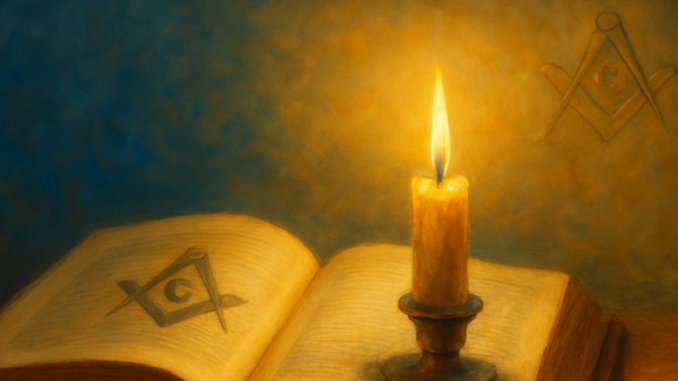
What if the answer to life’s greatest questions isn’t a definitive yes or no, but an honest “I don’t know”? Agnosticism makes room for exactly that kind of intellectual humility. Far from being a position of weakness, it takes genuine courage to acknowledge that some truths may lie beyond our reach. In Freemasonry, we find a remarkable kinship with this philosophical stance — not as doctrine, but as a living practice of seeking without the pretense of final answers.
What Does Agnosticism Actually Mean?
The word “agnostic” has its roots in Greek: “a” means without, and “gnosis” means knowledge. An agnostic is, quite literally, someone who acknowledges that certain knowledge — particularly about the existence of a higher power or the ultimate purpose of the universe — may be fundamentally unattainable. This is not intellectual laziness. It is a deeply considered epistemological position. The agnostic doesn’t claim that truth doesn’t exist, but rather that we as human beings may lack the tools to fully grasp it.
The term was first coined in the nineteenth century by the British biologist Thomas Henry Huxley, who grappled with the question of how we can truly know what we think we know. Since then, agnosticism has developed into a broad philosophical current that challenges absolute certainties — whether religious or atheistic in nature.
The Agnostic Spirit Inside the Lodge
Freemasonry is not a religion, not a political movement, and not a philosophical school in any strict sense. Yet it carries a philosophical core that aligns remarkably well with the agnostic outlook on life. Inside the lodge, people from vastly different backgrounds come together: believers and doubters, seekers and thinkers. What unites them is not a shared conviction about the afterlife or the nature of the divine, but a shared willingness to search.
The Freemason works with symbols that are deliberately multi-layered. The compasses, the square, the plumb line — they invite interpretation without prescribing a definitive reading. This symbolic work reflects a fundamentally agnostic principle: the recognition that truth may never be fully captured in words or concepts.
The wisest among us is the one who knows that he knows nothing.
Doubt as a Virtue: A Philosophical Tradition
Western philosophy has a long tradition of thinkers who saw doubt not as a weakness but as the starting point of all true knowledge. From the ancient Greek skeptics to the Enlightenment philosophers, one idea keeps resurfacing: certainty can be dangerous, and an open question is often more fruitful than a closed answer. The agnostic position stands firmly in this tradition and provides a counterweight to both dogmatic belief and dogmatic disbelief.
Within Freemasonry, this spirit of doubt is cherished. The rituals and symbols are not a catechism to be memorized, but rather a mirror in which each Brother can project his own questions and insights. The goal is not to receive a certificate of enlightenment at the end of the journey, but to value the search itself as a meaningful activity.
The Difference Between Agnosticism and Indifference
A common misconception is that agnosticism equals indifference toward life’s big questions. Nothing could be further from the truth. The genuine agnostic is intensely engaged with the great mysteries of existence but refuses to accept easy answers. It is a position of active doubt, not passive shrugging. This nuance is essential to understanding why agnostic thinking and Freemasonry complement each other so naturally.
- Agnosticism acknowledges the limits of human knowledge
- It invites ongoing inquiry and reflection
- It respects different paths toward meaning
- It rejects intellectual arrogance in all its forms
Agnosticism in an Age of Certainties
We live in an era that seems to reward conviction above all else. Social media amplifies outspoken opinions, algorithms feed us confirmation of what we already think we know. In this context, the agnostic stance is almost an act of resistance. It is a refusal to participate in the hardening of discourse, an invitation to face the complexity of existence without retreating into oversimplification.
Freemasonry offers a unique space in this landscape. The lodge is a place where genuine conversation can unfold without the pressure of winning an argument. Where the question matters more than the answer, and where different perspectives can coexist without one needing to defeat the other. This is not relativism — it is the recognition that the search for truth is a collective endeavor that benefits from a plurality of voices.
The Great Architect as an Open Symbol
Many Masonic lodges work with the concept of the Great Architect of the Universe. This idea is often misunderstood as a hidden definition of God. In reality, it functions as an open symbol that each Brother is free to interpret from his own convictions — or indeed from his own uncertainty. For the believer, it may point to God; for the agnostic, it may represent the mystery of existence itself. This openness is not a weakness but the very strength of the symbol.
Agnosticism and Freemasonry share a deep reverence for the unknown. Both invite us to live lives of questioning, intellectual humility, and respect for the many forms that human meaning-making can take. In a world that clamors for answers, they offer the quiet power of not knowing — not as a final destination, but as a starting point for a richer, deeper, and more dignified existence. The true seeker, after all, understands that the journey itself is the destination.
Copyright text & image: devrijmetselaar.nl
Texts are based on the ideas and content of the author of devrijmetselaar.nl, reviewed, corrected, and supplemented with the assistance of OpenAI. Images are created based on the ideas of the author of devrijmetselaar.nl using OpenAI/DALL-E.
Frequently Asked Questions
Can agnostics join Freemasonry?
Yes, absolutely. Freemasonry welcomes men of all belief systems, including agnostics, because membership is based on a willingness to seek truth rather than adherence to specific religious doctrines. The fraternity's symbolic teachings are deliberately open to multiple interpretations, allowing each member to draw his own conclusions about life's deepest questions.
Does Freemasonry require you to believe in God?
Freemasonry requires belief in a higher power or Supreme Being, but it does not dictate what that means or how you understand it. This inclusive approach respects the agnostic perspective, as it accommodates sincere seekers who acknowledge the limits of human knowledge while remaining open to spiritual exploration.
What is the connection between Freemasonry and agnosticism?
Both Freemasonry and agnosticism embrace intellectual humility and the pursuit of truth without claiming to possess all the answers. Freemasonry's use of multi-layered symbols and emphasis on personal interpretation reflect an agnostic principle: that truth may be complex, multifaceted, and best discovered through individual reflection rather than dogmatic certainty.
How do Freemasons view doubt and questioning?
Freemasonry values doubt and questioning as virtues that lead to genuine understanding and personal growth. Rather than expecting blind acceptance, the fraternity encourages members to critically examine symbols and ideas, recognizing that an open question often leads to deeper wisdom than a rigid, unexamined answer.

Be the first to comment