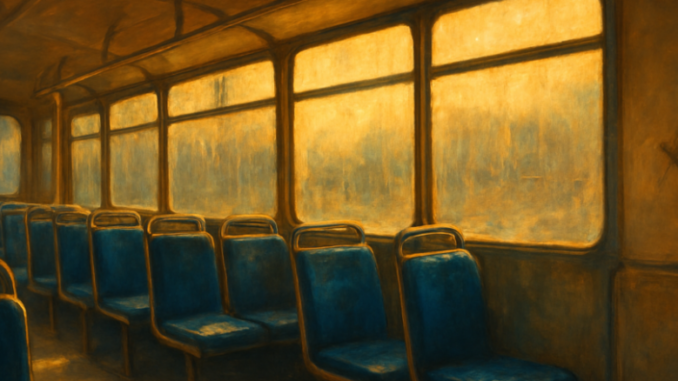
It’s early morning. On a city bus in Rotterdam, people sit side by side: a mother with her child, a student wearing headphones, an elderly man carrying groceries. They share the same space, the same journey, the same vulnerability. Then shots ring out. Today’s news confronts us with a question Freemasons have been asking for centuries: how do we build a world in which strangers can trust one another?
The Bus as a Mirror of Society
A city bus is more than a means of transportation. It is one of the few remaining places where every layer of society literally sits side by side. Rich and poor, young and old, people from vastly different backgrounds and life stories. No one chooses their fellow passengers, yet everyone shares a common destination. This forced proximity makes the bus a powerful symbol of what society truly is: a collection of individuals who depend on each other’s goodwill.
When violence invades that shared space, it doesn’t only harm those directly involved. It shakes the very foundation of communal life — the basic trust that we can be safe among strangers. For Freemasons, this trust is never taken for granted. It is a structure that requires constant maintenance.
Trust as a Foundation
In Freemasonry, we often speak of building the Temple of Humanity. This is not a literal building but a metaphor for a society in which people treat each other with dignity. The building blocks of this temple are not made of stone — they are made of trust, respect, and mutual care. Every time that trust is violated, a stone falls from the structure.
A chain is only as strong as its weakest link. A society is only as safe as its most vulnerable moment.
The question raised by an incident like this goes far beyond identifying the perpetrator or understanding their motives. The deeper question is: what has happened within our community that made violence on a random Tuesday morning on a city bus possible? This question is not about assigning blame. It is about honestly examining the cracks in our social fabric.
The Role of Community
Freemasons do not believe that individuals exist in isolation from their surroundings. Every person is shaped by the community in which they grow up, the opportunities they receive, the stories they are told. This does not mean that perpetrators bear no responsibility for their actions. But it does mean that we, as a society, also bear responsibility for the world we collectively create.
In the Lodge, Brothers and Sisters learn that no one stands alone. Every action has consequences that extend far beyond the moment itself. The hand we extend to another person can be the beginning of a chain of goodness. The hand we withdraw can leave a void in which despair takes root. This is not naive optimism — it is a sober understanding of how human communities function.
Rebuilding After the Shock
After an event like this, the instinct is often to build walls: more surveillance, more cameras, more control. This reaction is understandable, but it does not address the underlying problem. A society built solely on fear and control is not a community — it is a prison where everyone is both guard and inmate.
Freemasonry offers a different perspective. Instead of building only walls, we can build bridges. This doesn’t mean being naive about danger. It means having the courage to keep investing in human connection despite the fear. It means creating neighborhoods where people know each other, where loneliness is not the norm, where young people have a sense of purpose and possibility.
Practically, this means investing in gathering places where people from different backgrounds can meet. It means paying attention to those at risk of falling through the cracks. It means steering conversations toward what unites us rather than what divides us. And it means demonstrating, through our own example, that conflicts can be resolved without violence.
The Passengers We All Are
Ultimately, we are all passengers — not just on the city bus, but in the larger story of humanity. We board without knowing who will sit beside us, and we step off without knowing what will become of our fellow travelers. This uncertainty is not a weakness. It is the very essence of human existence.
Freemasonry teaches us not to deny this uncertainty but to embrace it. Precisely because we are vulnerable, precisely because we cannot control everything, it matters that we build a world in which that vulnerability is respected. A world in which the city bus can once again be what it is meant to be: a place where strangers can travel safely together.
The shooting in Rotterdam reminds us how fragile our shared spaces truly are. But it also reminds us of our collective mission. As Freemasons, we believe that every person can contribute to building a better society — not through grand gestures, but through daily choices: the glance we exchange, the conversation we start, the hand we extend. The Temple of Humanity is not built in a single day. It is built stone by stone, gesture by gesture, passenger by passenger.
Copyright text & image: devrijmetselaar.nl
Texts are based on the ideas and content of the author of devrijmetselaar.nl, reviewed, corrected, and supplemented with the assistance of OpenAI. Images are created based on the ideas of the author of devrijmetselaar.nl using OpenAI/DALL-E.
Frequently Asked Questions
What does Freemasonry teach about building trust in communities?
Freemasonry teaches that trust is the foundational building block of a safe and healthy society, which is symbolized as the 'Temple of Humanity.' Rather than viewing trust as something that happens naturally, Freemasons understand it requires constant maintenance, mutual respect, and care from all community members. This principle emphasizes that every individual action ripples through the broader community and contributes to either strengthening or weakening the bonds that hold society together.
How do Freemasons believe individuals should relate to their community?
Freemasons believe that no one exists in isolation—every person is shaped by and interconnected with their community. Rather than assigning blame solely to individuals, this perspective encourages communities to examine how they collectively create the world around them and take responsibility for fostering environments of opportunity and hope. In the Lodge, members learn that extending a hand in goodness can begin a chain of positive consequences, while withdrawing support can leave voids where despair takes root.
What is the Masonic response to violence and loss of safety in communities?
Instead of defaulting to fear-based responses like increased surveillance and control, Freemasonry advocates for honest examination of the 'cracks in our social fabric' that allow violence to occur. This involves understanding not just who committed an act, but examining the deeper community factors that made such violence possible. Freemasons believe that rebuilding trust and safety requires addressing root causes through dialogue, mutual care, and strengthening the bonds that connect all members of society.
What does Freemasonry mean by the 'Temple of Humanity'?
The 'Temple of Humanity' is a metaphor in Freemasonry for an ideal society in which people treat each other with dignity and respect. The building blocks of this temple are not physical materials but rather trust, respect, and mutual care among all people. Freemasonry teaches that this symbolic structure requires constant maintenance, and that every violation of trust weakens the foundation that holds communities together.
How does Freemasonry address the vulnerability we feel around strangers?
Freemasonry recognizes that modern society requires strangers to share spaces and depend on each other's goodwill—like passengers on a city bus from different backgrounds and life stories. Rather than withdrawing from this shared vulnerability, Freemasons advocate for building the foundational trust that allows people to coexist safely. Through the principles of mutual respect and communal responsibility taught in Masonic Lodges, Freemasons work to transform fear into confidence that we can be safe among strangers.

Be the first to comment