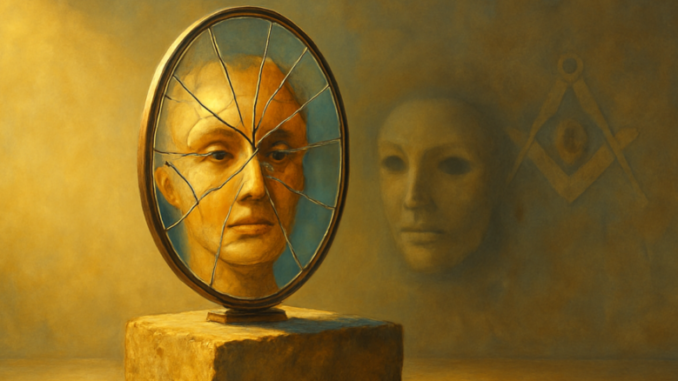
A mirror that cracks no longer shows a true reflection. The glass is still there, the frame intact, but the image looking back at you is splintered, distorted, unreliable. This is how we might view those moments when someone’s actions stand in stark contradiction to the role they occupy. When the news confronts us with people who were given trust and then betrayed it, we are forced to sit with an uncomfortable question: what is personality, really? And can we ever fully know it — in others or in ourselves?
The Mask and What Lies Behind It
The word “personality” derives from the Latin persona, which originally referred to a theatrical mask. Actors in classical theater wore masks to define their roles. The mask was not meant to deceive — it was meant to clarify. It told the audience who this figure was and what to expect from him. And yet, buried in this etymology lies an unsettling truth: if personality is a mask, what lies behind it?
In Freemasonry, this question occupies a central place, even if it is rarely stated so directly. The rough ashlar — the symbol of man at the beginning of his inner journey — is neither good nor bad. It is simply unworked. The stone contains both the potential for a perfect building block and the cracks and impurities that could render it useless. It is the Mason’s task to patiently chip, chisel, and polish. But what if that labor was never truly begun? What if someone wears the mask of the perfected stone while the rough core remains untouched?
Trust as Foundation
A primary school is a temple of trust. Parents place their most precious possession into the hands of strangers, trusting that those strangers possess integrity. This trust is not naïve — it is the mortar that holds societies together. Without trust, there can be no community, no cooperation, no transmission of knowledge and values to the next generation. When that trust is violated, it strikes at something fundamental in our shared edifice.
The Masonic lodge operates under a similar dynamic. Brothers enter the temple in good faith. They reveal their inner struggles, their doubts, their aspirations. This is only possible when there exists a shared conviction that everyone in that space is sincerely working on themselves. The ritual provides structure, but trust gives that structure its meaning. A lodge filled with Brothers who wear masks without ever revealing the rough stone beneath is nothing more than empty theater.
The Unfinished Self
It would be easy to pass judgment. To declare that some people are simply bad, that their character is beyond repair, that evil is a destination rather than a deviation. But the truth is rarely that simple. The philosopher who wrote that man is “condemned to be free” pointed to something essential: we are perpetually in the process of becoming. Every day, we choose anew who we are — consciously or unconsciously — through our actions and our omissions.
The rough ashlar bears no guilt. It is the Mason who neglects to chisel who carries the responsibility.
This does not mean we should blur boundaries or deny accountability. Quite the opposite. It acknowledges that the work upon the self is a choice — a daily discipline. Those who neglect that discipline, who let the chisel rust, who prefer the mask over genuine transformation, make a choice with consequences. And those consequences can be devastating, not only for themselves but for everyone who placed their trust in them.
The Mirror That We Are
When we are confronted with another person’s failure, the temptation is strong to distance ourselves. To think: that could never happen to me — I am different, I am better. But Freemasonry invites a different response. It asks: what does this cracked mirror show me about myself? Which rough spots on my own stone have I avoided working on? Where am I wearing a mask that no longer fits the person I aspire to become?
This is not a call for self-flagellation. It is a call for honesty. The lodge offers a space where such honesty is possible, protected by ritual and brotherhood. But the real work takes place in the silence of one’s own heart, in the moments when no one is watching, in the choices that earn no applause.
Building Blocks for the Future
So what remains for us? Perhaps this: the recognition that personality is not a fixed fact but an ongoing project. That trust is fragile and therefore deserves protection. That we all bear responsibility — not only for our actions but for our unworked corners. And that confrontation with the failure of others is ultimately an invitation to pick up our own chisel once again.
The rough ashlar reminds us of our unfinished character. Trust is the foundation of every community. The mask conceals, but labor transforms. The cracked mirror reveals what we would rather not see.
In the temple of daily life, we are constantly invited to choose. Not once, but again and again. The cracked mirror is a confrontation, but it is also a gift: it reminds us that the work is never done, that the building is always under construction, and that every moment is an opportunity to begin again with chisel in hand.
The splintered reflection that current events hold up to us is ultimately a mirror for us all. It does not ask for condemnation but for contemplation. Not for complacency but for vigilance. Personality is not a mask we put on once and forget about — it is an edifice we shape every single day. And in that ongoing labor, in that unfinished project of the self, lies both our deepest vulnerability and our greatest dignity.
Copyright text & image: devrijmetselaar.nl
Texts are based on the ideas and content of the author of devrijmetselaar.nl, reviewed, corrected, and supplemented with the assistance of OpenAI. Images are created based on the ideas of the author of devrijmetselaar.nl using OpenAI/DALL-E.
Frequently Asked Questions
What does the rough ashlar symbolize in Freemasonry?
The rough ashlar represents a person at the beginning of their inner journey—unworked stone that contains both potential and imperfections. It symbolizes that every Mason starts as an unfinished work and has the responsibility to chip away at their flaws through self-improvement and spiritual development. This teaches us that character is not fixed but continually being shaped through conscious effort and dedication.
Why is trust so important in a Masonic lodge?
Trust is the foundation that allows Brothers to share their inner struggles, doubts, and aspirations in a safe space. Without this shared conviction that everyone is sincerely working on themselves, the lodge would become merely empty theater rather than a genuine place of spiritual growth. Trust transforms the rituals and teachings into meaningful experiences that truly transform character.
How does Freemasonry address the question of who we really are?
Freemasonry acknowledges that personality, like the theatrical masks of ancient Rome, can sometimes hide our true nature. The organization teaches that we are perpetually becoming ourselves through our daily choices and actions, and that sincere self-work—represented by the Mason's labor on the rough stone—is how we align our outer mask with our inner character.
Can someone change their character according to Masonic philosophy?
Yes, Freemasonry is built on the belief that character is unfinished architecture and that personal transformation is always possible. The Mason's task is to patiently chisel away flaws and impurities through dedication and self-reflection, demonstrating that no one is beyond the capacity for genuine improvement and spiritual growth.

Be the first to comment