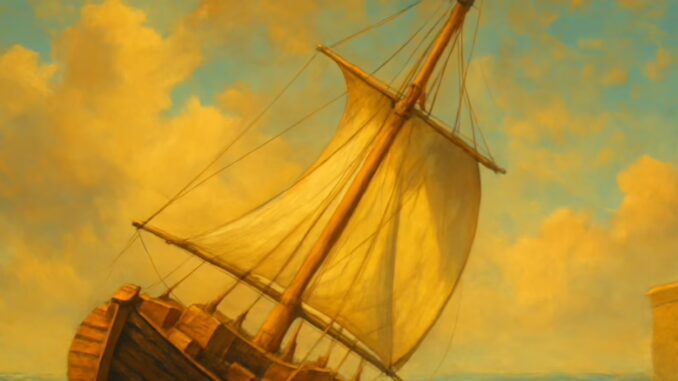
Here is a paradox worth contemplating: the more firmly convinced you are of something, the greater the danger of capsizing. Not figuratively — literally. The word “convinced” traces back to nautical language, where it described a ship carrying so much weight on one side that it listed dangerously, no longer responded to the helm, and risked rolling over at the first strong gust of wind. Certainty as a risk factor. Firmness as a source of instability. Isn’t that one of the most uncomfortable truths language has been quietly trying to tell us all along?
Certainty Makes You Lose the Helm
Let’s take that paradox seriously. In everyday speech, we say “I’m convinced” as though it’s a virtue — a sign of resolve and strength. We admire people who stand firm, who don’t budge an inch. But an old-time sailor would have raised an eyebrow at such admiration for imbalance. To him, being “over-convinced” wasn’t a badge of honor — it was a diagnosis. A ship that had shifted all its weight to one side was a ship in distress. The rudder rendered useless, the crew at the mercy of forces they could no longer steer against.
The shift in meaning is telling. Somewhere between the harbor and the living room, a word of warning became a compliment. We forgot that its original wisdom taught exactly the opposite: whoever loads everything on one side loses the ability to hold course.
The Level and the Square: Tools Against Imbalance
In the symbolic world of Freemasonry, this same theme emerges — translated into the language of architecture and the builder’s craft. Where the sailor distributes ballast to keep his vessel upright, the Mason uses the level to check whether his work is horizontally true. The square tests whether angles are right, whether any distortion has crept into the structure. The plumb line descends silently and reveals every deviation from the vertical — every invisible tendency to lean too far to one side.
In Freemasonry, these are no longer practical tools. They are symbols of an inner discipline. They invite continuous self-inspection: Am I still standing true? Am I listing? Is my structure — my character, my thinking — still in balance? The level doesn’t lie, and neither does the water in which a ship begins to lean. Both are unforgiving mirrors.
Is Doubt Then the Virtue?
One might object that this argument for balance is really an argument for indecision. If every conviction carries the risk of distortion, should we stop believing in anything? Should we doubt forever, tack endlessly, never drop anchor?
That would be a misunderstanding — and an important one. The sailor doesn’t avoid all cargo. Without ballast, a ship is even more vulnerable, tossed about by every wave. The point isn’t emptiness; it’s distribution. The art lies in placing weight so the vessel remains stable, maneuverable, and able to respond to whatever the sea brings. Convictions are necessary. Values give direction. But the moment all the weight shifts to one side — the moment there’s no room left for a counterpoint, another perspective, an unexpected change in the wind — strength becomes vulnerability.
The true strength of any structure lies not in the hardness of a single stone, but in the way all the stones together distribute the load.
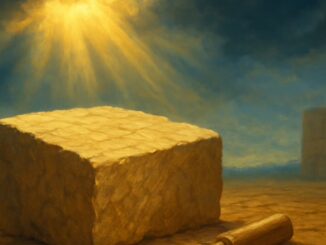
In Freemasonry, this principle is embodied in the image of the rough ashlar that is gradually worked and refined. Not by chipping everything away until nothing remains but a smooth, characterless sphere, but by shaping the stone so that it fits. So that it bears weight and is borne by others. So that it contributes its own mass without throwing the whole structure off balance. It is an image of reciprocity — of integration without self-erasure.
The Language of Craft as Life Wisdom
What seamanship and stonemasonry share is a language born from physical consequences. A listing ship sinks. A crooked wall collapses. There is no negotiating with gravity. It is precisely this unforgiving quality that makes these craft languages so valuable as sources of life wisdom. They weren’t invented at a writing desk; they grew from generations of direct experience with the consequences of imbalance.
The level asks: Is what you’re building in horizontal balance?
The plumb line asks: Are you deviating from your vertical truth, your core?
The square asks: Are your proportions right, or has distortion crept in?
The ballast asks: Have you distributed your weight, or are you leaning dangerously to one side?
Freemasonry invites its members to ask these questions not once, but continuously. Not as a final examination, but as a practice. As an ongoing recalibration of one’s own position, in the understanding that life is not still water but a sea that is always moving.
The Question That Remains
And so the paradox returns, but now with greater depth. Being convinced is not the endpoint of thought — it may well be the beginning of imbalance. That doesn’t mean we should abandon our convictions, but that we must continually weigh them, redistribute them, and test them against the level of honest conversation with others and the plumb line of genuine self-reflection.
The question this leaves us with is perhaps the most fruitful one there is. Not: What am I convinced of? But rather: Which way am I listing without realizing it? What weight have I carried for so long that I’ve forgotten it’s there? And what would happen if I shifted it to the other side — if only to feel how the ship sails differently?
Copyright text & image: devrijmetselaar.nl
Texts are based on the ideas and content of the author of devrijmetselaar.nl, reviewed, corrected, and supplemented with the assistance of OpenAI. Images are created based on the ideas of the author of devrijmetselaar.nl using OpenAI/DALL-E.
Frequently Asked Questions
What is the connection between the word 'convinced' and nautical language?
The word 'convinced' originally comes from nautical terminology, where it described a ship that had shifted too much weight to one side, causing it to list dangerously and lose the ability to respond to the helm. This maritime origin teaches us that excessive certainty can make us unstable and unable to adapt, much like an imbalanced ship. Understanding this etymology helps us appreciate why Freemasonry values balance and self-reflection over rigid, one-sided convictions.
How do Masonic tools like the level and square relate to personal development?
In Freemasonry, the level, square, and plumb line are symbolic tools that represent inner discipline and continuous self-inspection. They serve as unforgiving mirrors—much like water revealing a listing ship—to help Masons check whether they remain balanced in their character, thinking, and actions. These tools encourage Masons to regularly ask themselves: 'Am I still standing true? Am I listing toward imbalance?' This practice of self-examination is central to Masonic personal growth.
Does Freemasonry teach that we should doubt everything and never take a stand?
No—Freemasonry does not advocate for endless doubt or indecision. Rather, it teaches the importance of balance and distribution of conviction, just as a ship needs ballast to be stable. Convictions and values are necessary and give direction, but they must be held in equilibrium with openness to learning and adaptation. The Masonic ideal is to maintain firm principles while remaining flexible enough to respond to new circumstances and perspectives.
What is the practical benefit of maintaining balance in one's beliefs?
Maintaining balance in beliefs—rather than placing all your weight on a single conviction—keeps you mentally and morally maneuverable and responsive to truth. A balanced perspective allows you to navigate life's challenges with wisdom, just as a well-balanced ship can respond to changing winds and waters. Freemasonry teaches that this kind of equilibrium strengthens character and judgment, making us more capable of serving others and our communities effectively.


Be the first to comment