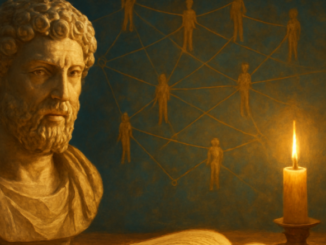
Ancient Roman bust of Marcus Aurelius symbolizing Stoic wisdom and Freemasonry
Marcus Aurelius – Freemasonry & Connection

Marcus Aurelius and Impermanence: What Truly Connects Us?

Why would a Roman emperor from the second century still have something meaningful to say about human connection? And what does his reflection on the brevity of life have to do with the brotherhood that Freemasons strive for? In the second book of his Meditations, Marcus Aurelius confronts himself with an uncomfortable truth: everything passes, including ourselves. Yet within that very acknowledgment lies a surprising lesson about what truly binds us together as human beings. What Does Marcus Aurelius Actually Mean by Impermanence? Let us first consider what the emperor actually writes. In Book II of the Meditations, Marcus Aurelius describes how everything we know passes like waves on a river. Our bodies decay, our names are forgotten, and even the memory of our deeds eventually fades. This may sound bleak, but for the Stoic, it is no cause for despair. It is an invitation to clarity. The impermanence Marcus Aurelius describes is not nihilism. It is a call to distinguish between what is truly valuable and what is merely appearance. Fame, possessions, power — these are fleeting things. But virtue, character, and the way we treat others carry a different quality. Not because they last forever, but because they […]

Stone carving tools on a rough ashlar symbolizing Masonic courage and growth
Michel de Montaigne – Freemasonry & Connection

Montaigne on Cowardice: Courage as a Masonic Virtue

Imagine standing at a crossroads in life where the easy path beckons, but your conscience pulls you in the opposite direction. Michel de Montaigne explored this very tension in his fifteenth essay, which examines the punishment of cowardice. At first glance, it appears to be a military treatise, but look closer and it strikes at the heart of what it means to live a virtuous life. For Freemasons, this essay resonates with particular force — courage and personal accountability are pillars of the Craft. What Montaigne Teaches Us About Cowardice In his short but powerful essay, Michel de Montaigne wrestles with a provocative question: should cowardice on the battlefield be punished by death, or is the disgrace itself punishment enough? He points to the Roman practice of publicly humiliating cowards rather than executing them. Soldiers who fled from battle were forced to walk through the camp dressed in women’s clothing for days on end — a spectacle designed to shame rather than destroy. Montaigne argues that executing someone for cowardice is fundamentally paradoxical. You cannot punish a lack of courage by killing the person, because death eliminates any possibility of redemption or improvement. This is classic Montaigne: he avoids absolute […]

Cyclist climbing a mountain road symbolizing Masonic perseverance and brotherhood
Personal Development & Leadership

Fifteen Seconds Behind: On Perseverance and Brotherhood

The sun beats down on the asphalt of the final mountain stage. A cyclist stares at the back of her rival, fifteen seconds up the road. Her legs scream for rest, her lungs burn, but somewhere deep inside a voice speaks: we never give up. Not for herself alone, but for the teammates who sacrificed themselves all day to bring her here. This moment of perseverance — carried by a collective — touches something Freemasons have known for centuries: the power of brotherhood in times of trial. The Final Kilometers: When Giving Up Becomes Tempting In professional cycling, the final kilometers of a grueling mountain stage are the moment of truth. All the training, all the preparation, all the strategy converge into a single question: do you hold on, or do you give in to the temptation to ease off the pace? The difference between victory and defeat can be measured in mere seconds. Fifteen seconds sounds like nothing, but on a gradient of ten percent, every meter feels like an eternity. What keeps riders upright in those moments is rarely pure physical strength. It is the awareness that they are not riding alone. Behind them lie miles in which […]

Symbolic image of brotherhood and loyalty within Freemasonry
Personal Development & Leadership

Blood Ties and Brotherhood: When Family Loyalty Turns Dark

A woman allegedly conspired with her own brother to arrange the contract killing of her ex-partner. The story is shocking — not just because of the crime itself, but because a family member was willing to participate. What drives a brother to go along with such a dark plan? And what does this tell us about the limits of loyalty? This disturbing case raises a profound question: when does faithfulness cross the line into complicity? Freemasonry, with its long tradition of reflection on brotherhood, offers a surprisingly relevant perspective on this very issue. The Blood Bond: Loyalty Without Conditions? Across cultures, family loyalty ranks among the highest virtues. “Blood is thicker than water,” as the saying goes. Standing by a sibling no matter what is often seen as a sign of unwavering devotion. This belief has ancient roots. In his Nicomachean Ethics, Aristotle described how familial bonds form a natural foundation for moral obligations. Supporting your kin is not a choice — it is a duty that springs from nature itself. Yet the case at hand exposes the dark side of unconditional loyalty. When a brother is willing to participate in a plot that could cost a human life, family […]

Masonic lodge illuminated by candlelight symbolizing watchfulness and light
Christianity

1 Thessalonians: Watching in the Light as a Fraternal Duty

There is a remarkable tension at the heart of Paul’s First Letter to the Thessalonians: he calls for vigilance as though the end is near, yet simultaneously urges the patient building of a loving community. How can urgency and patience coexist? This paradox lies at the core of a text that proves surprisingly relevant for anyone reflecting on moral growth and brotherhood — including those who walk the Masonic path. The Paradox of the Watchful Builder Paul wrote this letter around 50 AD to a young community in Thessalonica, a port city in northern Greece. It is the oldest known text in the New Testament — older even than the Gospels. What stands out immediately is the dual message: on the one hand, Paul expects the end of days to arrive soon; on the other, he offers detailed instructions for daily life. Work with your hands. Encourage the fainthearted. Be patient with everyone. At first glance, this seems contradictory. Why invest in relationships and craftsmanship if everything is about to end? And yet, there is a deeper truth hidden in this tension. The attitude of watchfulness does not replace the work of community building — it intensifies it. Those who […]

Open book of Montaigne's essays beside Masonic square and compasses symbolizing reflection
Michel de Montaigne – Freemasonry & Connection

Montaigne and Connection: Steadfastness as a Bridge to Others

Picture yourself standing in a room full of strangers. Everyone is wearing a mask — not a literal one, but the invisible masks of social expectation. How often do you find yourself trying to impress rather than genuinely connect? In the sixteenth century, Michel de Montaigne wrote a penetrating essay on constancy that cuts straight to the heart of this question. His insights remain strikingly relevant for anyone reflecting on authentic human connection, and they resonate deeply with what Freemasons have pursued within their brotherhood for centuries. The Paradox of Unyielding Resolve In the twelfth essay of his first book, Montaigne examines what it truly means to be steadfast. He reveals how easily we confuse genuine inner stability with the outward appearance of immovability. That exterior can be deeply deceptive. Montaigne describes how people sometimes seem resolute out of pride or fear, while internally they are crumbling. True constancy, he argues, springs from self-knowledge and the acceptance of our human limitations. This distinction matters enormously for anyone thinking about connection with others. When you know and accept your own weaknesses, there is no need to perform. You can allow yourself to be vulnerable without losing your foundation. Montaigne saw this […]

Ancient temple columns symbolizing Freemasonry building metaphors from Corinthians
Christianity

First Corinthians: Building Metaphors and Brotherhood

Around the year 55 CE, Paul of Tarsus sat down in Ephesus to write a letter to the fledgling Christian community in Corinth. This bustling port city, perched on a strategic isthmus between two seas, thrived on commerce, philosophy, and religious diversity. The letter we know as First Corinthians contains some of the most compelling imagery in early Christian literature: the community as a temple, believers as building stones, and the imperative to build upon a solid foundation. For those familiar with the symbolic language of Freemasonry, these metaphors sound remarkably familiar. A Letter to a Divided Community Understanding the historical context of this letter is essential to grasping its symbolism. First-century Corinth was a cosmopolitan city where Greeks, Romans, Jews, and freedmen lived side by side. The young congregation Paul had founded there was struggling with internal division. Different factions rallied behind different leaders, threatening to fracture the community’s unity. It is against this backdrop that Paul develops his powerful building metaphor. In the third chapter, he compares the community to a building whose foundation he himself has laid. Others build upon it, but the quality of their work will be tested by fire. This image of the skilled […]

Historical portraits of famous Freemasons through the centuries
History

Famous Freemasons Throughout History: A Remarkable Legacy

For centuries, Freemasonry has attracted men who not only excelled in their fields but also felt a deep yearning for brotherhood, philosophical inquiry, and personal growth. Famous Freemasons can be found across virtually every domain of human endeavor — from politics and the arts to science, the military, and business. Their membership in a lodge speaks to a shared pursuit of wisdom, ethics, and community — values that Freemasonry has championed for more than three hundred years. This overview brings together a broad and diverse collection of historical and more recent brethren, placing their Masonic membership in the context of their lives and times. The Early Centuries: Freemasons in the 18th and 19th Century Organized Freemasonry as we know it today began in 1717 with the founding of the first Grand Lodge in London. From that moment, the movement spread rapidly across Europe and North America. It comes as no surprise, then, that many of the most influential thinkers, statesmen, and artists of the eighteenth and nineteenth centuries were drawn to the principles of the lodge. George Washington — Founding Father and Brother Perhaps the most iconic name among famous Freemasons is George Washington (1732–1799), the first President of the […]

Manual gear shift symbolizing conscious effort and Masonic brotherhood
Personal Development & Leadership

Manual Gears and Brotherhood: Why Conscious Effort Connects

In a world racing toward automation, a surprising number of drivers still choose to drive a manual transmission. It seems paradoxical — why exert effort when ease is readily available? Yet hidden within this apparent illogic lies a deeper truth about human connection: that choosing engagement over convenience is what gives our relationships real meaning. It is precisely this tension that strikes at the heart of what brotherhood truly means in Freemasonry. The Paradox of Purposeful Effort Here is a statement that sounds contradictory at first: genuine connection does not arise despite effort but precisely because of it. The driver who opts for a stick shift when an automatic is available is making a quiet declaration of engagement. With every gear change, the driver remains an active participant in the act of driving rather than a passive observer being ferried from A to B. This choice for active involvement has a remarkable parallel in Freemasonry. When Brethren gather in the Lodge, they consciously choose a form of togetherness that demands effort. The ritual is not designed for comfort. The symbols call for contemplation. The conversations require genuine listening and reflection. One could just as easily stay home on the couch […]

Stuntman leaping from a platform symbolizing trust and Masonic brotherhood
Freemasonry & Society

The Human Catapult: On Daredevils, Trust, and Brotherhood

Picture this: you’re standing on a platform, about to be launched through the air by a human catapult. Below you lies a landing zone. Around you stands a team that has gone over every detail. And yet, things go wrong. A stuntman recently broke his ankle after a jump with a human catapult at a major festival. The news struck me — not just because of the pain involved, but because of the deeper question it raises: what does it truly mean to surrender yourself to a system, to other people, to the unknown? The Leap and the System A stuntman who allows himself to be launched into the air does something most of us would never dare. It’s not just about the physical courage required — it’s about the trust that precedes the leap. A structure has been built. Calculations have been made. People stand ready to catch you. You surrender yourself to a system that is larger than you are. And sometimes, despite every preparation, things go wrong. This isn’t some abstract philosophical puzzle. It’s the reality of everyday life for each one of us. Perhaps not as spectacular as a human catapult, but equally real. Every time […]

Masonic lodge interior symbolizing tension and brotherhood among brothers
Personal Development & Leadership

Division in the Lodge: A Philosophy of Brotherhood

What if brotherhood is not a state of harmony but a state of sustained discomfort? What if the true test of connection lies not in the moments when everything runs smoothly, but precisely in the moments when tension becomes so palpable that walking away seems more attractive than staying? If that is the case, then everything we think we know about standing together in a lodge changes. The lodge is no longer a sanctuary — it becomes a crucible. And the division a brother feels with his lodge is not proof of failure, but perhaps the very beginning of genuine insight. The Paradox of Commitment There is a peculiar law that governs human communities: the more someone cares about a group, the more keenly they experience its shortcomings. Indifference, after all, knows no disappointment. Those who expect nothing are never hurt. But those who make themselves vulnerable, who invest time and energy in a collective ideal — they feel it when that ideal crumbles under the weight of habit, complacency, or misunderstanding. This is not weakness. It is the inevitable byproduct of sincere commitment. In Freemasonry, this paradox takes on a distinctive form. The lodge presents itself as a workshop […]

Symbolic depiction of Gnostic and Masonic paths to brotherhood in the Netherlands
Personal Development & Leadership

Inner Knowing in the Netherlands: Two Paths to Brotherhood

For centuries, the Netherlands has been captivated by the idea of inner knowing — the pursuit of hidden wisdom that cannot be handed down through books or authorities but must be discovered through personal experience. The tradition of gnosis in the Netherlands has a rich history, stretching from medieval mystical movements to contemporary spiritual communities. At the same time, Freemasonry offers a different yet closely related path toward brotherhood and self-knowledge. How do these two worlds relate to each other? And what can they learn from one another about forming meaningful connections between people? The Gnostic Path: Inner Knowing as Foundation The Gnostic tradition, which has blossomed again and again in the Netherlands across the centuries, starts from a powerful premise: truth is not something imposed from the outside but something that already slumbers within the human soul. The word gnosis comes from the Greek and literally means knowledge — but knowledge of a very particular kind. It is not about factual data or scientific understanding. It is about a direct, inner experience of the divine or the absolute. In the Dutch context, this tradition has always occupied a special place. As early as the late Middle Ages, the Low […]

Famous Freemasons gathered in a lodge symbolizing brotherhood and unity
Personal Development & Leadership

Famous Freemasons: What Their Brotherhood Can Teach You

When you read about famous Freemasons throughout history, one thing immediately stands out: they came from vastly different backgrounds, professions, and belief systems. Yet they found common ground in the lodge. Composers sat alongside generals, writers beside statesmen. What united them? And more importantly, what can you take from their example and apply to your own life? This article isn’t about name-dropping — it’s about the practical power of brotherhood these men shared. What Truly Connected Famous Freemasons Think about the eighteenth and nineteenth centuries — an era of revolutions, radical new ideas, and deep social tensions. Yet during this very period, composers, scientists, politicians, and artists gathered together in lodges. Not to advance each other’s careers or build networks in the modern sense of the word. They came together because they believed in something greater: the possibility of growing as human beings, alongside others walking the same path. Historical records show that musicians like Mozart and Haydn were active members of Viennese lodges. Enlightenment thinkers such as Voltaire were initiated shortly before their deaths. And across the Atlantic, Freemasons played a significant role in shaping a young republic. What made this remarkable? Within the lodge, social distinctions fell away. […]

Symbolic river scene representing Masonic brotherhood and self-sacrifice
Personal Development & Leadership

Self-Sacrifice and the Deepest Meaning of Brotherhood

Sometimes a story stops you in your tracks. A mother pulls her children to safety from a river’s current, only to be swept away herself. In that split second, she made a choice that touches the very essence of what it means to live for another. As Freemasons, we recognize in such moments something that reaches beyond words — something that strikes at the heart of brotherhood. The Choice No One Wants to Face You may have asked yourself what you would do in a life-or-death situation. Not as a theoretical exercise, but when the water is literally rising around you. Most of us, thankfully, know such moments only from stories or films. Yet it happens every day, somewhere in the world: someone faces a choice where their own life hangs in the balance in order to save another. What this mother did on the banks of the Waal River in the Netherlands was not a calculated decision. It was a response that rose from the deepest layer of her being — a place where love and responsibility merge into something greater than the individual. In Freemasonry, we call this the bond that reaches beyond words or rituals: the brotherhood […]

Athletes and Freemasons united in brotherhood across borders and centuries
Freemasonry & Society

When Nations Meet: Sport and Brotherhood Through the Ages

In 1896, athletes from thirteen different nations gathered in Athens for the first modern Olympic Games. Among them were men whose homelands had regarded each other as enemies just fifty years earlier. Yet there they stood, shoulder to shoulder on the field of play, united by a competition that transcended borders. Today, as international football matches once again bring political tensions to the surface, it is worth looking back at how sport has both united and divided throughout history — and what this teaches us about the deeply human yearning for brotherhood. The Olympic Ideal and Its Masonic Roots Few people realize that the revival of the Olympic Games was closely linked to ideals that were also cherished in Masonic lodges. The nineteenth-century movement that gave rise to the modern Games was steeped in universalist principles: the conviction that all people, regardless of origin or nationality, are capable of nobility and fair competition. This philosophy mirrors the Masonic ideal of the chain of brotherhood, in which men from vastly different backgrounds meet as equals. The first international sporting competitions emerged in the eighteenth century — a period when lodges were expanding rapidly across Europe. It is no coincidence that both […]

Freemasons standing together symbolizing brotherhood during times of crisis
Freemasonry & Society

Epidemics and Brotherhood: What Crises Teach Freemasons

A rising line on a graph. Numbers climbing. Experts issuing warnings. When reports of potential disease outbreaks begin to circulate, something shifts in our collective consciousness. But what do these moments truly reveal about our society? And what can Freemasons — with their centuries-old emphasis on brotherhood and civic responsibility — contribute to the conversation about crises that affect us all? Why Do Predictions Unsettle Us So Deeply? It’s a question that demands attention every time we’re confronted with alarming charts and expert analyses. Why does our pulse quicken at the sight of an upward-trending curve? The answer may not lie solely in our fear of illness, but in something far more fundamental: our connection to one another. In these moments, we realize we are not isolated islands. What strikes one person can strike us all. That awareness, however uncomfortable, contains a profound truth that Freemasons have recognized for centuries: humanity forms one great chain, and every link matters. What Does History Teach Us About Brotherhood in Times of Crisis? Consider the great plague epidemics of the Middle Ages. Social structures collapsed. Fear drove people apart. And yet, some communities held firm — places where people continued to care for […]

Historic Masonic lodge interior in Den Bosch representing brotherhood and ritual
Personal Development & Leadership

Freemasons in Den Bosch: Why Do Brothers Seek Each Other?

What drives people to join a community that has existed for centuries? Freemasons in Den Bosch form a remarkable link in a chain that stretches back to the Middle Ages. But what does brotherhood actually mean in an age where individualism seems to be the default? Let’s explore these questions together — as if we were sitting at a table in one of the historic buildings of this Brabant capital. Why Do We Speak of Brotherhood? The word brotherhood conjures up different images for different people. Some think of family, others of a secretive society. But in Freemasonry, the word carries a deeper meaning. It’s not about blood ties or exclusivity — it’s about a shared quest for meaning and self-improvement. Imagine walking into a room where background, profession, and social status are irrelevant. Where a lawyer sits beside a carpenter, a doctor next to an artist. What binds them is not what they have, but who they aspire to become. That is the essence of brotherhood as Freemasons understand it. Freemasons in Den Bosch: A History of Connection Den Bosch has a rich Masonic history. The city, with its medieval character and deep cultural traditions, has always provided fertile […]

Historic Maastricht streetscape evoking the tradition of Freemasonry in the city
Personal Development & Leadership

Freemasonry in Maastricht: Brotherhood on the River Maas

Walk through the narrow streets of Maastricht and you pass centuries of history without even realizing it. Between Romanesque churches and baroque facades hides a lesser-known tradition: that of Freemasonry. In this city where cultures and languages have intersected for centuries, brotherhood has taken on a character all its own. This is not a tour of monuments — it is a journey along the invisible threads that connect people to one another. A City of Crossroads and Encounters Maastricht is no ordinary Dutch city. Situated at the point where the Netherlands, Belgium, and Germany converge, it breathes a cosmopolitan atmosphere you simply won’t find anywhere else in the country. The Burgundian character, the influences from the Rhineland, the Walloon traces in the local dialect — everything here speaks of connection across borders. It is precisely in this context that Freemasonry in Maastricht has flourished for centuries. The lodges in the province of Limburg have always occupied a distinctive position within the Grand East of the Netherlands. Far from the administrative center in The Hague, close to international influences, they developed a character of their own. Here, brotherhood was never abstract. It took shape in the daily interactions between people of […]

Neighbors connecting in community inspired by Masonic brotherhood principles
Personal Development & Leadership

Brotherhood in a Fragmented World: Lessons from Freemasonry

Last week, a 74-year-old man died alone in a Rotterdam apartment block. His body wasn’t discovered for three weeks — not because he lived in some remote area, but in a building with thirty neighbors. The story struck a raw nerve. We live closer together than ever before, yet we know each other less and less. Somewhere in this tension between proximity and alienation lies an urgent question: what happened to our sense of community? And what can we learn from a fraternity that has spent centuries experimenting with building meaningful bonds between strangers? The Vanishing Village Square Modern society is changing at breakneck speed. Studies consistently show that nearly half the population in developed Western nations reports feeling lonely at least some of the time. The numbers are highest among young adults and the elderly. These aren’t statistics about people living in isolated rural areas — they describe residents of cities and towns, surrounded by thousands of others. The traditional village square, where people naturally ran into each other, has been replaced by digital spaces where algorithms determine what we see and who we interact with. The chance encounter at the bakery, the chat over the garden fence, the […]

Montaigne philosophy and Freemasonry symbolism representing self-knowledge
Freemasonry & Connection

Montaigne and Freemasonry: Passions and True Connection

Why do we sometimes direct our deepest emotions at things that don’t actually matter? And more importantly, how do we recognize the moment our passions deceive us? These are questions the sixteenth-century philosopher Michel de Montaigne posed in his essay on how the soul projects its emotions onto false objects. They are also questions that resonate powerfully within the ritual space of the Masonic lodge, where brethren gather to examine themselves and seek authentic human connection. What Did Montaigne Mean by “False Objects”? Montaigne identified a peculiar yet universal human tendency. When we are overwhelmed by powerful emotions — anger, grief, frustration — we instinctively seek an outlet that has nothing to do with the real source of our distress. A man who receives bad news kicks a chair. A person in mourning lashes out at the messenger. The soul, Montaigne argued, simply cannot bear the full intensity of its passions, and so it desperately searches for something — anything — to direct them toward, even if that target is entirely innocent. This insight is not a judgment but an observation about human vulnerability. Montaigne draws our attention to the fact that we often deceive ourselves by pouring emotional energy […]