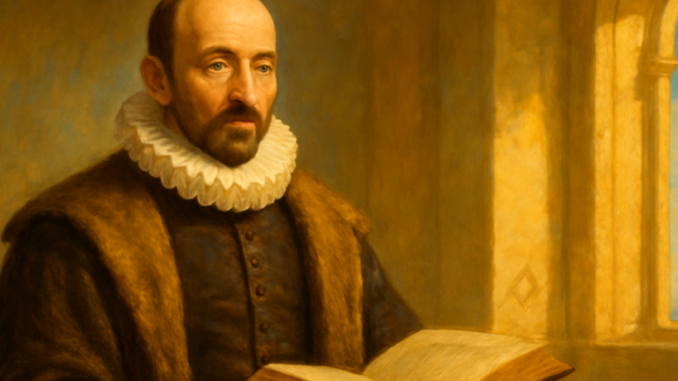
Picture this: a group of brethren sit together in silence after a long ritual. The evening was intense, and the words have done their work. One brother smiles softly; another stares pensively at the floor. Both experienced the same ceremony, yet their inner responses are fundamentally different. It is precisely this tension between different ways of seeing that Michel de Montaigne described four hundred years ago in his essay on Democritus and Heraclitus — and that still resonates at the very heart of Freemasonry today.
Two Philosophers, Two Views of the World
In the fiftieth essay of the first book of his Essays, Michel de Montaigne draws upon a classic image from the philosophical tradition: Democritus, the laughing philosopher, and Heraclitus, the weeping philosopher. Both observed the human condition, but where Democritus greeted humanity’s folly with a broad smile, Heraclitus shed tears over it. Montaigne does not use this contrast to declare a winner. Instead, he poses a deeper question: how do we relate to the world around us? And how do we form our judgments?
Montaigne ultimately sides with Democritus — not out of cynicism, but from a gentle, almost loving detachment. For him, humanity is not something to despise or mourn but to observe with quiet wonder. This goes far beyond philosophical amusement. It is an ethical choice: the choice to understand rather than condemn.
The Art of Judging Without Condemning
What makes this essay remarkable is that Montaigne does not stop at the anecdote. He uses the contrast between Democritus and Heraclitus as a springboard for a profound reflection on human judgment. Why, he wonders, are we so quick to judge others when we scarcely know ourselves? Montaigne argues for a judgment that is humble — one that acknowledges our own flaws are at least as great as those of the people we judge. It is a plea for intellectual humility, a theme that occupied Aristotle and Socrates before him as they explored the boundaries of human knowledge.
This attitude of cautious judgment has a direct parallel in Freemasonry. In the lodge, a brother or sister does not learn to measure the outside world against some ideal standard. Instead, the task is to work the rough stone within oneself. The goal is not to weigh others and find them wanting. It is to honestly face one’s own imperfections and, from that vantage point, look upon the world with gentleness. Those who truly know themselves — as both Montaigne and the Masonic tradition teach — judge others more softly.
Connection as a Counterweight to Judgmental Thinking
There is a subtle but powerful lesson hidden in Montaigne’s preference for laughter over tears. To laugh at the human condition is to acknowledge that you are part of it yourself. It is not a laugh from above but a laugh of recognition. And in that recognition lies connection. You can only truly be connected to another person when you accept that both of you are imperfect, both searching, both on the way.
Freemasonry is built upon exactly this foundation. Brotherhood does not arise because brethren are perfect but because they acknowledge together that they are not. The lodge is not a place of condemnation but of shared vulnerability. The rituals emphasize this time and again: the search for light is a collective endeavor. No one stands alone, and no one holds the definitive answer. As Montaigne demonstrates, the willingness to suspend judgment is the very prerequisite for genuine encounter.
True brotherhood begins where judgment ends: in the recognition that we are all imperfect and searching, and that this is precisely what unites us.
Self-Reflection as a Bridge Between Montaigne and the Lodge
In this essay, Montaigne also writes about how he himself forms judgments, and this is perhaps the most revealing part. He admits that his opinions shift, that he sometimes doubts what he felt certain about just the day before. Rather than hiding that doubt, he embraces it. This is a radically honest posture that closely mirrors the Masonic practice of self-reflection. After every meeting, after every ritual, the brother is invited to look inward — not to find a perfect answer, but to summon the honesty required for personal growth.
It is no coincidence that these themes run through Montaigne’s broader work as well. In his essays on customs, on his philosophical sources — from the Skeptics to the Stoics — the same refrain returns: know yourself, and be gentle in that knowing. It is an approach to life that Freemasonry shares, and in an age of snap judgments and sharp divisions, it feels more relevant than ever.
Where Values Converge
When we place the core of Montaigne’s argument alongside the central values of Freemasonry, the parallels are striking:
Self-reflection: Both Montaigne and Freemasonry place knowing yourself above judging others.
Virtue: The pursuit of a gentle and just judgment is a moral exercise, not an intellectual game.
Brotherhood: Connection arises through shared vulnerability, not through shared certainties.
The search for truth: Honestly acknowledging doubt is not a weakness but a prerequisite for genuine knowledge.
Inner growth: Working the rough stone demands exactly the kind of honesty Montaigne practices in this essay.
The Smile as a Gesture of Belonging
Perhaps the most beautiful lesson of this essay is that connection does not begin with grand words or lofty ideals but with a simple gesture: a smile of recognition. Democritus did not laugh to mock humanity. He laughed to say: I see you, I recognize myself in you, and it is precisely because of that recognition that I can smile. It is this same warm sense of recognition that brethren experience when they gather in the lodge — when they set aside the noise of the outside world and meet one another as fellow travelers on an unfinished road.
In the end, Montaigne’s essay is not really about choosing between laughter and tears. It is about the quality of attention we bring to our fellow human beings. Do we look with judgment or with curiosity? Do we seek to condemn or to understand? The lodge offers a space where this question is not merely theoretical but deeply lived — ritual after ritual, meeting after meeting, stone by stone.
Montaigne reminds us that wisdom does not lie in having all the answers but in the willingness to keep asking honest questions — about the world and, above all, about ourselves. Freemasonry takes that same insight and turns it into practice: a shared journey of self-knowledge, humility, and connection. In a world that so often rewards quick judgments, both Montaigne and the Craft invite us to pause, to look again, and to meet one another with a gentle smile of recognition. That smile may be the truest symbol of brotherhood there is.
Copyright text & image: devrijmetselaar.nl
Texts are based on the ideas and content of the author of devrijmetselaar.nl, reviewed, corrected, and supplemented with the assistance of OpenAI. Images are created based on the ideas of the author of devrijmetselaar.nl using OpenAI/DALL-E.

Be the first to comment