Bronze key on a stone table symbolizing Seneca's philosophy and Masonic freedom
Lucius Annaeus Seneca – Freemasonry & Connection

Seneca on True Freedom: Breaking the Invisible Chains

There is a key lying on the table. Cast in bronze, worn smooth by countless hands. You could pick it up, walk outside, and open any door you encounter. Yet you remain seated — not because the door is locked, but because you are not sure you truly want to be free. Lucius Annaeus Seneca wrote about precisely this paradox in his eighteenth letter to Lucilius: the human being who remains captive even though the cage stands wide open. The Key Nobody Picks Up In Letter XVIII, Seneca addresses his friend Lucilius with a question that has remained equally urgent across the centuries: what truly makes a person free? The answer Seneca offers is as simple as it is unsettling. Freedom does not begin with breaking external chains — it begins with recognizing the shackles we have placed upon ourselves. The slave who fears his master is less enslaved than the free citizen who refuses to face his own fears. Seneca describes how we bind ourselves to possessions, to the approval of others, to habits that once offered comfort but have since become prisons. The philosopher invites us to periodically live as though we own nothing, thereby loosening the grip […]

Mountain glacier reflecting sunlight as a symbol of Masonic self-reflection
Personal Development & Leadership

The Melting Glacier and Your Character: A Masonic Lesson

Picture yourself standing on the flanks of the world’s highest mountain, surrounded by ancient ice and silence. You are not alone. Thousands of climbers have come before you, and each one left something behind — not just footprints, but something far more human: their body heat, their waste, their urine. Recent research has revealed that even these seemingly insignificant acts contribute to the accelerated melting of the glacier. It is a confronting insight that raises a deeper question: what are you leaving behind? Small Actions, Great Consequences Recent studies have shown that the warm urine of climbers on Mount Everest measurably contributes to the melting of the Khumbu Glacier. It sounds almost absurd — how can something as trivial as relieving yourself in the snow affect something as vast as a glacier? Yet this is precisely what happens when thousands of people visit the same place year after year. The sum of all those small actions creates an unintended chain reaction. Freemasons will recognize this principle immediately. In lodge, we constantly speak of building the inner temple, stone by stone. But the same logic works in reverse: every rough stone you leave unworked, every small negligence you ignore, contributes to […]

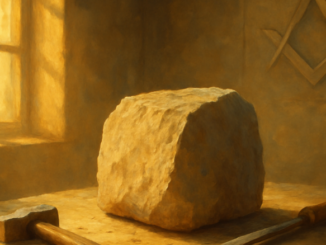
Rough ashlar stone with gavel and chisel symbolizing Masonic character formation
Personal Development & Leadership

Tragedy and Reflection: On the Forming of Character

Sometimes a news headline stops you in your tracks. A twelve-year-old boy killed under violent circumstances. An adult suspect arrested. You read the words, feel the helplessness, and wonder: how can a human being be capable of such a thing? It is precisely in moments like these that the ancient question of human character forces itself upon us — not as an abstraction, but as an urgent search for understanding. The Unfathomable Human Being When confronted with extreme violence, we instinctively reach for explanations. We want to understand what drives a person, what went wrong in the shaping of a personality. The philosopher Aristotle argued that character is not given at birth but formed through repeated actions. You become what you do, again and again. You do not become virtuous by reading about virtue — you become virtuous by acting virtuously. This insight is as comforting as it is unsettling. It means that every human being has the capacity for growth and improvement. But it also implies that wrong choices, repeated over time, can shape a personality capable of terrible deeds. Freemasonry takes this idea profoundly seriously. The Rough Stone as Metaphor In Freemasonry, the rough ashlar is a central […]

Rough ashlar stone with gavel symbolizing Stoic obstacles in Freemasonry
Marcus Aurelius – Freemasonry & Connection

Marcus Aurelius on Obstacles: Stoic Wisdom for Freemasons

In 172 AD, Emperor Marcus Aurelius sat along the Danube frontier, surrounded by war and personal loss, and wrote some of the most penetrating observations ever recorded about the human capacity to transform adversity. His fifth book of the Meditations contains a core insight that still resonates in Masonic lodges around the world nearly two thousand years later: the obstacle becomes the way. This philosophical legacy connects the ancient Stoic tradition with the ongoing pursuit of moral perfection that lies at the heart of Freemasonry. The Historical Context of Book V Marcus Aurelius never intended his Meditations for publication. They were private notes — a journal of self-examination written during one of the most turbulent periods of his reign. Book V emerged during the Marcomannic Wars, a grueling campaign against Germanic tribes that kept the emperor far from Rome, surrounded by death and hardship. And yet, amid all of it, he turned his gaze inward. He asked himself a deceptively simple question: how do I remain a good man when the world around me descends into chaos? This was no rhetorical exercise. Marcus Aurelius buried children, lost trusted advisors, and watched soldiers fall around him. His own health was failing. […]

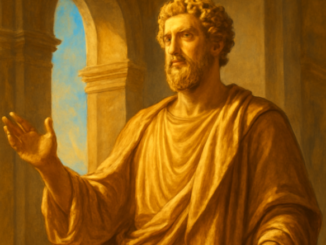
Ancient Roman statue of Marcus Aurelius representing Stoic philosophy and wisdom
Marcus Aurelius – Meditations

Marcus Aurelius Book V: The Philosophy of Overcoming Obstacles

When Marcus Aurelius wrote about overcoming obstacles in the fifth book of his Meditations, he drew on a rich philosophical tradition stretching back to the earliest Stoics in ancient Greece. To the modern reader, his words can feel strikingly relevant. To the Freemason, they carry a particular resonance — echoing the ideal of the rough ashlar that must be shaped and polished through sustained inner effort. But how does the outsider’s reading of these texts differ from that of someone steeped in initiatory traditions? This article compares both perspectives and reveals what they share in the search for meaning. The Stoic Roots of Book V Marcus Aurelius never intended his Meditations for publication. They were personal exercises in the art of living — spiritual journal entries composed, most likely, during gruelling military campaigns along the Danube frontier. Book V breathes the spirit of Stoicism as it was founded by Zeno of Citium around 300 BCE. The core idea is straightforward: we cannot control the external world, but we can control how we respond to it. Obstacles are not enemies — they are teachers. This philosophy reached Marcus Aurelius through a chain of thinkers. Cleanthes and Chrysippus refined Zeno’s teachings, but […]

A mirror reflecting a rough ashlar stone symbolizing Masonic self-examination
Spiritual Traditions

Drug Violence and the Weekend Pill: A Spiritual Mirror

A middle-aged man sits at his kitchen table, shaking his head at yet another news report about a drug-related killing. ‘Terrible,’ he mutters over his morning coffee. That same evening, at a party, he accepts a pill from a friend without a second thought. The moment of moral reflection has vanished like mist in the sun. This everyday scene touches on a profound question that philosophers and spiritual traditions have posed for centuries: how can we truly know ourselves — and what do we do with that knowledge? The Modern Moral Contradiction Many Western societies find themselves in a peculiar moral split. On one hand, there is genuine horror at the violence fueled by the drug trade — assassinations, threats against journalists, lawyers murdered in broad daylight. These events shake our collective conscience. On the other hand, recreational drug use is deeply woven into weekend culture. This contradiction raises a fundamental question: how do we relate to our own role in the larger picture? It is easy to point the finger at criminal organizations, at failed policy, at someone else. It is far more difficult to turn the mirror toward ourselves. And it is precisely in that movement — the […]

Symbolic depiction of prophetic courage and Masonic building tools
Islam

Surah Hud and Prophetic Courage: A Spiritual Lesson

Perhaps you know the feeling: you know what the right thing to do is, but the world around you seems to be pulling in a different direction. You stand alone with your conviction, wondering whether your voice will ever be heard. This very human dilemma lies at the heart of Surah Hud, the eleventh chapter of the Quran. It tells the stories of prophets who swam against the tide, who kept speaking when no one wanted to listen. Their stories are timeless and touch on themes that also hold a central place in Freemasonry: steadfastness, truth, and the courage to follow your inner compass. The Heart of Surah Hud Surah Hud takes its name from the prophet Hud, a figure in the Arabian tradition who was sent to the people of Aad. But the surah reaches far beyond a single prophet. It contains the stories of Noah, Salih, Abraham, Lot, Shu’ayb, and Moses. Each of them confronts a people who refuse to listen — a people clinging to old habits and material certainties. The common thread is unmistakable: the prophets call for justice and spiritual purity, but are met with resistance, mockery, and sometimes outright violence. What makes this surah […]

Rough ashlar stone and chisel symbolizing Masonic self-improvement journey
Personal Development & Leadership

Reckless Actions and the Courage to Admit Your Mistakes

You probably recognize the moment: you say or do something without thinking, and only afterward does it dawn on you how hurtful or inappropriate it was. That painful flash of recognition, followed by the inevitable question — what now? A recent news story about a well-known actor who publicly apologized for mocking a sign language interpreter touches on this deeply universal human theme. The celebrity himself isn’t what matters here. What matters is the question his behavior raises: what does it truly mean to acknowledge your mistakes, and how does doing so shape you into a better person? The Rough Ashlar We All Are In Freemasonry, the rough ashlar plays a central role as a symbol for the individual at the beginning of their inner journey. You enter the lodge as unworked material — full of irregularities, sharp edges, and hidden flaws. The goal is never to deny or conceal these imperfections, but to recognize them and patiently work on them. Every mistake, every thoughtless action, every moment of weakness is like an imperfection in that stone. When someone publicly mocks another person — especially someone performing an essential service for deaf and hard-of-hearing members of the community — it […]

Open copy of Marcus Aurelius Meditations beside Masonic rough ashlar stone
Marcus Aurelius – Content & Summary

Marcus Aurelius Book V: Overcoming Obstacles as an Art

Imagine waking up and facing the day ahead like a mountain you must climb. Everything inside you resists. Your mind searches for excuses, and the warm blankets feel like a safe harbour. It is precisely in moments like these that the Roman Emperor Marcus Aurelius addressed himself with words that still resonate nearly two thousand years later. In the fifth book of his Meditations, he explores how we need not see obstacles as enemies — but as the path itself. The Context of Book V Marcus Aurelius never wrote his Meditations for publication. They were personal exercises in the art of living — private reflections set down during some of the most turbulent years of the Roman Empire. Book V was most likely composed during military campaigns along the Empire’s northern frontiers, amid war, plague, and personal loss. These circumstances make the text all the more powerful: this is not a philosopher speaking from an ivory tower, but a man confronting the harshest realities of existence on a daily basis. The book opens with a passage that almost everyone can relate to. Marcus describes the moment of waking, when the temptation to stay in bed is at its strongest. He […]

Ancient compass symbolizing Stoic philosophy and Masonic inner direction
Lucius Annaeus Seneca – Letters to Lucilius

Seneca and Stoic Philosophy: Ancient Roots of Masonic Wisdom

A compass always points north, no matter where you stand or how lost you feel. For Lucius Annaeus Seneca, philosophy served exactly this purpose — not as a collection of abstract theories, but as a reliable guide that gives the soul direction in times of uncertainty. In his sixteenth letter to Lucilius, he unfolds this idea with an urgency that still resonates today. But what intellectual traditions shaped Seneca’s conviction that philosophy is indispensable for a life well lived? And what can Freemasons recognize in this ancient quest for an inner compass? The Stoic Foundation of Seneca’s Thought Seneca wrote from the heart of Roman Stoicism, a philosophical school founded around 300 BCE by Zeno of Citium in the painted colonnade of Athens. Stoicism taught that a person can only be truly free when they master their inner disposition, regardless of external circumstances. This core idea permeates Letter XVI entirely. In essence, Seneca reaffirms what Zeno, Cleanthes, and Chrysippus had articulated centuries earlier: happiness does not lie in what happens to us, but in how we respond to it. Yet Seneca was no slavish follower. He adapted the rigorous Greek Stoa for Roman life, where political power, wealth, and social […]

Rough ashlar stone with hammer and chisel symbolizing Masonic character building
Marcus Aurelius – Freemasonry & Connection

Marcus Aurelius on Duty: The Stone as a Symbol of Character

Every morning, before the first light slips through the window, every human being faces the same inner struggle. The warmth of the bed pulls at us while the day and its obligations wait. In Book V of his Meditations, Marcus Aurelius describes exactly this moment — the instant when character is forged. For Freemasons, this struggle resonates with a deeply rooted symbol: the working of the rough stone. Both traditions understand that the fulfillment of duty is not a burden but the very hammer with which we shape ourselves into something enduring. Waking Up as a Moral Turning Point Marcus Aurelius opens Book V with a scene every reader recognizes. He addresses himself at the break of day: rise, for you were made for the work that befits a human being. The emperor does not philosophize from an ivory tower but from the mud of military campaigns and the weight of administrative burdens. His words carry the gravity of lived experience. In his writing, this daily act of waking becomes a metaphor for a greater awakening. Not only must the body rise, but the mind must orient itself toward its true calling. In Freemasonry, we find a kindred idea: the […]

Open book with classical philosophy texts symbolizing Montaigne's essays
Michel de Montaigne – Philosophical Background

Montaigne on Profit and Loss: Tracing the Philosophical Roots

When Michel de Montaigne argues in his twenty-first essay that one man’s profit is another man’s loss, he draws upon a rich philosophical tradition stretching back centuries. This short but influential essay reflects not only the economic turmoil of sixteenth-century France but also the voices of Seneca, Plutarch, and Stoic philosophy. How did Montaigne relate to these thinkers, and what can we still learn today from their dialogue about greed, temperance, and human relationships? The World of the Renaissance Humanist To understand Montaigne’s essay, we must immerse ourselves in the intellectual climate of the French Renaissance. Scholars were rediscovering classical texts from Greek and Roman antiquity on a massive scale. Montaigne, born in 1533, grew up with Latin as his first language. His father ensured he could read the classics as naturally as other children read fairy tales. This upbringing made him a true humanist — someone who regarded the wisdom of the Ancients not as dead knowledge but as a living guide for daily life. Renaissance humanism was defined by a return to the source: the original Greek and Latin texts, stripped of medieval interpretations. Erasmus had paved the way with his rediscovery of the New Testament in Greek. […]

Rough ashlar and open book symbolizing Locke's blank slate in Freemasonry
Symbolism & Rituals

Voltaire on Locke: The Soul as a Blank Slate

In a dimly lit London study sometime in the 1720s, a young French exile bent over the works of an English philosopher who had died just decades earlier. François-Marie Arouet — better known as Voltaire — discovered in the writings of John Locke a revolutionary idea: the human mind is born a blank slate. No innate ideas, no predetermined truths, only the pure possibility of growth through experience. This discovery would change Voltaire forever, and it forms the heart of his third philosophical letter. The Context of Voltaire’s Exile When Voltaire lived in England between 1726 and 1728, he was fleeing not only the Bastille but also the suffocating intellectual climate of Louis XV’s France. In England, he encountered a society where freethinkers could debate openly, where Isaac Newton’s science was celebrated, and where John Locke’s philosophy was considered common knowledge. He later gathered these experiences into his Philosophical Letters, a collection of essays that introduced English thought to the French public. The third letter, devoted to Locke, stands out because Voltaire does more than simply report on scientific discoveries. He poses a fundamental question about human nature itself: Who are we, and how do we arrive at our knowledge? […]

Rough ashlar stone symbolizing inner beauty and Masonic self-improvement
Personal Development & Leadership

Cosmetic Surgery and Inner Beauty: A Masonic Perspective

In a dimly lit lodge room, an older Freemason leans toward a younger brother. ‘See those cracks in the ceiling?’ he asks quietly. ‘Some want to plaster over them, but they tell the story of this building. Without those lines, it would be a soulless space.’ The younger brother nods thoughtfully — while outside, the world grows ever more obsessed with erasing every perceived flaw. A Fivefold Increase That Raises Deeper Questions Reports of botched cosmetic procedures involving injectable treatments have increased fivefold in recent years. Behind that statistic lie personal tragedies: people who sought enhancement and ended up with scars, infections, or permanent disfigurement. But perhaps behind this troubling trend lies a deeper question — one that touches the very core of what it means to be human. Why are we so willing to risk our health for an appearance that conforms to some external ideal? The philosopher Michel de Montaigne wrote in the sixteenth century about the human compulsion to correct what is imperfect. In his essays, he reflected on the paradox that we often place more value on what others think of us than on who we truly are. That observation is more relevant today than ever. […]

Rough ashlar stone resting in stillness, symbolizing Masonic spiritual practice
Spiritual Traditions

Stillness as Spiritual Practice: Masonic Lessons from Impasse

When political negotiations grind to a halt and progress seems like a distant mirage, the instinctive reaction is frustration. We want movement, results, forward momentum. But for those who have learned to look beneath the surface, an apparent impasse can reveal an ancient secret that builders and philosophers have cherished for centuries: stillness as a gateway to genuine transformation. The Stone That Does Not Move Picture a rough ashlar. It sits there, unworked, seemingly useless. Days pass, perhaps weeks, and nothing appears to happen. The untrained eye sees only stagnation — an obstacle, raw material that stubbornly refuses to become what it should be. Yet every stonemason knows that this period of rest is far from empty. The stone is being studied, measured, and carefully considered. The craftsman contemplates where the chisel must fall, which forms lie hidden within the rough material. The same dynamic plays out on the political stage whenever negotiations seem to stall. Commentators see no grand gestures, no breakthroughs, and declare the process broken. But is the absence of visible action truly the same as the absence of meaning? Freemasonry teaches us that the answer is far more complex than it first appears. Patience as a […]

Ancient Roman bust symbolizing Marcus Aurelius and Masonic inner retreat
Marcus Aurelius – Freemasonry & Connection

Marcus Aurelius and Freemasonry: The Art of Inner Retreat

There is a remarkable kinship between the Stoic wisdom of a Roman emperor and the ritual practice of an ancient fraternity. When Marcus Aurelius writes about retreating into oneself in Book IV of his Meditations, he touches upon a theme that also runs deep within Freemasonry. How do these two traditions — separated by nearly two thousand years — relate to one another? And what can they still teach us today about the art of finding inner peace in a restless world? The Stoic Perspective: The Citadel of the Mind Marcus Aurelius never intended his Meditations for publication. They were personal notes, often written at the front lines during military campaigns. In Book IV, he unfolds a core idea that underpins his entire philosophy: a person can, at any moment and regardless of circumstances, retreat into their own inner world. He compares the mind to a citadel — an impregnable fortress that can only be surrendered from within. The outside world, with all its chaos and demands, has no real power over our inner state unless we voluntarily hand that power over. For the Roman emperor, this was no idle philosophical exercise. He ruled a vast empire and faced wars, […]

Ancient rough stone being shaped by chisel symbolizing Stoic moral improvement
Lucius Annaeus Seneca – Content & Summary

Seneca Letter 11: On Blushing, Shame, and Moral Nobility

There comes a moment when the cheeks flush without permission. A wave of heat rises through the face, as uncontrollable as the tide. In his eleventh letter to Lucilius, the Stoic philosopher Seneca examines this remarkable phenomenon — the blush of shame. But beneath this physical reaction lies a far deeper inquiry: one about the nature of virtue, the inner voice that guides our conduct, and the presence of a wise witness within our minds. What does this blushing reveal about who we truly are? The Involuntary Blush as a Mirror of the Soul Seneca opens his letter with an observation that is both simple and profound: even the most seasoned orators can blush when they stand before a crowd. Even those accustomed to public performance sometimes feel that irresistible warmth rising to their faces. This is not a weakness, the Stoic philosopher insists, but a quality of nature that even the wisest person cannot entirely suppress. The body has its own language — a language that does not always obey the commands of reason. The blush reveals something essential about our humanity: that we are not purely rational beings, but also creatures of flesh with reactions rooted deep within […]

Marcus Aurelius bust symbolizing Stoic philosophy and Masonic virtue
Marcus Aurelius – Freemasonry & Connection

Marcus Aurelius on the Good: Living According to Nature

What did Marcus Aurelius actually mean when he wrote about living in accordance with nature? And why does this ancient idea resonate so deeply with what Freemasons strive for? In the third book of his Meditations, the Roman emperor unfolds a vision of the good that remains strikingly relevant today. These are thoughts worth exploring together — as seekers of truth have always done. What Did Marcus Aurelius Mean by ‘Nature’? This is perhaps the first question that arises when reading Book III. Marcus Aurelius speaks constantly about living according to nature, but he does not mean the romantic ideal of untouched forests and flowing rivers. For the Stoics, nature carried a far deeper meaning: the rational order that permeates the universe, the logos that connects all things. The emperor saw each person as part of a greater whole. When we act in harmony with our rational nature, we act rightly — almost by definition. This may sound abstract, but its practical implication is remarkably clear: to live virtuously means to recognize and fulfill your role in the larger fabric of existence. Is this not precisely what a Freemason pursues when working on his rough ashlar? The Connection Between Stoic […]

Ancient Greek philosophers debating virtue in a classical setting
Plato – Content & Summary

Plato’s Protagoras: Can Virtue Be Taught?

Before dawn, young Hippocrates pounds on the door of Socrates, his eyes blazing with excitement. The famous sophist Protagoras has arrived in Athens, and Hippocrates is desperate to become his student. But Socrates asks a question that changes everything: what exactly do you expect to learn? This moment launches one of Plato’s most vivid dialogues — a work that wrestles with a question as urgent today as it was in ancient Athens: is virtue something that can be taught, or is it an innate quality that some simply possess and others do not? The Encounter Between Socrates and Protagoras In the luxurious home of the wealthy Callias, Socrates meets the renowned sophist Protagoras, surrounded by admiring students and other celebrated thinkers such as Hippias and Prodicus. Protagoras is no ordinary teacher — he charges substantial fees for his instruction and claims he can train young men to become better citizens. Socrates, ever the critical questioner, issues a challenge: if virtue can truly be taught, why do great statesmen consistently fail to make their own sons as virtuous as themselves? This is no mere academic exercise. It strikes at the heart of what it means to be a good person and […]

Overturned coach on a mountain road symbolizing Masonic brotherhood in crisis
Personal Development & Leadership

When the Coach Overturns: Brotherhood in Times of Disaster

The mountain air is still crisp when the coach begins its descent. Thirteen travelers — strangers to one another — share the same wooden bench, the same sweeping views of Alpine peaks. Then everything tips. In a split second, strangers become companions in fate, bystanders become rescuers, and somewhere in the chaos, something unfolds that Freemasons recognize instinctively: the true nature of brotherhood. A Mountain Road as a Metaphor for Life The tragic accident in the Swiss Alps — one dead, twelve injured — shocks us. But beneath the headlines lies a deeper layer of meaning. Anyone who has walked a mountain trail knows the path is rarely predictable. Rocks shift, weather turns, and what seemed stable can give way in the blink of an eye. This is not merely a physical reality; it is a spiritual truth that Freemasons have acknowledged for centuries. In Freemasonry, we speak of life as a journey from rough to polished. The rough ashlar we symbolically receive at our initiation must be shaped through experience, reflection, and trial. No one chooses to face those trials in the form of an overturned coach on an Alpine pass. Yet it is precisely in such moments that […]