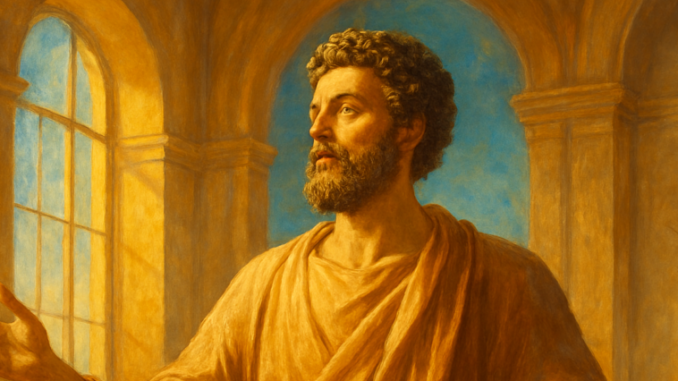
What is your place in the grand scheme of things? It’s a question that has occupied human minds for centuries — from Roman emperors to modern-day seekers of truth. In Book X of his Meditations, Marcus Aurelius invites us to view the world from a cosmic perspective. It’s an invitation that resonates deeply with the core of Freemasonry: the quest for connection, both with ourselves and with the world around us.
The Eagle’s View
Marcus Aurelius was no armchair philosopher. As Roman Emperor, he stood at the center of an empire engulfed in war, political intrigue, and relentless daily responsibilities. Yet he found time to reflect deeply on the nature of existence. In Book X of his Meditations, he describes the value of viewing yourself from above — as if soaring like an eagle over a vast landscape, watching the bustle of human life below. From that vantage point, your worries shrink and your sense of connection expands.
This cosmic perspective is not an escape from reality. It is, in fact, a way to see more clearly what truly matters. Marcus Aurelius writes that everything in existence is part of one interconnected whole. You, me, the stars above — we are all woven into the same cosmic fabric. This idea is not merely comforting; it also carries an obligation. If we are part of something greater, we bear a responsibility toward that greater whole.
Connection as a Masonic Value
For Freemasons, connection is a foundational principle. The Brotherhood is built on the idea that people, regardless of background, are united by shared values. In the Lodge, men meet as equals rather than rivals. They work together toward self-improvement and the betterment of the world. This is precisely what Marcus Aurelius means when he speaks of humankind as part of a larger organism.
The cosmic perspective teaches us that brotherhood is not a choice we make — it is a recognition of what already exists: our inseparable bond with all living things.
The Stoic philosophy of Marcus Aurelius and the Masonic tradition share a striking conviction: personal growth and social responsibility go hand in hand. You cannot truly improve yourself without regard for your fellow human beings. And conversely, you cannot improve the world without first working on yourself.
Virtue as a Compass
In Book X, Marcus Aurelius emphasizes that the cosmic perspective should not lead to apathy. On the contrary — it should inspire us to act virtuously, precisely because our actions are part of the greater whole. Every choice you make, however small, ripples outward into the world. This awareness lends weight and meaning to your daily conduct.
Freemasons often speak of working on the “rough ashlar” — a symbol for the imperfect individual who, through self-reflection and practice, becomes ever more refined. Marcus Aurelius would have recognized this metaphor immediately. He regarded life as a continuous exercise in self-improvement — not to achieve perfection, but to draw closer to one’s own potential. The cosmic perspective supports this endeavor by reminding us what truly holds value: not fame or fortune, but character and integrity.
Seeking Light in Darkness
Both in Stoic tradition and in Freemasonry, light plays a central role. For Marcus Aurelius, light is a metaphor for insight and clarity. The cosmic perspective acts as a torch that dispels the darkness of ignorance and narrow-mindedness. When you place yourself and your problems within a larger context, the shadows become far less frightening.
In Masonic ritual, the candidate is symbolically led from darkness into light. This is far more than a theatrical gesture. It represents the inner journey from ignorance to knowledge, from confusion to clarity. Marcus Aurelius would have understood and appreciated this symbolism deeply. His entire philosophy revolves around finding inner light, even amidst the chaos of the imperial court.
Practical Wisdom for Today
What can we learn from Book X in our own time? The cosmic perspective is not abstract philosophy meant to gather dust on a shelf. It is a practical tool for daily life. When you feel overwhelmed by problems, try stepping back. View the situation from above. Ask yourself: how important will this be in a year? In ten years? In a hundred?
This doesn’t mean trivializing your problems. It means placing them in perspective. And that perspective creates space for what truly matters: your relationships, your integrity, your contribution to the world. Freemasons sometimes call this “building the temple of humanity” — the understanding that with every action, you are constructing something greater than yourself.
Consider adopting these daily practices inspired by Marcus Aurelius and the Masonic tradition: Take a moment each day to place your worries in cosmic perspective. Ask yourself whether your actions contribute to the greater whole. Seek connection with others — not as a strategy, but as a recognition of shared humanity. Work on your own character, knowing that inner growth radiates outward into the world.
A Timeless Message
Marcus Aurelius wrote his Meditations nearly two thousand years ago, yet his words remain strikingly relevant. The human condition has not fundamentally changed. We still wrestle with the same questions about meaning, connection, and virtue. The cosmic perspective offers no ready-made answers, but it opens a space where those questions sound different — less oppressive, more liberating.
For Freemasons, this is familiar territory. The Lodge is a place where great questions may be asked without ready answers being imposed. It is about the journey, not the destination. Marcus Aurelius would have felt at home in that space. His philosophy, like Masonry itself, is a lifelong practice of seeking — always moving toward the light, always refining the rough stone, always remembering that we are part of something infinitely larger than ourselves.
The intersection of Stoic philosophy and Freemasonry reveals a profound truth: we are not isolated beings navigating a meaningless world. We are threads in a vast cosmic tapestry, each contributing to a pattern greater than we can fully perceive. Whether you encounter this idea through the writings of a Roman emperor or through the rituals of the Lodge, the message is the same — look upward, look inward, and never forget your connection to the whole. In that awareness lies both our greatest responsibility and our deepest source of meaning.
Copyright text & image: devrijmetselaar.nl
Texts are based on the ideas and content of the author of devrijmetselaar.nl, reviewed, corrected, and supplemented with the assistance of OpenAI. Images are created based on the ideas of the author of devrijmetselaar.nl using OpenAI/DALL-E.

Be the first to comment