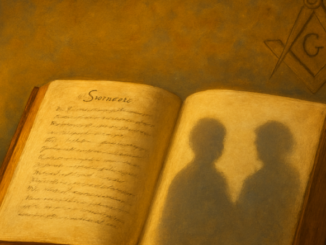
Open book with Montaigne essays and Masonic square and compasses symbol
Michel de Montaigne – The Essays

Montaigne on Negotiation: Philosophical Sources Explored

When you face a difficult choice, where do you turn for guidance? In the sixteenth century, a French nobleman asked himself the very same question. Michel de Montaigne wrote his fifth essay about military commanders who had to decide whether to negotiate during a siege. Behind this seemingly practical question lies a rich philosophical tradition that remains surprisingly useful today — not least for those who walk the path of self-improvement and moral reflection. The Question Beneath the Question At first glance, Montaigne is dealing with a military problem: is it honorable for a commander to launch a sortie while negotiations are underway? But read a little deeper, and you discover a timeless ethical puzzle. How do you act with integrity when circumstances are uncertain? When does caution become wisdom, and when does it slide into cowardice? These questions connect directly to everyday life. Imagine you are in conversation with someone about a conflict, and you suddenly discover new information that changes the game entirely. Do you use that knowledge? Do you hold back? The dilemma of the besieged commander is recognizable to anyone who has ever had to choose between tactical advantage and personal integrity. Stoic Roots of the […]

Open book with classical philosophy text symbolizing Montaigne and Freemasonry
Michel de Montaigne – The Essays

Montaigne on Passions and False Objects: Philosophical Roots

In the fourth essay of his first book, Michel de Montaigne investigates a curious phenomenon: how the human soul directs its emotions toward objects that are not the true cause of those feelings. This insight did not arise in a vacuum. Montaigne drew deeply from a long philosophical tradition reaching back to Greek and Roman thinkers. The question of how we handle our passions — and why we sometimes aim them at the wrong targets — had occupied philosophers for centuries before Montaigne ever picked up his pen in his tower library in Bordeaux. The Stoic Legacy: Mastery Over Emotion The influence of Stoicism on Montaigne’s thinking is especially tangible in this essay. The Stoics — notably Seneca and Epictetus — argued that human suffering does not arise from external events, but from the judgments we form about them. When we feel anger toward an object that has hurt us, or when we direct grief at a symbol rather than the real cause, we are demonstrating precisely what the Stoics meant: our passions are often misplaced. Seneca wrote at length about how anger can seduce us into irrational behavior. In his treatise On Anger, he gave countless examples of people […]

Montaigne's tower study with candles and manuscripts symbolizing self-reflection
Michel de Montaigne – The Essays

Montaigne and the Philosophy of Feelings That Transcend Us

It is a cool evening in 1572. In his tower study in Bordeaux, a man sits hunched over yellowed manuscripts. Candle wax drips onto passages of Seneca, the margins filled with his own annotations. He asks himself: why do we grieve for people we barely knew? Why do our feelings reach beyond our immediate experience? This seemingly simple question would grow into one of the most penetrating essays of the Renaissance. Michel de Montaigne drew upon a rich philosophical heritage for this third essay — a heritage that continues to inspire Freemasons in their pursuit of self-knowledge to this day. The Stoic Legacy: Emotions Under the Microscope Montaigne‘s inquiry into the reach of human feeling is deeply rooted in Stoic philosophy. Seneca, the Roman philosopher and statesman, was his most important teacher from across the centuries. In his letters to Lucilius, Seneca explored at length how emotions can overwhelm us and how we might deal with them wisely. The Stoic ideal of apatheia — freedom from disruptive passions — fascinated Montaigne, but he did not embrace it fully. Instead, he used it as a starting point for his own, more nuanced view of emotional life. The Stoics taught that our […]

Open book with Montaigne's Essays beside Masonic square and compasses in soft light
Michel de Montaigne – The Essays

Montaigne on Grief: Philosophical Roots and Masonic Symbolism

There comes a moment when words fail. A moment when the soul is so overwhelmed by sorrow that it freezes, falls silent, or erupts in a flood no one anticipated. Michel de Montaigne wrote about precisely this in his second essay — a brief but deeply penetrating exploration of the limits of human emotion. Beneath its seemingly simple subject lies a rich philosophical inheritance stretching from the Greek Stoics to Renaissance humanism. And for those accustomed to thinking in symbols, it opens a world of meaning that reaches far beyond the surface of everyday experience. The Silent Voice of the Stoics Montaigne‘s reflections on grief are unthinkable without Stoic philosophy. This school of thought, born in third-century Athens, taught that emotions are the result of the judgments we make about reality. Sorrow does not arise from what happens to us, but from how we interpret it. Seneca, the Roman philosopher whom Montaigne so frequently quotes, wrote extensively about the art of dealing with loss and adversity. He insisted that the wise person does not suppress emotions but learns to understand them. In his essay on sadness, however, Montaigne takes a more nuanced position. He observes that extreme emotions sometimes paralyze […]