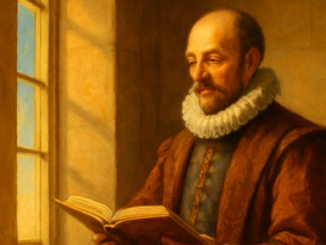
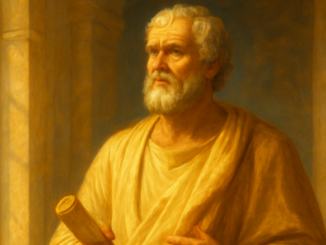
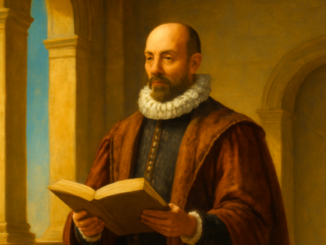
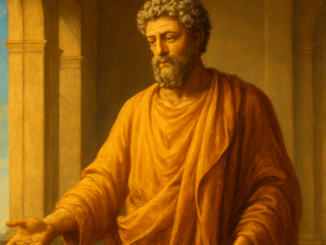
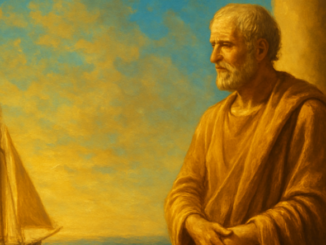
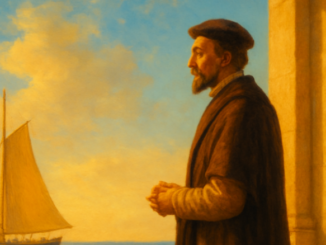
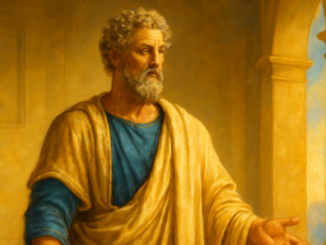
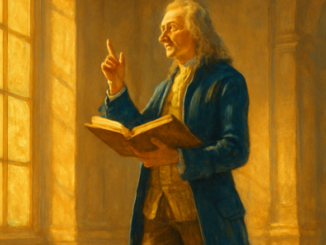
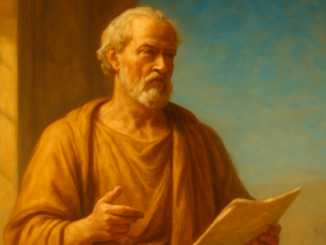
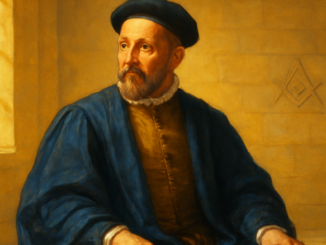
Ancient Greek dialogue scene representing Plato's Meno and the pursuit of virtue
Plato – Content & Summary

Plato’s Meno: Virtue and Knowledge as Foundations for Growth

In fifth-century Athens, a young aristocrat named Meno posed a question that philosophers have grappled with ever since: can virtue be taught, or is it an innate quality? Plato recorded this exchange in a dialogue that not only explores the foundations of ethics but also introduces a revolutionary theory of knowledge. The Meno remains one of the most accessible yet profoundly deep works in Western philosophy — a text that compels us to reflect on what we truly know and how we can become better people. For those on the Masonic path, where self-improvement and the pursuit of wisdom stand at the very heart of the Craft, this ancient dialogue holds remarkable resonance. The Central Question of the Dialogue The Meno opens with a direct and seemingly simple question from its title character to Socrates: is virtue something that can be taught, does it come through practice, or is it naturally present in human beings? True to his method, Socrates refuses to answer the question before first establishing what virtue actually is. This leads to an inquiry characteristic of Plato’s early dialogues — the dismantling of false certainties to create space for genuine understanding. Meno makes several attempts at a […]

Marcus Aurelius statue symbolizing Masonic presence and self-reflection
Marcus Aurelius – Freemasonry & Connection

Marcus Aurelius on the Here and Now: Freemasonry & Connection

You probably know the feeling: you’re sitting in a conversation, but your mind has already drifted to tomorrow. You’re walking through the city, but you’re mentally somewhere else entirely. The present moment sometimes feels like the hardest place to truly inhabit. Marcus Aurelius, the Roman emperor-philosopher, wrestled with exactly the same challenge more than eighteen centuries ago. In the second book of his Meditations, he wrote some of his most penetrating thoughts on presence and connection. For Freemasons, his words touch on something essential — the question of how to be truly present, both for yourself and for your Brothers. The Burden of Past and Future Marcus Aurelius never wrote his Meditations for publication. They were private notes — a conversation with himself. That’s precisely why they feel so raw and honest. In Book II, he confronts himself with the waste that occurs when the mind constantly slips away to what has been or what is yet to come. He reminds himself that the present is the only thing anyone truly possesses. The past is gone, the future uncertain. Only this moment offers space for action, for growth, for genuine connection. This wasn’t idle philosophizing. For Marcus Aurelius, it was […]

Golden city of El Dorado symbolizing Masonic ideals and Voltaire's philosophy
Symbolism & Rituals

Voltaire’s El Dorado: Utopia as a Mirror for Freemasonry

What would a perfect society look like? A place where greed holds no power, where people treat each other with genuine respect, and where wisdom matters more than wealth. Voltaire imagined exactly such a world in his masterpiece Candide, in the legendary kingdom of El Dorado. But was this golden land meant as a blueprint for humanity — or as a sharp mirror reflecting our deepest flaws? And what does an eighteenth-century literary utopia have to do with the ideals that Freemasons continue to cherish today? A Golden City That Doesn’t Exist In Candide, the naïve protagonist stumbles into El Dorado after a long string of misfortunes. It is a hidden kingdom where gold and gemstones litter the streets as though they were ordinary pebbles. The inhabitants laugh at Candide’s astonishment. What value does gold have when everyone already has enough? Voltaire doesn’t present this paradise as a serious proposal for how society should be organized. Instead, he uses it as a stark contrast to the world he saw around him — the cruelty, the wars, the religious intolerance of his era are inverted in El Dorado into their exact opposite. And yet, Candide leaves this paradise voluntarily. He wants […]

Symbolic representation of trust and brotherhood in Freemasonry
Lucius Annaeus Seneca – Freemasonry & Connection

Seneca on True Friendship and Brotherhood in Freemasonry

Have you ever shared a secret with someone you weren’t entirely sure you could trust? Or perhaps you’ve kept someone at arm’s length — someone who actually deserved your full openness? Nearly two thousand years ago, the Stoic philosopher Lucius Annaeus Seneca wrote a short but powerful letter to his friend Lucilius about precisely this dilemma. His reflections on true friendship cut to the heart of what it means to be genuinely connected to another person. And remarkably, they align seamlessly with one of the central values of Freemasonry: brotherhood. Trust Must Come Before Friendship — Not After Seneca opens his third letter with a warning that still resonates today. He argues that you should never trust someone first and only then consider whether they are worthy of that trust. Instead, you must carefully evaluate who you allow into your life — and then give your trust completely. Stopping halfway, Seneca insists, is worse than never beginning at all. This distinction between shallow acquaintances and deep friendships forms the backbone of his argument. For anyone who has ever visited a Masonic lodge, this will sound familiar. Freemasonry has no room for half-hearted bonds. When a candidate is initiated, he enters […]

Ancient Greek philosopher in contemplation symbolizing Freemasonry and Plato
Plato – Freemasonry & Connection

Plato’s Phaedo and Freemasonry: A Shared Quest for Light

Imagine sitting in a room with your closest friends, knowing this conversation will be your last. What would you want to talk about? For Socrates, in the final hours before his death, the answer was clear: the immortality of the soul and the meaning of a life well lived. In Plato’s dialogue Phaedo, we find not only a philosophical masterpiece on life and death, but also a wellspring of insights that resonate remarkably with the core principles of Freemasonry. The Setting of a Final Farewell The Phaedo unfolds in Socrates’ prison cell on the day of his execution. His students — Phaedo, Simmias, Cebes, and others — gather around their teacher for one last conversation. What follows is neither a lament nor a bitter goodbye, but a calm, profound exploration of what it means to live and die as a philosopher. Socrates faces his own death with a serenity that both astonishes and inspires his companions. This composure is not indifference or denial. It is the fruit of a life devoted to self-reflection and the pursuit of truth. Socrates spent his entire existence examining the human condition, asking difficult questions, and challenging false certainties. Now, at the end, he reaps […]

Ancient Roman oil lamp illuminating a writing tablet with Masonic symbols
Marcus Aurelius – Meditations

Marcus Aurelius and the Present Moment: Philosophical Roots

An oil lamp flickers softly as a Roman emperor, weary after a day of warfare on the northern frontiers, reaches for his writing tablet. It is deep into the night, somewhere around 170 AD. Marcus Aurelius begins to write — not for publication, but for himself. Sentences about impermanence, the present moment, the urgent need to live now. Where did these thoughts originate? What philosophical currents shaped this imperial mind that continues to inspire millions to this day? The Stoic Roots of the Present Moment In Book II of his Meditations, Marcus Aurelius turns with remarkable intensity to the theme of living in the here and now. This focus was no casual whim but the product of centuries of Stoic philosophical tradition. The Stoic school, founded by Zeno of Citium around 300 BC, developed a philosophy centered on mastering one’s own thinking. Marcus Aurelius inherited this tradition through a chain of teachers and writings stretching back to Greek antiquity. At the heart of Stoic thinking about time lies a fundamental insight: only the present moment is truly ours. The past is gone and unchangeable; the future is uncertain and beyond our control. Epictetus, the former slave whose teachings Marcus Aurelius […]

Symbolic golden city of El Dorado representing Voltaire's philosophical utopia
Symbolism & Rituals

Voltaire and El Dorado: Philosophical Roots of the Utopia

In 1759, Voltaire published his satirical masterpiece Candide, in which the naïve protagonist stumbles upon a seemingly perfect land: El Dorado. This golden realm, hidden deep in the mountains of South America, serves as a philosophical mirror held up to European society. But which thinkers and intellectual currents shaped Voltaire’s vision of this utopia? The roots stretch from Plato’s ideal state to the Renaissance humanists, touching upon questions that Freemasons have grappled with for centuries: how do we build a better world? The Utopian Tradition Before Voltaire The concept of an ideal society has a long history in Western thought. Plato, in his Republic, envisioned a community governed by philosopher-kings, where justice reigned as the supreme virtue. This vision remained influential for centuries, inspiring generations of thinkers to formulate their own societal ideals. In 1516, Thomas More published Utopia, describing a fictional island where private property did not exist and religious tolerance prevailed. The very title became synonymous with any imagined perfect land. Voltaire knew these works intimately. As a voracious reader and tireless correspondent with intellectuals across Europe, he had access to the entire utopian canon. Tommaso Campanella’s The City of the Sun and Francis Bacon’s New Atlantis were […]

Open book with quill pen symbolizing Montaigne's philosophical essays
Michel de Montaigne – Philosophical Background

Montaigne on Ambassadors: Philosophical Roots of Diplomacy

A letter arrives. A messenger awaits instructions. A prince must decide how much freedom to grant his envoy. What appears to be a straightforward question about diplomatic communication conceals a far deeper philosophical inquiry — one that captivated Michel de Montaigne: how much trust does a person deserve, and where lies the boundary between obedience and independent judgment? The philosophical traditions that shaped Montaigne’s thinking, from Stoicism to Renaissance humanism, cast a remarkable light on this sixteenth essay from his first book. The Stoic Undercurrent When Montaigne writes about the conduct of ambassadors, the voice of Seneca resonates unmistakably through the text. The Roman philosopher, whose letters to Lucilius Montaigne had studied so thoroughly, constantly emphasized the importance of practical wisdom over blind adherence to rules. Seneca warned that those who merely carry out orders without understanding are not truly acting — they are merely moving. This idea saturates Montaigne’s analysis of the envoy who must choose between the literal wording of his instructions and the spirit of his mission. Stoicism taught that the wise person judges situations by their true nature, not by their outward appearance. Marcus Aurelius wrote in his personal meditations that one should ask of every […]

Ancient Greek philosopher Socrates discussing the immortality of the soul
Plato – Content & Summary

Plato’s Phaedo: The Soul and Its Immortality Explained

What happens to the soul when the body dies? Is death the final chapter, or does it mark a transition to something greater? These questions are not merely philosophical curiosities — they touch the very core of human existence. In the Phaedo, one of his most profound dialogues, Plato invites us into the final hours of Socrates, who is about to drink the hemlock. What follows is not a eulogy steeped in sorrow, but a lucid argument for the immortality of the soul. Why Did Plato Write This Dialogue? The Phaedo is far from an abstract treatise detached from real life. On the contrary, Plato situates his most profound reflections on the soul precisely within the context of his master Socrates’ death. This deeply personal setting lends the question of immortality an emotional urgency that no theoretical exercise could achieve. Socrates’ friends are gathered in his cell, torn between grief and an almost desperate curiosity. They want to know: is this truly the end? Plato uses this dramatic setting to weave philosophy together with existential reality. The dialogue demonstrates that wisdom is not an escape from life, but rather a way of confronting death head-on. Socrates does not speak as […]

Montaigne essay on envoys and the Masonic balance of obedience and judgment
Michel de Montaigne – Content & Summary

Montaigne on Envoys: When Obedience Falls Short

What happens when a messenger carries out his orders to the letter, without stopping to consider whether circumstances have changed? Michel de Montaigne poses this question in his brief but provocative essay ‘On the Custom of Some Ambassadors.’ His answer touches on a fundamental tension that resonates deeply within Freemasonry: the balance between obedience and personal judgment. What Is This Essay Really About? In the sixteenth essay of Book One of his Essays, Montaigne examines the role of envoys and ambassadors in diplomatic missions. Though it is one of his shorter reflections, the central question is far from simple. Montaigne asks to what extent an envoy has the right — or even the duty — to deviate from his literal instructions when the situation demands it. Should a messenger obey blindly, or should he use his own insight to better serve the intentions of the one who sent him? The essay was written in an age when diplomacy was a perilous affair. Communication was slow, decisions often had to be made on the spot, and a single miscalculation could mean the difference between war and peace. Montaigne knew this world from the inside. As a former mayor of Bordeaux and […]

Ancient Roman bust of Marcus Aurelius symbolizing Stoic wisdom and Freemasonry
Marcus Aurelius – Freemasonry & Connection

Marcus Aurelius and Impermanence: What Truly Connects Us?

Why would a Roman emperor from the second century still have something meaningful to say about human connection? And what does his reflection on the brevity of life have to do with the brotherhood that Freemasons strive for? In the second book of his Meditations, Marcus Aurelius confronts himself with an uncomfortable truth: everything passes, including ourselves. Yet within that very acknowledgment lies a surprising lesson about what truly binds us together as human beings. What Does Marcus Aurelius Actually Mean by Impermanence? Let us first consider what the emperor actually writes. In Book II of the Meditations, Marcus Aurelius describes how everything we know passes like waves on a river. Our bodies decay, our names are forgotten, and even the memory of our deeds eventually fades. This may sound bleak, but for the Stoic, it is no cause for despair. It is an invitation to clarity. The impermanence Marcus Aurelius describes is not nihilism. It is a call to distinguish between what is truly valuable and what is merely appearance. Fame, possessions, power — these are fleeting things. But virtue, character, and the way we treat others carry a different quality. Not because they last forever, but because they […]

Open book with garden and rough ashlar symbolizing Voltaire and Freemasonry
Symbolism & Rituals

Voltaire’s Candide: Why the Pursuit of Good Remains a Struggle

What does it truly mean to pursue the good in a world full of setbacks? Voltaire posed this question more than 250 years ago in his famous satirical novel. Today, we revisit that question — not as literary historians, but as seekers looking for the connection between philosophical insight and the values that Freemasonry holds dear. This is a reflection on optimism, virtue, and the inevitable struggle that accompanies the good life. Why Did Voltaire Take Aim at Naïve Optimism? Voltaire lived during a period of sweeping intellectual transformation. The Enlightenment ushered in a new faith in reason, but also in the notion that we inhabit “the best of all possible worlds.” This brand of optimism, popularized by the philosopher Gottfried Wilhelm Leibniz, was demolished by Voltaire with biting irony. His protagonist Candide travels through a world ravaged by war, natural disasters, and human cruelty, while his tutor Pangloss insists that everything is for the best. But was Voltaire a pessimist? That would be too simple. Voltaire did believe in progress — but progress that must be fought for. The good does not arise on its own. It demands effort, reflection, and the deliberate cultivation of virtue. And it is […]

Open book with Masonic square and compasses symbolizing wisdom and reflection
Lucius Annaeus Seneca – Freemasonry & Connection

Seneca on Reading and Inner Peace: A Masonic Reflection

Can a person truly find peace of mind by reading voraciously — or does that restless hunger for the next book actually work against the very calm we seek? This paradox, set down nearly two thousand years ago by the Stoic philosopher Lucius Annaeus Seneca in his second letter to Lucilius, touches a tension that Freemasons know well. The search for knowledge and light stands among the most exalted ideals of the lodge, yet when does that noble search tip over into mere distraction? Seneca’s words invite a philosophical exploration that proves remarkably relevant for anyone who takes brotherhood, wisdom, and inner growth seriously. Less Is More: Seneca’s Counterintuitive Warning Seneca opens his second letter with advice that cuts against the grain. He cautions his friend Lucilius against jumping from one book to the next, the way a drifter moves from town to town without ever putting down roots. The compulsive reader, Seneca argues, suffers from a kind of intellectual restlessness that achieves the opposite of what he seeks. Instead of gathering wisdom, he collects impressions that slip through his fingers like sand. It is a provocative claim. We live in an age of seemingly unlimited access to knowledge, where […]

Ancient Greek columns symbolizing duty and Masonic brotherhood
Plato – Freemasonry & Connection

Plato’s Crito: What Duty Teaches Us About Brotherhood

Imagine this: an old friend offers you a chance to escape your death sentence. The guards have been bribed, the plan is flawless, and everyone who loves you is begging you to flee. What do you do? This is precisely the situation Socrates faces in Plato’s dialogue Crito. His answer strikes at the very heart of what it means to be a person of integrity — and resonates deeply with values that Freemasons have cherished for centuries. Why Does Socrates Refuse to Flee? The dialogue opens in the early hours of morning, when Crito slips into Socrates’ prison cell with an urgent plea. The execution is drawing near, but there is still time to escape. Crito has arranged everything. He appeals to friendship, to Socrates’ responsibility toward his sons, to his own reputation. Yet Socrates refuses. His reasoning is as simple as it is immovable: it does not matter what others think of you — only whether your actions are just. Socrates has lived his entire life in Athens and accepted the city’s laws. To flee now would violate those laws and, in doing so, undermine his own life’s work. The question is not whether the laws are perfect, but […]

Voltaire writing Candide surrounded by Enlightenment philosophical symbols
Symbolism & Rituals

Voltaire and Candide: Philosophical Roots of the Struggle for Good

It is 1759. In a Parisian salon, a grey-haired man hunches over a manuscript. His pen scratches furiously across the paper while carriages rattle past outside. François-Marie Arouet — better known as Voltaire — is writing sentences that will force an entire continent to reconsider the nature of good and evil. What drove this thinker to produce such biting satire, and which philosophical traditions fuelled his lifelong struggle? The Shadow of Leibniz To understand Voltaire’s Candide, we must first reckon with the philosopher he set out to demolish: Gottfried Wilhelm Leibniz. In his Theodicy of 1710, the German polymath argued that we inhabit “the best of all possible worlds.” God, as a perfect being, could have created nothing less than the most perfect reality. Every instance of evil we perceive, Leibniz reasoned, is a necessary component of some greater good that lies beyond our comprehension. Voltaire initially felt some sympathy for this optimistic worldview. But the Lisbon earthquake of 1755 — which killed tens of thousands of men, women, and children in a single morning — shattered that sympathy beyond repair. How could a loving God allow innocent children to be buried alive under rubble? The abstract reasoning of Leibniz […]

Open book on a table symbolizing Seneca's Stoic wisdom and Masonic reflection
Lucius Annaeus Seneca – Letters to Lucilius

Seneca’s Second Letter: Philosophical Sources of Inner Peace

A book lies open on a table. Not just any book, but a source of stillness amid the noise of the world. Lucius Annaeus Seneca wrote his second letter to Lucilius on the art of reading and the pursuit of inner peace. What appears at first glance to be practical advice about choosing books unfolds into a profound meditation on the human mind. The philosophical roots of this letter reach well beyond the Stoic school alone — they touch on traditions that would find resonance centuries later in the symbolic workshops of Freemasons. The Stoic Ground on Which Seneca Built Seneca’s thinking is firmly rooted in Stoic philosophy, founded by Zeno of Citium around 300 BCE. This school taught that true freedom arises when the mind detaches itself from external circumstances and focuses on what truly lies within reach: one’s own thoughts, judgments, and reactions. In Letter II, Seneca translates this principle into the practice of reading. He warns against accumulating many books without genuine depth. A mind that leaps from text to text finds no anchor. The Stoic tradition recognized a threefold division of philosophy: logic, physics, and ethics. Seneca concentrated almost exclusively on ethics — on the practical […]

Rough ashlar and chisel symbolizing Montaigne's philosophy of courage and virtue
Michel de Montaigne – Philosophical Background

Montaigne on Cowardice: Philosophical Roots of Courage

When Michel de Montaigne wrote his fifteenth essay on the punishment of cowardice, he touched upon a question that has occupied philosophers for centuries. What makes cowardice such a grievous vice that some societies punished it with death? To truly understand Montaigne’s reflections, we must descend into the philosophical wellsprings from which he drew: the Stoics, the Greek moral philosophers, and the humanist tradition of his own era. In exploring the intellectual background of his thought, we discover not only the roots of his argument but also why these questions still resonate deeply within any brotherhood that places virtue at its center. The Stoic Legacy: Courage as a Cardinal Virtue Montaigne’s thinking about cowardice and courage is deeply rooted in the Stoic tradition. Seneca, whom he read extensively and quoted often, regarded courage as one of the four cardinal virtues — inseparably linked to wisdom, justice, and temperance. For the Stoics, cowardice was not merely a lack of physical bravery; it was a fundamental disturbance of the soul. To flee from danger was ultimately to flee from oneself. Marcus Aurelius wrote in his Meditations that a person must align his actions with nature and reason. From that perspective, cowardice was […]

Open book with candle symbolizing Seneca's wisdom and Masonic reflection
Lucius Annaeus Seneca – Content & Summary

Seneca’s Second Letter: On Reading and Inner Peace

A candle flickers as a Freemason closes his book and stares out the window. How many texts has he skimmed this week? How many pearls of wisdom has he brushed against without truly absorbing them? In his mind, the voice of a Roman philosopher echoes — one who recognized this very same restlessness nearly two thousand years ago. Lucius Annaeus Seneca wrote his friend Lucilius a letter that remains as relevant today as it was then: a meditation on the art of truly reading and the path toward inner peace. The Heart of Seneca’s Message In his second letter to Lucilius, Seneca addresses a problem that feels strikingly modern: the tendency to jump from one book to the next without ever putting down deep roots in any of them. He compares this behavior to someone who constantly moves from place to place and, as a result, never forms real friendships. To be everywhere is to be nowhere. This idea forms the backbone of the letter and touches on a fundamental human longing — the desire to find stillness in a world overflowing with stimulation. The Stoic philosopher does not argue for narrow-mindedness or intellectual stagnation. On the contrary, he acknowledges […]

Ancient Greek prison scene representing Plato's Crito dialogue and Freemasonry
Plato – Content & Summary

Plato’s Crito: A Dialogue on Duty and Obedience

It is early morning. Through the narrow slit of a prison window, the first light falls on the sleeping figure of Socrates. His old friend Crito has been sitting beside him for hours, waiting for the right moment to wake him with an urgent proposal: escape, while you still can. What follows is one of the most powerful conversations in Western philosophy — a dialogue that continues to stir Freemasons and seekers of truth in their deepest convictions about duty, honor, and right action. A Friend With an Escape Plan The dialogue of the Crito takes place in the prison of Athens, where Socrates awaits his death sentence. Crito, a wealthy and devoted friend, has arranged everything for an escape. He has bribed the guards, prepared escape routes, and organized safe haven abroad. His arguments are deeply human and sympathetic: Socrates still has a family, his death would be a loss for philosophy, and besides, the verdict is unjust. Why would a wise man submit to a judgment based on false accusations? Socrates listens patiently. He acknowledges his friend’s good intentions but refuses to make decisions driven by emotion or public opinion. Instead, he proposes they examine the matter the […]

Open book of Montaigne's Essays beside Masonic square and compasses
Michel de Montaigne – Freemasonry & Connection

Montaigne on Good and Evil: A Masonic Perspective

Two people witness the same event. One sees a disaster; the other sees an opportunity. Michel de Montaigne wrote about this very phenomenon in the sixteenth century, arguing that our perception of good and evil depends not on the facts themselves but on the opinions we hold about them. This idea touches on a fundamental question that also lies at the heart of Freemasonry: how do we arrive at moral judgment? And what connects the reflections of this French essayist to the search for light that Brethren have pursued for centuries? The World Through Montaigne’s Eyes Michel de Montaigne, the sixteenth-century French philosopher and writer, opens his essay with a simple but profound thesis: nothing is inherently good or evil. It is our mind that assigns value to the things around us. Banishment, which one person experiences as punishment, is embraced by another as liberation. Poverty drives some to despair, while others find genuine freedom in a life without possessions. Montaigne drew heavily on the Stoic tradition, particularly the works of Epictetus and Seneca. But he went further than his predecessors by weaving this philosophy into personal experience and concrete examples from his own time. His approach was never abstract […]