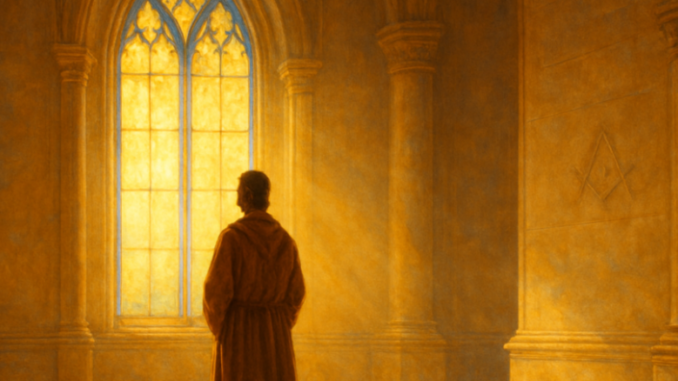
In The Lost Symbol, Dan Brown plunges readers into a world where the human mind supposedly exerts measurable effects on physical reality. At the heart of the story lies noetic science — a discipline that, according to the novel, proves that thoughts and intentions can influence matter itself. But how much of this is grounded in real science, how much is exaggeration, and how much is pure fiction? In this fact-check, we place the world of the novel alongside the world of established science to find out.
What Is Noetic Science According to Dan Brown?
In The Lost Symbol, Dan Brown portrays noetic science as a revolutionary field of research demonstrating that human consciousness can directly influence matter. The novel suggests that scientists in secret laboratories conduct experiments in which focused intentions produce measurable physical effects. This premise draws on a long tradition of esoteric ideas about the power of the mind — ideas that also circulate within Freemasonry as metaphors for inner transformation.
Brown references the Institute of Noetic Sciences (IONS), an organization that actually exists in Petaluma, California. It was founded in 1973 by astronaut Edgar Mitchell following his Apollo 14 mission. During his return to Earth, Mitchell reported a profound mystical experience that inspired him to dedicate his life to consciousness research. The institute is very real — but the question is what it has actually proven.
The Scientific Perspective: What Do Researchers Actually Say?
From the standpoint of mainstream science, the picture is far more nuanced than Brown’s thriller suggests. The Institute of Noetic Sciences does indeed conduct research into consciousness, meditation, and what it calls “extended human capacities.” However, most peer-reviewed scientific journals consider the methodology behind much of this research to be insufficiently rigorous. Experiments involving random number generators — in which human intention supposedly influences outcomes — have been repeatedly criticized for statistical weaknesses and a lack of independent replication.
Noetic science exists as a research field, but its most spectacular claims about the power of thought remain scientifically unproven.
The word “noetic” itself derives from the Greek nous, meaning mind or intellect. Aristotle used the term in his philosophical writings to describe the knowing part of the soul. In its classical sense, noetic knowledge is simply knowledge acquired through reason. Dan Brown, however, gives the word a far broader, quasi-magical significance that strays well beyond its original philosophical context.
Where Both Perspectives Converge: The Fascination with Consciousness
Despite the vast gap between the world of fiction and the scientific laboratory, both share a genuine fascination with the mysteries of human consciousness. The question of how subjective experience arises from neural activity — what philosophers call the “hard problem of consciousness” — remains unsolved. Both the novelist and the researcher acknowledge that here lies a mystery that exceeds our current models of understanding.
This shared sense of wonder resonates deeply within Freemasonry, where working on the inner self is a central pursuit. The rough ashlar shaped into a perfect cube symbolizes personal development through conscious reflection and self-knowledge. Where noetic science claims external effects of thought on matter, Freemasonry focuses on internal transformation. Both seek the deeper layers of what it means to be human, albeit through very different methods and with very different expectations.
What Is Exaggerated and What Is Pure Fiction?
The Lost Symbol presents experiments in which thoughts cause water to crystallize in specific patterns and meditation groups lower crime rates in cities. These claims are based on studies that remain highly controversial in the scientific community. The water crystal studies by Japanese researcher Masaru Emoto have been rejected by mainstream chemists due to methodological flaws and the absence of proper blinding. The meditation-crime studies suffer from similar problems involving inadequate control groups and confounding variables.
To break it down clearly:
Fact: The Institute of Noetic Sciences exists and conducts research into consciousness.
Exaggerated: The claim that noetic science is widely accepted within academic circles.
Fiction: The idea that thoughts directly and measurably alter the physical world in the way the novel describes.
Lessons for the Seeking Mind
Dan Brown is a master at blending historical fact with speculation and outright fiction. This makes his novels thrilling, but it also makes them potentially misleading for readers who don’t carefully distinguish between reality and imagination. The Lost Symbol invites reflection on the possibilities of the human mind, but the critical reader would do well to test its spectacular claims against reputable sources.
For Freemasons, this discussion offers an interesting mirror. The Craft has always valued both reason and mystery, both Enlightenment thinkers and symbolic traditions. Spinoza, Voltaire, and Goethe — all connected to Masonic ideals — pursued truth through critical thinking without ever losing their sense of wonder. That balance between openness to the unknown and skepticism toward unfounded claims remains a valuable compass for anyone on the path of self-improvement.
Noetic science as Dan Brown presents it in The Lost Symbol is largely a literary construction built around a real but scientifically marginal field of research. The fascination with the power of consciousness is ancient and legitimate. The claim that thoughts directly and measurably change physical matter, however, remains unproven. For Freemasons and thoughtful readers alike, the real lesson may be the one the Craft has taught for centuries: pursue knowledge with an open mind, but never abandon the discipline of critical thinking. The true secret is not hidden in a laboratory — it resides in the lifelong work of shaping the self.
Copyright text & image: devrijmetselaar.nl
Texts are based on the ideas and content of the author of devrijmetselaar.nl, reviewed, corrected, and supplemented with the assistance of OpenAI. Images are created based on the ideas of the author of devrijmetselaar.nl using OpenAI/DALL-E.


Be the first to comment