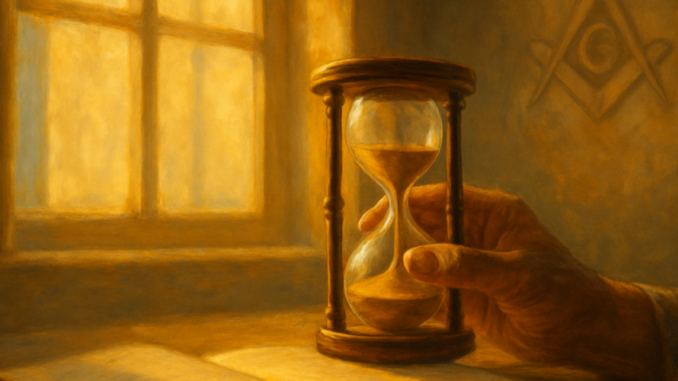
In a small living room, a sixty-seven-year-old man sits across from his children. Three weeks ago, he received the diagnosis: metastatic pancreatic cancer. Now, with news that a new medication may offer hope, his daughter gently asks, ‘Dad, how are you feeling?’ He is silent for a long time. Then he says something no one expects: ‘For the first time, I know who I really am.’ This article explores the profound connection between mortality, identity, and the ancient wisdom of Freemasonry.
A Breakthrough That Reaches Beyond Medicine
The news that a drug for metastatic pancreatic cancer may soon become available brings hope to thousands of patients and their families. Pancreatic cancer is one of the most ruthless forms of the disease, often detected only after it has already spread. A treatment capable of extending life is nothing short of revolutionary.
Yet medical breakthroughs like this inevitably raise questions that reach far beyond survival rates and side effects. When people are confronted with their own mortality — and then unexpectedly given a second chance — something remarkable happens to their sense of self. The question ‘Who am I?’ suddenly acquires an urgency rarely felt in the routine of everyday life.
Freemasonry and the Work of Self-Improvement
Within Freemasonry, the concept of personality — of who we truly are — holds a central place in ways that might surprise outsiders. Where modern culture often equates personality with temperament or character traits we are born with, the Freemason sees it as something to be shaped, refined, and perfected over time. The rough ashlar that must be worked into a perfect cube is no abstract symbol; it is a daily invitation to labor on the self.
Michel de Montaigne, the sixteenth-century philosopher whose essays still resonate across the centuries, wrote extensively about the art of self-examination. He argued that we only truly come to know ourselves when we set aside the masks we wear for others. This idea lives on in the Lodge: ritual creates a sacred space where Brethren meet one another stripped of the everyday roles defined by position, status, or wealth.
Personality is not a given — it is a life’s work. The Freemason views each day as a fresh opportunity to become the best version of himself.
Mortality as a Catalyst for Self-Knowledge
The Stoic philosopher Seneca understood that contemplating death need not be paralyzing. On the contrary: the awareness that our time is finite can be profoundly liberating. It compels us to distinguish between what truly matters and what is merely distraction.
For someone who learns that a new medication may extend their life, a peculiar in-between state emerges. The immediate threat recedes, but the awareness of mortality remains. It is precisely in that space that deeper self-examination becomes possible. What do I want to leave behind? Which relationships deserve my attention? What qualities do I wish to cultivate in the time I have left?
These are not idle philosophical musings. They are the most practical questions a human being can ask. And they are the very questions that Freemasonry has been helping men explore for centuries — not in the abstract, but through lived experience, ritual, and fellowship.
Identity as an Ethical Responsibility
Freemasonry does not treat personal development as a narcissistic pursuit. It frames it as an ethical obligation. Aristotle called this the pursuit of eudaimonia — a flourishing life in which virtues such as courage, justice, and temperance take center stage. The goal is not to cultivate an impressive self-image, but to make a genuine contribution to the community and to the people around us.
In Lodge meetings, this principle is made tangible through the practice of brotherly correction. Brethren hold one another accountable when behavior diverges from shared values. This is not condemnation; it is an invitation to reflect. After all, who can see their own blind spots without the mirror that others hold up?
The Paradox of Medical Progress
A new drug for metastatic pancreatic cancer represents a triumph of human ingenuity and collaboration. At the same time, it exposes a paradox that Freemasonry has recognized for centuries: the more we succeed in postponing death, the more urgent the question becomes of what we are doing with our lives.
Johann Wolfgang von Goethe, himself a Freemason and one of the great minds of the Enlightenment, wrote that a person only truly lives when they are creating and growing. Stagnation is not an option for anyone who is truly alive. The extra time that a new treatment may offer is therefore not a gift to be received passively — it is a responsibility to be filled actively and deliberately.
What Remains When Everything Falls Away?
The question that Freemasonry ultimately poses to each of its members is the same question that a serious diagnosis demands: Who are you when all external trappings fall away? When your career, your possessions, your social standing no longer mean anything — what is left? The answer, according to the Masonic tradition, lies in the inner work you have done throughout your life.
It lies in the relationships you have nurtured and deepened. In the values you have lived by, not merely professed. In the wisdom you have sought and shared with others. In the courage with which you have faced adversity and loss.
These are not abstract ideals. They are the concrete outcomes of daily choices — choices about how to spend your time, how to treat the people around you, and how to respond when life strips you down to the essentials. Freemasonry provides a framework within which these choices can be made consciously, in the company of others traveling the same path. Not to deny death, but to embrace life fully for as long as it lasts.
The news of a potentially life-extending treatment for metastatic pancreatic cancer is a beacon of hope for everyone touched by this devastating disease. But behind the medical headlines lies a deeper question that concerns us all: Who do we want to be in the time we are given? Freemasonry teaches that identity is not fixed at birth — it is a lifelong project of refinement, growth, and service. Perhaps the greatest lesson of mortality is not that life ends, but that every moment we have is an opportunity to shape who we truly are. The rough stone is always waiting to be worked.
Copyright text & image: devrijmetselaar.nl
Texts are based on the ideas and content of the author of devrijmetselaar.nl, reviewed, corrected, and supplemented with the assistance of OpenAI. Images are created based on the ideas of the author of devrijmetselaar.nl using OpenAI/DALL-E.

Be the first to comment