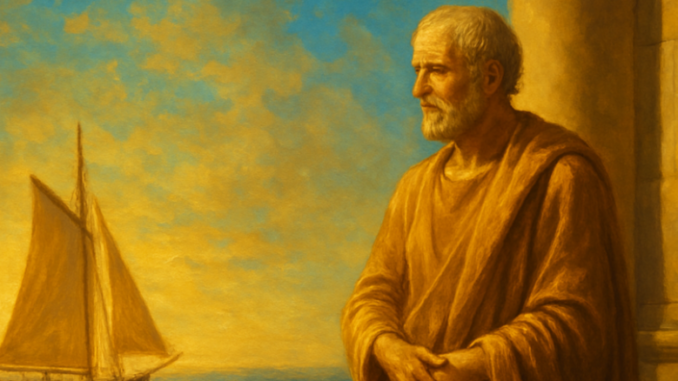
Perhaps you know that moment — standing at an open grave, wondering: how long am I allowed to grieve? Is there a limit to sorrow, or is the question itself somehow inappropriate? Lucius Annaeus Seneca wrestled with exactly these questions two thousand years ago. In his sixty-third letter to his student Lucilius, he unfolds a nuanced vision of grief that still resonates today, rooted in ancient philosophical traditions that have also profoundly influenced Freemasonry.
The Stoic School as Foundation
Seneca wrote from within the Stoic tradition, a philosophical school founded around 300 BCE by Zeno of Citium in Athens. At its core, Stoicism revolves around the distinction between what lies within our power and what falls beyond it. Emotions such as grief belong to the first category: we cannot control the loss itself, but we can govern our response to it. This insight forms the backbone of Letter LXIII.
Yet Seneca was no emotionless rationalist. He departed from early Stoics like Chrysippus, who regarded every emotion as a weakness to be conquered. Seneca acknowledged that grief is a natural response — even a tribute to the one we have lost. His position was more subtle: not the elimination of sorrow, but the prevention of sorrow consuming us entirely.
The Influence of Epicurus and the Greco-Roman Tradition
Although Seneca was a Stoic, he showed a remarkable appreciation for Epicurus, the rival philosopher whose school was known for its emphasis on inner tranquility and friendship. In Letter LXIII, Seneca echoes the Epicurean idea that we should take pleasure in the memory of what we once had, rather than mourning what we have lost. This synthesis of Stoic and Epicurean elements marks Seneca as an eclectic thinker who drew wisdom from multiple sources.
Seneca was also influenced by Cicero, who several decades earlier had written his famous Tusculanae Disputationes on coping with grief. Cicero himself had suffered terribly from the loss of his daughter Tullia and sought consolation in philosophy. Seneca knew this work and built upon it, though with a more personal tone characteristic of his epistolary style.
The Roman Social Framework of Mourning
In the Rome of Seneca’s day, mourning was not merely a private matter — it was also a social and political act. Strict conventions governed mourning periods, attire, and behavior. A Roman widow was expected to wear black for a full year; a man who grieved too long for a friend risked being perceived as weak. In Letter LXIII, Seneca navigated between these social expectations and his philosophical convictions.
He recognized that it would be unnatural not to grieve, while simultaneously warning against excessive sorrow that prevents the mourner from continuing to live. This search for balance between feeling and reason is a theme that resonates deeply with the symbolism of Freemasonry, where the square and compasses represent the harmony between emotion and intellect.
Grief is not a weakness to be overcome, but a force that must be brought into balance.
Connections to Freemasonry and Brotherhood
Freemasonry has historically drawn extensively from Stoic principles. The emphasis on personal development, the work of shaping the rough ashlar of one’s character, and the acceptance of mortality are themes that directly align with Seneca’s philosophy. In the lodge, death is not suppressed but integrated into ritual — through symbols such as the skull and the Chamber of Reflection.
Seneca’s approach to grief fits naturally within this framework. He does not ask for denial of loss, but for a conscious attitude toward impermanence. Just as the Master Mason degree confronts the Brother with his own mortality, Letter LXIII confronts the reader with the inevitability of loss and poses the question: how do you carry on living afterward?
The Letter as a Mirror for Personal Growth
What makes Letter LXIII particularly compelling is its personal tone. Seneca does not write as a detached sage dispensing abstract wisdom, but as a human being who has grieved himself. He refers to the loss of friends and acquaintances and shares his own struggles. This makes the letter accessible and recognizable, even after two millennia.
The philosophical traditions that nourished Seneca — from Zeno to Epicurus to Cicero — together form a rich soil from which his wisdom blossoms. But it is Seneca’s own voice that brings these traditions to life. He invites you not merely to read, but to reflect: how do you deal with loss? What do you do with the memory of those you loved?
Historical Impact Through the Ages
Seneca’s ideas on grief have influenced thinkers across the centuries — from early Christian writers to Renaissance humanists like Petrarch and Montaigne, and later Enlightenment philosophers. Montaigne, himself a celebrated essayist, cited Seneca frequently and considered him one of his intellectual fathers.
In modern psychology, we find echoes of Seneca’s approach in theories of grief processing that acknowledge sorrow not as a problem to be solved, but as a process to be lived through. The ancient wisdom proves surprisingly relevant to our contemporary understanding of the human experience.
Seneca’s Letter LXIII is more than a historical document. It is an invitation to pause and consider how you deal with loss — rooted in a philosophical tradition that has also shaped Freemasonry. The question Seneca poses is ultimately the same question every Brother or seeker asks himself: how do I live a worthy life, knowing that all things are impermanent? The answer lies not in denying grief, but in finding balance — precisely as the square and compasses remind us in the lodge.
Copyright text & image: devrijmetselaar.nl
Texts are based on the ideas and content of the author of devrijmetselaar.nl, reviewed, corrected, and supplemented with the assistance of OpenAI. Images are created based on the ideas of the author of devrijmetselaar.nl using OpenAI/DALL-E.



Be the first to comment