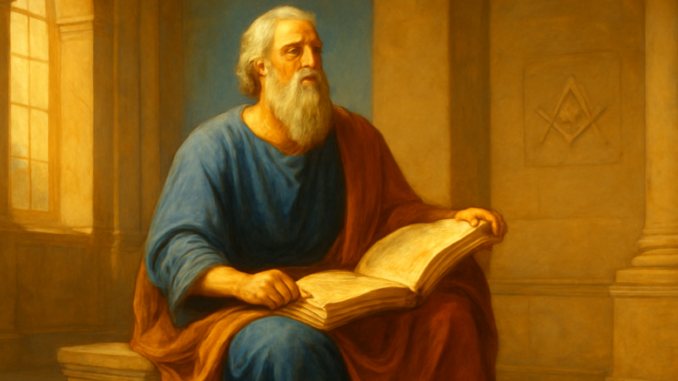
What truly makes a society just? This question consumed Plato until the very end of his life, when he composed his final and longest dialogue: The Laws. Unlike The Republic, where philosopher-kings rule supreme, The Laws explores how ordinary citizens can build a virtuous community through legislation and education. The philosophical traditions that shaped this monumental work continue to resonate today — perhaps nowhere more clearly than in the principles and practices of Freemasonry.
Why Did Plato Write The Laws in His Final Years?
Plato began writing The Laws around the age of eighty, shortly before his death in 347 BCE. After a lifetime of philosophical exploration and political disappointment — most notably his failed attempts to advise the tyrant of Syracuse — he returned to a fundamental question: how can a community function well without perfect rulers? Unlike the idealistic vision of The Republic, The Laws takes human imperfection as its starting point. Here, law is not a necessary evil but a pedagogical instrument designed to guide citizens toward virtue.
This pragmatic turn reflects Plato’s intellectual maturation. He had come to recognize that even the finest philosophers are fallible and that institutions are needed to compensate for human weakness. The dialogue unfolds on the island of Crete, where three elderly men — an Athenian, a Spartan, and a Cretan — deliberate on the ideal constitution. The setting is deliberate: Crete was regarded throughout the Greek world as the cradle of ancient law and religious tradition.
Which Philosophical Traditions Shaped The Laws?
The influence of Pythagoras on The Laws is profound, though often overlooked. The Pythagorean tradition, which Plato encountered early in his career during travels to southern Italy, emphasized harmony, proportion, and the mathematical order of the universe. These principles resurface throughout The Laws — in Plato’s insistence on mathematical proportions in land ownership, in the precise number of households (exactly 5,040), and in the distribution of administrative responsibilities. These numbers are anything but arbitrary: 5,040 is divisible by every integer from 1 to 10, allowing maximum flexibility in civic organization.
Socrates, Plato’s great teacher, is notably absent from this dialogue, yet his spirit pervades the work. The Socratic method of inquiry, the emphasis on self-knowledge, and the conviction that no one does wrong willingly all form the philosophical bedrock of The Laws. Where Socrates focused primarily on the individual soul, however, Plato translates these insights into collective structures. The central question shifts from “How do I become a good person?” to “How do we together form a good community?”
How Did the Greek City-State Influence Plato’s Thinking?
The historical context of the Greek polis is essential to understanding The Laws. Plato lived in an era when Athens was still recovering from the devastating Peloponnesian War and its democracy was under immense strain. He had witnessed his mentor Socrates sentenced to death by a democratic court — an experience that fueled his deep suspicion of unchecked popular rule. At the same time, he admired certain elements of the Spartan and Cretan constitutions, with their emphasis on discipline, communal spirit, and respect for tradition.
In The Laws, Plato attempts a synthesis: Athenian freedom combined with Spartan order, tempered by wisdom and religious reverence. Laws should not be obeyed merely out of fear of punishment but understood and embraced as expressions of cosmic justice. This pedagogical ideal — shaping citizens into independently thinking yet community-minded individuals — finds powerful echoes centuries later in Masonic ritual and philosophy.
Plato’s Laws teaches us that true order arises not through coercion, but through laws that educate citizens toward inner harmony.
What Connects The Laws to Freemasonry?
The parallels between Plato’s vision and Freemasonry are striking. Just as Plato’s ideal state shapes citizens through laws, music, and physical training, the Lodge shapes its members through ritual, symbolism, and fraternal correction. Both traditions share a profound confidence that human beings are not born as perfected creatures but can be formed into better versions of themselves. The rough ashlar that is worked into a perfect cube — one of the most central images in Masonic symbolism — mirrors Plato’s vision of education as the shaping of the soul.
Aristotle, Plato’s most famous student, later criticized The Laws as too rigid and impractical. Yet even he acknowledged the value of Plato’s insight that laws must do more than punish — they must form character. This tension between ideal and reality, between the perfect blueprint and the stubborn messiness of human life, characterizes both the philosophical and the Masonic tradition. The Freemason pursues the “Royal Art” of self-perfection, fully aware that perfection itself is never truly attained.
Why Does This Work Remain Relevant Today?
Plato’s Laws poses questions that every generation must answer anew. How do we balance individual freedom with collective responsibility? What role should education play in forming good citizens? Can laws actually make people better, or do they merely regulate behavior? These are not abstract philosophical puzzles — they strike at the heart of how we live together in society.
For the Freemason, Plato’s final work offers a philosophical mirror. The Lodge is itself an attempt to create an ordered community in which personal growth and fraternal harmony go hand in hand. Rituals and symbols function, much like Plato’s laws, as pedagogical instruments that invite participants into deep self-reflection. Two and a half millennia after it was written, The Laws remains a wellspring of inspiration for anyone who thinks seriously about how to build a good and meaningful life.
Plato’s Laws represents the culmination of a lifelong quest for justice. Influenced by Pythagoras, shaped by Socrates, and inspired by the living experiments of the Greek city-states, this final dialogue offers a vision of governance rooted in education, proportion, and moral development. For Freemasons and thoughtful seekers alike, it stands as a timeless reminder that the pursuit of a just society begins with the cultivation of the individual soul — a rough stone patiently worked, day by day, toward something closer to perfection.
Copyright text & image: devrijmetselaar.nl
Texts are based on the ideas and content of the author of devrijmetselaar.nl, reviewed, corrected, and supplemented with the assistance of OpenAI. Images are created based on the ideas of the author of devrijmetselaar.nl using OpenAI/DALL-E.

Be the first to comment