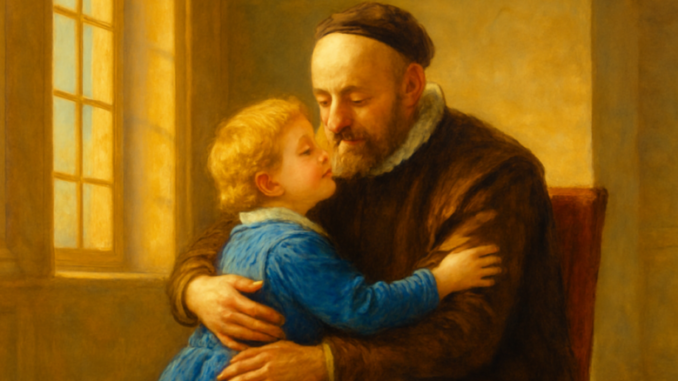
In 1580, Michel de Montaigne published a remarkably personal essay on the relationship between fathers and their children. In the eighth essay of his second book, titled ‘On the Affection of Fathers for Their Children,’ he posed a question that still resonates today: what is the true nature of parental love, and how does it compare to the intellectual creations a person brings into the world? The answer Montaigne arrived at touches on fundamental questions about legacy, responsibility, and the art of letting go — themes that carry a profound resonance within Freemasonry.
A Letter to a Mother
The essay opens as a letter addressed to Madame d’Estissac, a noblewoman who had raised her son with remarkable devotion after the death of her husband. Montaigne praises her maternal dedication and uses it as a springboard for a broader examination of fatherly love. He observes that the affection parents feel for their children is among the most natural of human emotions, yet paradoxically, it is one that is rarely examined with any real clarity. Because it seems so self-evident, it tends to be overlooked by philosophy.
By addressing the essay to a specific individual, Montaigne gives his reflections an intimate character. He does not write as a moralist prescribing how parents should behave, but as a man questioning himself. This method — the searching inner dialogue — is the hallmark of his entire body of work, and it elevates this essay far beyond a simple treatise on child-rearing.
Love Guided by Reason
Montaigne argues that a father’s love for his children only becomes truly valuable when it is guided by reason. Blind, instinctive affection can easily degenerate into possessiveness or tyranny. He criticizes fathers who treat their children as property, who keep them under their thumb well into adulthood, and who refuse to hand over responsibility. Such fathers, he contends, do not love their children — they love their own power.
Against this domineering model, Montaigne sets an ideal of affection that grows as the child develops into an independent, thinking being. The most beautiful form of parental love, he writes, is the kind that sets the child free. He points to classical examples, including the Roman philosopher and statesman Cicero, who expressed deep affection for his daughter Tullia precisely because he treated her as an intellectual equal.
For Montaigne, the noblest form of fatherly love is not holding on, but equipping a child to live without the father.
Children of the Mind: The Legacy of Intellectual Creation
One of the most striking turns in the essay comes when Montaigne draws a comparison between biological children and intellectual creations. He suggests that the products of the mind — books, poems, philosophical works — are in a sense nobler than physical offspring. For while the act of procreation is something we share with all living creatures, the creation of an intellectual work belongs exclusively to the rational faculties of humankind.
Montaigne invokes several historical figures to illustrate this point. He refers to Epicurus, who on his deathbed found greater consolation in the writings he left behind than in any material possession. He also cites Virgil, who on his own deathbed asked that the Aeneid be destroyed because it was unfinished — a request that Emperor Augustus famously refused. For Montaigne, this illustrates the deep, almost paternal bond a creator feels with the offspring of his mind.
Montaigne applies this insight to himself with characteristic candor. He regards his own essays as his most personal legacy — perhaps even more personal than his relationship with his biological children. With sometimes shocking honesty, he admits that he takes more pleasure in writing than in fatherhood itself.
Against the Tyranny and Greed of Aging Fathers
A substantial portion of the essay is devoted to what Montaigne considers a widespread injustice: elderly fathers who refuse to pass on their possessions and responsibilities to the next generation. He condemns the miserliness with which some fathers guard their wealth, keeping their sons in a state of dependency long after those sons have reached full maturity.
Montaigne writes about this from personal experience. His own father, Pierre Eyquem de Montaigne, had transferred the family estate to his son during his own lifetime. Michel remembered this gesture as an act of wisdom and trust. He contrasts it with ancient Greece, where the lawgiver Solon was celebrated for enacting laws that protected the rights of sons against tyrannical fathers. The message is clear: true fatherly love expresses itself not through control, but through the gradual transfer of autonomy.
The Connection to Masonic Brotherhood
The themes Montaigne explores in this essay resonate deeply with the values cherished within Freemasonry. The idea that genuine affection should be liberating rather than possessive is a core principle in the Masonic tradition. Within the lodge, a Master does not seek to bind apprentices to himself, but to guide them toward independence. The ideal of the rough ashlar being shaped into a more perfect whole carries precisely this thought: growth is only real when it leads to independent thinking and action.
The concept of intellectual creations as a form of legacy also aligns closely with Masonic tradition. The rituals, the transmitted texts, the moral lessons passed from generation to generation — these are the intellectual children of Master Builders who have long since passed to the Eternal East. Just as Montaigne regarded his essays as his most enduring inheritance, so too does the Masonic Brotherhood view its accumulated wisdom as a living legacy, constantly renewed yet rooted in timeless principles.
There is also a powerful parallel in Montaigne’s insistence on reason as the guide to love. Freemasonry has always emphasized that emotion, while vital, must be tempered by rational reflection. The Square and Compasses themselves symbolize this balance — the measured application of moral principles to the raw material of human experience. Montaigne’s vision of a father who loves wisely rather than blindly mirrors the Masonic ideal of a Brother who acts with both heart and mind.
Montaigne’s essay on fatherly affection, written more than four centuries ago, remains a powerful meditation on what it means to truly love — and truly let go. His insight that the greatest act of parental devotion is preparing someone to stand on their own resonates far beyond the family sphere. For Freemasons, it speaks to the very heart of the Craft: the work of shaping not just ourselves, but those who come after us, equipping them with the tools to build on their own. In the end, our most lasting legacy is never what we hold onto, but what we freely pass on.
Copyright text & image: devrijmetselaar.nl
Texts are based on the ideas and content of the author of devrijmetselaar.nl, reviewed, corrected, and supplemented with the assistance of OpenAI. Images are created based on the ideas of the author of devrijmetselaar.nl using OpenAI/DALL-E.
Frequently Asked Questions
What is the main argument Montaigne makes about parental love in his essay?
Montaigne argues that true parental love must be guided by reason rather than blind instinct. He contends that the noblest form of fatherly love is not about holding onto or controlling children, but rather about equipping them to become independent, thinking beings who can live without their father's dominance.
Why did Montaigne address his essay as a letter to Madame d'Estissac?
By addressing the essay to a specific individual—a noblewoman who had devoted herself to raising her son after her husband's death—Montaigne gave his reflections an intimate, personal character. This approach allowed him to write not as a prescriptive moralist, but as a man engaging in a searching inner dialogue about parental affection, which is the hallmark of his philosophical method.
How does Montaigne distinguish between genuine parental love and possessiveness?
Montaigne criticizes fathers who treat their children as property and keep them under their control into adulthood, arguing that such men do not truly love their children but rather love their own power. He contrasts this with true parental love, which he illustrates through examples like Cicero, who showed deep affection for his daughter by treating her as an intellectual equal and granting her independence.

Be the first to comment