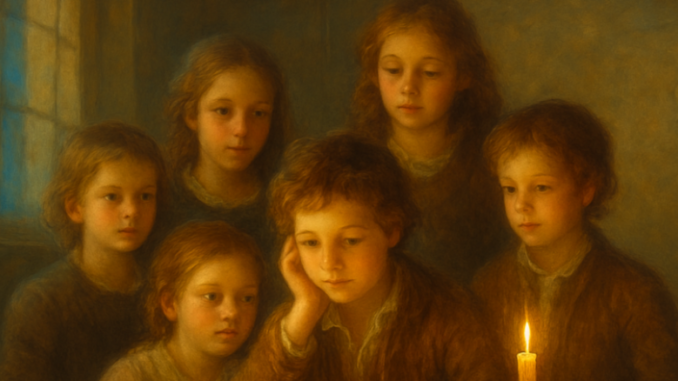
What can the eighth child of a philosopher teach us about brotherhood and the formation of personality? The question may seem unusual at first glance, but a closer look at the lives of great thinkers reveals that family circumstances often shaped their understanding of human connection. The role of the brother — both in the literal and the figurative sense — runs like a golden thread through the philosophical tradition, and it finds a particularly powerful echo in the practice of Freemasonry.
Why Does Birth Order Matter So Much?
Picture a large family in eighteenth-century Europe. Eight children, perhaps more. The eldest inherits the estate, the middle children seek their fortunes in trade or the military, and the youngest? They must make do with whatever remains. Yet it is precisely in this position that something remarkable emerges: the necessity of forging an identity independent of family tradition and birthright.
The Genevan philosopher Jean-Jacques Rousseau wrote extensively about how upbringing and environment shape character. Although Rousseau himself was not an eighth child, he understood deeply that one’s position within a family — as a brother among brothers — fundamentally influences personality. A child who learns to navigate relationships with older siblings develops skills that are entirely different from those of an only child.
What Does Philosophy Teach Us About the Concept of Brotherhood?
The word “brother” carries a dual meaning. On one hand, it refers to a bond of blood. On the other, it points toward a deeper, spiritual kinship. Aristotle, in his Nicomachean Ethics, wrote about philia — the friendship between equals that arises from shared virtue. This form of brotherhood transcends biological ties and becomes a deliberate, conscious choice.
Cicero, the Roman statesman and philosopher, built upon this idea. He viewed true brotherhood as a foundation of society itself. It is not blood that makes the brother, but a shared devotion to truth and justice. This principle resonates powerfully with Freemasonry, where men address one another as brothers regardless of origin or social standing.
How Does Brotherhood Shape Personality?
Here we arrive at the heart of the matter. Personality is not a fixed trait — it is an ongoing process of becoming. Freemasonry recognizes this and provides a structure within which that process can unfold. The brotherhood serves as a mirror: in the eyes of your fellow brethren, you discover aspects of yourself that you would never uncover in solitude.
Brotherhood is not a title you receive, but a character you develop through daily devotion to shared values.
Immanuel Kant, the philosopher of Königsberg, emphasized the importance of autonomy and moral development. A person becomes truly free only when he acts from internally held principles rather than external compulsion. Yet even Kant acknowledged that this freedom can flourish only in relation to others. The brother — whether bound by blood or by spirit — serves as a touchstone for our moral growth.
What Makes the Eighth Position So Unique for the Philosopher-Brother?
The eighth child grows up in a world that has already been largely shaped by others. The roles are assigned, the expectations set. It is precisely within this seemingly constrained space that the drive toward originality is born. Blaise Pascal, who grew up in an intellectually stimulating yet restrictive household, understood the importance of carving out one’s own path within existing structures.
Freemasonry offers a similar paradox. Within a tradition of centuries-old rituals and prescribed forms, every brother finds the space to develop his unique personality. The ritual is not a prison — it is the canvas upon which individual growth becomes visible.
The Lesson of Multiplicity
Anyone who grows up as one among many learns instinctively that the world does not revolve around them. This may be the most important lesson for every Freemason. The lodge is composed of brethren from different backgrounds, professions, and philosophies of life. It is precisely in this diversity that the strength of brotherhood resides.
- Listening to others deepens self-understanding
- Bridging differences strengthens character
- Shared rituals create shared meaning
- The position of the younger brother teaches humility
How Does This Translate to the Masonic Path?
Freemasonry is an invitation to self-reflection. Every brother is encouraged to work the rough stone of his personality into a more perfect form. This is not an individualistic project — it is a collective endeavor. Brethren help one another, challenge one another, and celebrate each other’s progress along the way.
Johann Wolfgang von Goethe, himself a Freemason, wrote in his works about the necessity of continuous self-formation. He called it Bildung — a process that is never truly complete. The philosopher as the eighth child, the brother who must earn his place rather than inherit it, embodies this ideal perfectly. Not by birthright, but through personal effort, he earns his position in the chain.
The question we started with turns out to be richer than expected. The eighth child of a philosopher — the brother who must find his own way — teaches us that personality is not a gift but a task. Freemasonry provides the framework within which this task takes shape. In the brotherhood, we find not only kindred spirits but also the mirror that shows us who we might become. Perhaps this is the deepest wisdom shared by the philosophical tradition and the Masonic path: we become ourselves through the other.
Copyright text & image: devrijmetselaar.nl
Texts are based on the ideas and content of the author of devrijmetselaar.nl, reviewed, corrected, and supplemented with the assistance of OpenAI. Images are created based on the ideas of the author of devrijmetselaar.nl using OpenAI/DALL-E.
Frequently Asked Questions
What is the connection between birth order and the development of brotherhood?
According to the article, birth order significantly influences how individuals understand human connection and brotherhood. Children born later in large families, particularly eighth children, must forge identities independent of family tradition and birthright. This necessity of navigating relationships with older siblings develops unique skills that shape personality differently than those of only children. This dynamic of learning to relate to brothers within a family provides a foundation for understanding the broader concept of brotherhood in philosophy and Freemasonry.
How do philosophers like Aristotle and Cicero define brotherhood beyond blood relations?
Philosophers have long recognized brotherhood as having two dimensions. Aristotle's concept of philia refers to friendship between equals arising from shared virtue, transcending biological ties. Cicero expanded this idea by arguing that true brotherhood is a foundation of society built not on blood, but on shared devotion to truth and justice. This philosophical understanding of brotherhood as a deliberate, conscious choice based on shared values rather than kinship directly informs Freemasonry's practice of addressing men as brothers regardless of their social origin or standing.
How does Freemasonry use the concept of brotherhood to shape personality and personal development?
Freemasonry recognizes that personality is not fixed but an ongoing process of becoming. The fraternal brotherhood structure provides a deliberate framework within which this personal development can unfold. Fellow brethren serve as a mirror, allowing individuals to discover aspects of themselves they might not otherwise recognize. Through this mutual reflection and shared commitment to the principles of brotherhood, Freemasonry facilitates the continuous evolution and development of personality in its members.

Be the first to comment