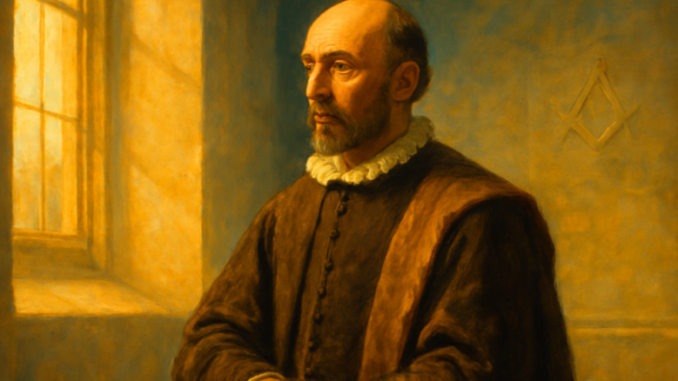
Imagine stepping away from the noise of everyday life. You close the door, put your phone aside, and sit alone with your thoughts. Does that feel like liberation — or confrontation? In the sixteenth century, Michel de Montaigne wrote a remarkable essay on precisely this theme. His conclusion was surprising: true solitude has little to do with physical isolation and everything to do with the freedom of your own mind. Understanding this reveals a connection that resonates deeply with the very heart of Freemasonry.
What Montaigne Really Meant by Being Alone
In his thirty-eighth essay, titled ‘On Solitude,’ Montaigne does not advocate fleeing from society. Quite the opposite — he warns against the illusion that you can escape inner turmoil simply by retreating to the countryside or a monastery. ‘The soul carries its torments with it,’ he writes. In doing so, he touches on something fundamental: solitude is not a matter of location but of inner disposition. You can feel lonelier in a crowd than in an empty room, and conversely, in silence you can be deeply connected to yourself and the world.
Montaigne builds on the thinking of Seneca and Marcus Aurelius, Stoic philosophers who likewise emphasized the importance of inner freedom. But where the Stoics often leaned toward emotional detachment, Montaigne strikes a warmer tone. He does not seek the absence of feeling, but the presence of self-knowledge. This is what makes his essay so relatable to modern readers: it is not about severing ties, but about purifying your relationship with yourself.
The Chamber of Reflection as a Workshop for the Mind
If you are familiar with Freemasonry, you may recognize the concept of the Chamber of Reflection. In Masonic tradition, there is an ancient ritual practice in which the candidate is placed in a secluded, dimly lit space for a period of time before initiation. This experience is neither punishment nor isolation. It is an invitation to turn inward, to order your thoughts, and to look honestly in the mirror before entering a new phase of life. The space is known as a place of contemplation — not loneliness in the negative sense of the word.
It is striking how closely this ritual practice aligns with what Montaigne describes. He speaks of a ‘back room of the mind’ — an inner space that you carry with you at all times. A place where you can reflect without the pressure of expectations, ambitions, or the opinions of others. In Freemasonry, this inner workshop is not seen as an end in itself, but as a point of departure. You go inward in order to emerge stronger, more conscious, and with greater compassion. The solitude serves the connection.
Self-Reflection as the Foundation of Brotherhood
Here, Montaigne’s ideas and Masonic philosophy meet on a profound level. Freemasonry regards self-reflection as an indispensable step toward moral growth. You can only truly be of service to others once you know yourself. You can only listen sincerely when you are aware of the prejudices and insecurities that color your own perception. And you can only be a trustworthy brother or sister when you are honest about your own shortcomings.
Montaigne would have recognized this entirely. He did not write his essays as lessons for others, but as honest investigations of his own mind. ‘I am myself the matter of my book,’ he declared in his preface. That attitude of radical honesty toward oneself is precisely what Freemasonry asks of its members. Not perfection, but the willingness to work on yourself. The rough ashlar need not be polished smooth in a single stroke. What matters is the ongoing process.
True solitude is not a flight from the world, but a return to yourself — so that you can engage with others with greater depth and sincerity.
The Paradox of Withdrawal and Connection
There is a beautiful paradox woven through both Montaigne’s essay and Masonic tradition. To become more deeply connected to others, you must first learn to be alone. To truly contribute to the community, you must first put your own inner house in order. This is not egoism — it is a prerequisite for genuine engagement. Montaigne withdrew to his famous tower library, yet throughout his life he remained active as the mayor of Bordeaux, as a traveler, and as a conversation partner to thinkers like Étienne de La Boétie, whose profound friendship shaped him deeply.
In Freemasonry, you see the same pattern. The lodge is an enclosed space, set apart from the outside world, where brothers and sisters come together for ritual, reflection, and dialogue. But that seclusion is not the goal. The goal is to return to society better equipped to serve it. The values practiced in the lodge — tolerance, sincerity, compassion, and the search for truth — are meant to be lived outside the lodge. This is what makes Freemasonry not an otherworldly society, but a school for daily life.
What Montaigne Still Teaches Us Today
We live in a time when loneliness is often seen as a problem. And sometimes it is. But Montaigne reminds us that there is a crucial difference between isolation and conscious introspection. The first happens to you; the second you choose. Freemasonry offers a framework in which that conscious introspection does not take place in a vacuum, but is embedded within a community of like-minded individuals walking the same path.
Consider the principles that both Montaigne and Freemasonry hold dear: self-reflection as the foundation for personal and moral growth; the courage to look honestly at yourself without judgment; withdrawal as preparation for deeper connection; and brotherhood rooted in vulnerability and trust. These are not abstract ideals — they are practices that transform how we relate to ourselves and to each other.
Montaigne wrote more than four hundred years ago, but his insights remain as relevant as ever. Those who dare to take the step of truly being alone with themselves discover that the silence is not emptiness. It is the space where genuine self-understanding begins — and from which authentic, meaningful connection with others becomes possible.
Montaigne’s vision of solitude and Freemasonry’s emphasis on inner work share a common truth: the path to meaningful connection with others runs through honest self-examination. Whether in a sixteenth-century tower library or in the quiet of a Chamber of Reflection, the invitation is the same — turn inward not to escape the world, but to meet it with greater clarity, compassion, and purpose. In that paradox lies one of the most enduring lessons both traditions have to offer.
Copyright text & image: devrijmetselaar.nl
Texts are based on the ideas and content of the author of devrijmetselaar.nl, reviewed, corrected, and supplemented with the assistance of OpenAI. Images are created based on the ideas of the author of devrijmetselaar.nl using OpenAI/DALL-E.
Frequently Asked Questions
What is Montaigne's main point about solitude in his essay 'On Solitude'?
Montaigne argues that true solitude is not about physical isolation from society, but rather about achieving inner freedom and self-knowledge. He emphasizes that 'the soul carries its torments with it,' meaning that retreating to a remote location cannot escape inner turmoil. True solitude is a matter of inner disposition, not location—you can feel lonely in a crowd or deeply connected to yourself in silence.
How does Montaigne's philosophy differ from Stoic philosophy?
While Montaigne builds on Stoic thinking from philosophers like Seneca and Marcus Aurelius who emphasized inner freedom, his approach is warmer and more relatable. Unlike Stoics who often sought emotional detachment, Montaigne does not aim for the absence of feeling. Instead, he pursues self-knowledge and presence of feeling, focusing on purifying your relationship with yourself rather than severing emotional ties.
What is the Chamber of Reflection in Freemasonry and how does it relate to Montaigne's ideas?
The Chamber of Reflection is a Masonic ritual practice where candidates are placed in a secluded, dimly lit space before initiation to turn inward, order their thoughts, and practice honest self-examination. This directly aligns with Montaigne's concept of a 'back room of the mind'—an inner workshop you carry with you where you can reflect without external pressure, expectations, or others' opinions.

Be the first to comment