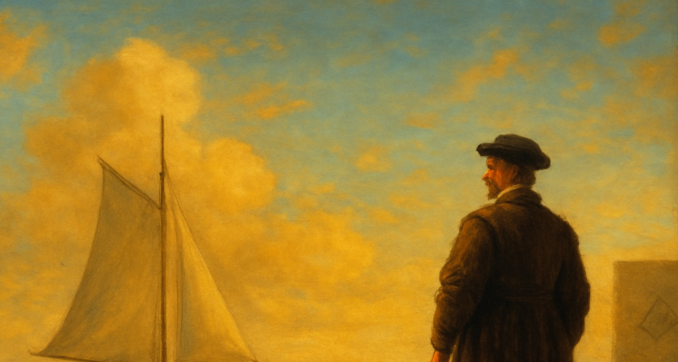
In his sixth essay from the first book, Michel de Montaigne examines what appears to be a practical theme: the dangers of negotiation in times of conflict. Yet beneath the surface lies a profound philosophical question about trust, vulnerability, and human integrity. When we read this essay through two distinct lenses — classical philosophy and Masonic symbolism — a surprising conversation emerges between two worlds that both seek truth in moments of uncertainty.
The World of the Renaissance Humanist
Montaigne wrote his essays during the second half of the sixteenth century, a period when France was torn apart by religious civil wars. The humanistic tradition of the Renaissance formed his intellectual foundation. This movement, inspired by rediscovered classical texts, placed human experience at the center of the search for wisdom. For Montaigne, this meant a return to the sources: the Greek and Roman thinkers who had grappled with the very same human dilemmas centuries before.
His essay on the perilous hours of negotiation reveals just how deeply rooted Montaigne was in this tradition. He draws on historical examples, references generals and statesmen from antiquity, and uses their experiences as a mirror for his own troubled times. This method was a hallmark of Renaissance humanism: treating the past as a teacher for the present.
Stoic and Skeptic Influences
Two philosophical currents run particularly deep through this essay. The first is Stoicism, especially as transmitted through the works of Seneca and Plutarch. The Stoics taught that a wise person should not be governed by emotions or external circumstances, but by inner virtue and rational judgment. This lesson echoes throughout the essay whenever Montaigne warns against the temptation to lower one’s guard during negotiations.
The moment of apparent peace is often the most dangerous moment, because the mind then inclines toward carelessness.
The second influence is Pyrrhonian skepticism, which Montaigne would embrace with increasing conviction as he grew older. Named after the Greek philosopher Pyrrho, this school of thought holds that absolute certainty is impossible. In the context of negotiation, this translates into a fundamental distrust of the words and promises of the opposing party — not out of cynicism, but out of epistemological humility. We can never fully know what lives in another person’s heart.
The Symbolic World of the Freemason
When we approach the same themes from the perspective of Masonic symbolism, the viewpoint shifts in a fascinating way. Where Montaigne speaks of the dangers of negotiation between enemies, the Freemason recognizes the ritual moment of transition: the threshold between outside and inside, between the profane and the sacred. This threshold is no neutral point but a charged boundary where vigilance is essential.
The symbol of the blindfold during initiation illustrates this powerfully. The candidate finds himself temporarily in a state of not-knowing, entirely dependent on trust in those who lead him. It is a moment of vulnerability that paradoxically demands safety. The Freemason learns here what Montaigne observed on the battlefield: moments of transition call for heightened attention.
Where Both Worlds Meet
Despite their different languages and contexts, the humanist philosopher and the Freemason meet on crucial common ground. Both acknowledge that moments of transition — whether a ceasefire or a ritual passage — require a special quality of presence. It is no coincidence that Freemasonry places great importance on contemplation and self-examination, precisely the practices that Montaigne champions throughout his essays.
Both traditions warn against complacency in seemingly safe moments. Both emphasize the importance of inner integrity over outward appearance. Both look to classical antiquity as a source of timeless wisdom. And both recognize the limits of human knowledge and certainty.
The Lesson Both Perspectives Offer
Comparing Montaigne’s philosophical background with Masonic symbolism does not yield a simple synthesis, but it does produce a deeper understanding. The humanist teaches us to look critically at historical examples and to question our own assumptions. The symbolic tradition teaches us that some truths cannot be captured in arguments but must be experienced through ritual.
Together, they point to a fundamental human condition: we constantly find ourselves on thresholds, in transitions, in moments of negotiation with ourselves and others. The question is not whether we are vulnerable in such moments, but how we handle that vulnerability. Montaigne would say: through relentless self-examination. The Freemason would answer: by letting the symbols speak where words fall short. Both answers deserve our attention.
On closer inspection, Montaigne’s essay on the dangerous hours of negotiation turns out to be a rich philosophical text that far transcends practical advice for military commanders. His roots in Stoicism, skepticism, and Renaissance humanism give the essay a timeless depth. When we place this wisdom alongside the symbolic language of Freemasonry, we see how different traditions approach the same human challenge: how do we remain honest and vigilant when circumstances invite us toward carelessness? The answer may not lie in either tradition alone, but in our willingness to learn from both.
Copyright text & image: devrijmetselaar.nl
Texts are based on the ideas and content of the author of devrijmetselaar.nl, reviewed, corrected, and supplemented with the assistance of OpenAI. Images are created based on the ideas of the author of devrijmetselaar.nl using OpenAI/DALL-E.
Frequently Asked Questions
How does Freemasonry relate to Renaissance philosophy and Montaigne's ideas?
Both Freemasonry and Renaissance humanism, as exemplified in Montaigne's work, share a deep commitment to seeking truth through human experience and wisdom from classical sources. The Masonic tradition incorporates philosophical principles about virtue, rational judgment, and self-knowledge that echo the Stoic and skeptical influences found in Montaigne's essays. This philosophical alignment demonstrates how Freemasonry preserves and transmits timeless wisdom about human nature and integrity across centuries.
What is the significance of the blindfold in Masonic initiation?
The blindfold during Masonic initiation symbolizes a deliberate state of not-knowing that parallels Montaigne's philosophical skepticism about absolute certainty. This ritual moment represents the threshold between ignorance and enlightenment, teaching the candidate epistemological humility and the importance of vigilance during moments of transition. The blindfold ultimately prepares the initiate to receive light and wisdom with proper respect and awareness.
How does Freemasonry teach about trust and vulnerability?
Freemasonry, like Montaigne's philosophy, recognizes that trust must be balanced with vigilance and moral integrity rather than naive openness. The fraternal bonds in Masonry are built on shared virtues and rational judgment, not blind faith, creating a community where vulnerability is protected by mutual commitment to honor and truth. This approach transforms potentially dangerous moments of exposure into opportunities for genuine human connection grounded in authentic principles.
Why is Masonic symbolism relevant to understanding practical human challenges?
Masonic symbolism, like the classical examples Montaigne drew upon, serves as a timeless mirror for understanding present-day human dilemmas around trust, negotiation, and integrity. The ritual symbols encode profound philosophical lessons that help Masons navigate complex situations with wisdom drawn from ancient traditions. By engaging with these symbols, Freemasons develop the rational judgment and self-awareness needed to face life's challenges authentically.


Be the first to comment