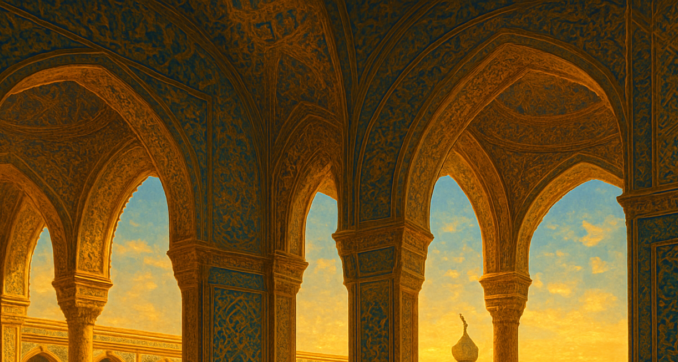
What does it truly mean to be a citizen of a city? Not merely someone who lives there, but someone who bears responsibility for it — who builds upon its foundations of justice and compassion? In the ninetieth surah of the Quran, known as Al-Balad (The City), humanity is confronted with a penetrating mirror: are you willing to climb the steep path? That question resonates with surprising force within a tradition that sees itself as a brotherhood of builders. In this article, we place two perspectives side by side: the Quranic vision of the city as a moral trial and the Masonic vision of building an inner temple. Not to equate them, but to discover where they meet.
The Quranic City: An Oath and a Mission
Surah Al-Balad opens with an oath sworn upon the city itself — traditionally understood as Mecca, the holy city where the Prophet resided. The text speaks of humanity being created into hardship and struggle. Life is not a tranquil plain but a continuous climb. The surah then presents a crucial choice: a person can squander their wealth in vanity, or they can choose the steep path. That steep path consists of freeing a slave, feeding an orphan or a person in need during times of famine, and belonging to those who practice patience and mercy.
In this surah, the city is far more than a geographical location. It represents the whole of human society — the fabric of relationships within which a person makes their moral choices. The oath upon the city is an oath upon the community itself, upon the responsibility that comes with being human. The renowned Quranic scholar Ibn Kathir interpreted the steep path as the struggle against one’s own ego — an inner jihad that weighs more heavily than any outward battle.
The Masonic City: Building the Inner Temple
Freemasonry has no holy city in the literal sense, but the image of the city as a constructed work is deeply embedded in its tradition. The lodge itself is sometimes described as a reflection of the Temple of Solomon — the ideal edifice that embodies the pursuit of perfection. But the true city the Freemason builds is an inner one. James Anderson, who compiled the first Constitutions of Freemasonry in 1723, emphasized the moral edifice that every Brother must erect within himself. Jean-Théophile Désaguliers, co-founder of the Grand Lodge of London, likewise stressed that the art of building was a metaphor for the improvement of character and society.
Where the Quranic city calls humanity to compassion and liberation, the Masonic city calls humanity to self-knowledge and fraternal connection. The rough ashlar that the Entered Apprentice works upon is nothing other than his own imperfect character. The polished stone that emerges from that labor is his contribution to a greater whole — a city of just individuals who together form a living temple. Johann Wolfgang von Goethe, who was initiated as a Freemason, wrote about this inner architecture in his work Wilhelm Meister’s Journeyman Years, describing humanity as perpetually building upon itself, stone by stone, choice after choice.
The Steep Path and the Rough Ashlar: Where Two Traditions Meet
At first glance, the Quranic surah and the Masonic tradition seem to belong to entirely different worlds. One is rooted in divine revelation; the other is a brotherhood that expressly does not consider itself a religion. Yet they share a striking conviction: that moral growth requires effort. The steep path in Al-Balad is no easy route. It demands sacrifice — sharing one’s possessions, showing patience, choosing others over personal comfort. In precisely the same way, the Masonic tradition describes the working of the rough ashlar as a lifelong endeavor, not a one-time gesture.
Both traditions also warn against self-deception. Al-Balad speaks of the person who claims to have spent great wealth, while thinking no one sees him. The text reminds us that humanity has been given eyes, a tongue, and lips — not only to speak but to distinguish between good and evil. In Freemasonry, the All-Seeing Eye serves a comparable function: it reminds the Brother that his deeds are weighed, not by a punishing authority, but by his own conscience. Marcus Aurelius, the Stoic emperor whose Meditations are studied by many Freemasons, wrote in the same spirit that no one can flee from their own inner judgment.
Two Perspectives on Liberation
One of the most striking images in Al-Balad is the freeing of a slave as the first step on the steep path. In the seventh-century context of the Arabian Peninsula, this was a radical social statement. But its meaning reaches beyond the literal act. Later Quranic commentators also read in this verse the liberation of the person from their own chains — greed, pride, indifference. This spiritual reading finds a remarkable echo in the Masonic initiation, in which the candidate enters the lodge blindfolded and stripped of metallic objects. He is symbolically freed from outward wealth and status in order to be received as an equal among equals.
Spinoza, whose philosophy of inner freedom is valued by many Freemasons, argued that true freedom does not consist of doing whatever one desires, but of understanding the laws that govern existence. That thought bridges the distance between the Quranic and the Masonic vision of liberation. In both cases, freedom begins with recognizing what binds us — whether those are outward chains or inner ones. The steep path upward, in both traditions, starts with the humility to acknowledge one’s own bondage.
Shared Ground, Distinct Paths
It is important to emphasize that drawing parallels between the Quran and Freemasonry is not an attempt to merge or equate the two. The Quran is a text of divine revelation for Muslims, carrying an authority rooted in faith. Freemasonry is a fraternal order that welcomes men of all faiths and encourages each to deepen his own spiritual understanding. What makes the comparison illuminating is not the similarities alone, but the way both traditions independently arrive at a shared truth: that authentic spirituality is not found in words, but in the daily courage to walk the steep path of compassion and self-improvement.
The city — whether Mecca or the symbolic lodge — is never simply a place one inhabits. It is a space of moral obligation, a community that demands something of its citizens. The Quran asks: will you climb? Freemasonry asks: will you build? Both questions ultimately point in the same direction — upward, toward a better version of ourselves and the society we share.
Both the Quranic Surah Al-Balad and the Masonic tradition teach that true spirituality does not reside in words alone, but in the daily courage to walk the steep path of compassion and self-improvement. Whether one is called to climb or called to build, the destination is the same: a life of moral purpose, lived not in isolation but in service to the greater human city we all inhabit together.
Copyright text & image: devrijmetselaar.nl
Texts are based on the ideas and content of the author of devrijmetselaar.nl, reviewed, corrected, and supplemented with the assistance of OpenAI. Images are created based on the ideas of the author of devrijmetselaar.nl using OpenAI/DALL-E.
Frequently Asked Questions
What is the main similarity between the Quranic concept of the city and the Masonic vision?
Both traditions view the city not merely as a physical location but as a moral and spiritual journey. In the Quran's Surah Al-Balad, the city represents the fabric of human society and moral responsibility, while in Freemasonry, the city is a metaphor for building an inner temple and improving one's character. Both emphasize personal transformation and ethical conduct within community.
What does Surah Al-Balad mean by 'the steep path'?
According to the article, the steep path refers to the choice to pursue virtue through specific moral actions: freeing slaves, feeding orphans and those in need during times of famine, and practicing patience and mercy. Scholar Ibn Kathir interpreted this steep path as an inner struggle against one's own ego, representing an inner jihad that is more significant than outward battles.
How do Freemasons interpret the concept of building a city?
Freemasonry uses the image of building—particularly referencing the Temple of Solomon—as a metaphor for personal and societal improvement. Rather than constructing a literal city, Freemasons focus on building an inner temple through character development. Early Masonic leaders like James Anderson and Jean-Théophile Désaguliers emphasized that the art of building symbolizes moral elevation and the improvement of both individual character and society.

Be the first to comment