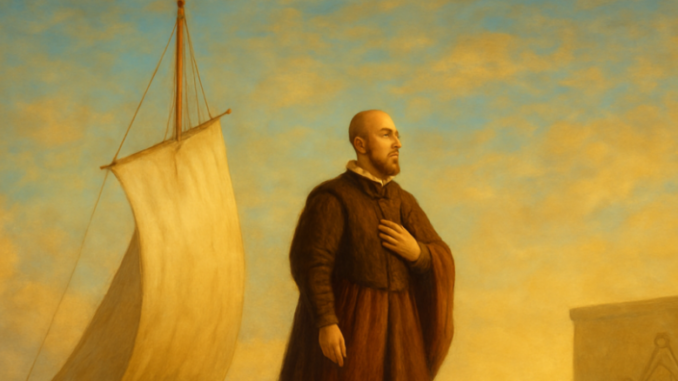
When Michel de Montaigne examines conscience in the fifth essay of his second book, he does not write in an intellectual vacuum. His thoughts on guilt, self-knowledge, and the inner judge draw from centuries of philosophical tradition. From the Stoics to the Skeptics, from Plutarch to the humanists of his own era, Montaigne weaves a tapestry of influences into something distinctly his own. This article places his essay within that broader intellectual context and reveals how two seemingly opposing philosophical worlds — the ancient and the Renaissance — converge in his thinking.
The Ancient Voice: Stoicism and the Inner Tribunal
Stoic philosophy is one of the most important sources for Montaigne’s reflections on conscience. For thinkers like Seneca and Epictetus, conscience was not an abstract concept but a living force — an inner tribunal that constantly holds a person to account. In his letters to Lucilius, Seneca wrote that the wise man should interrogate himself every evening, acting as his own judge. This image of the self-judging individual returns in Montaigne’s work, though in an adapted form.
Where Seneca preaches a certain rigor and treats conscience as an instrument of moral discipline, Montaigne takes a more nuanced position. He acknowledges the power of conscience, but he also questions it. Is conscience truly a reliable guide, or can it also mislead? It is precisely in this doubt that the influence of another ancient tradition reveals itself.
The Skeptical Undercurrent: Pyrrho and the Art of Suspension
Montaigne is often placed within the tradition of Skepticism, and not without reason. The Greek philosopher Pyrrho of Elis taught that true wisdom begins with the suspension of judgment. Nothing is certain, and the person who believes they possess the truth deceives themselves most of all. Montaigne translated this principle into his own world. His famous motto — Que sais-je? (What do I know?) — is not a rhetorical question but a philosophical program.
In the essay on conscience, this skeptical attitude operates in subtle ways. Montaigne describes how the guilty betray themselves through their own fear and restlessness, but he simultaneously observes that the innocent sometimes display the very same signs. Conscience, then, is no infallible measure. With this insight, Montaigne undermines both the Stoic certainty and the legal practices of his own time, in which a suspect’s physical reaction could be taken as proof of guilt. Sextus Empiricus, whose works Montaigne studied thoroughly, would have recognized this dismantling of apparent certainties.
Plutarch as Mirror and Guide
No ancient author influenced Montaigne as profoundly as Plutarch. The Greek writer was not a dusty authority for him but a living conversational partner. Plutarch’s Moralia, with their rich collection of ethical reflections and anecdotes, served as a direct source for the essay on conscience. Montaigne employs similar narrative strategies: he illustrates a philosophical point with a vivid anecdote, shifts effortlessly between the personal and the universal, and avoids dogmatic conclusions.
What Montaigne takes from Plutarch is above all a method. Where Aristotle works systematically and Plato chooses the dialogue as his vehicle, Plutarch offers a more associative, almost meditative prose. Montaigne refined this approach into his own essayistic form — searching, probing, willing to change direction mid-thought. Under his pen, conscience becomes not a fixed concept but a living phenomenon that resists definitive description.
Renaissance Humanism: The Human Being as Measure
Montaigne wrote during a period when Renaissance humanism had transformed Europe’s intellectual landscape. Thinkers like Erasmus and Giovanni Pico della Mirandola had placed the human being at the center once again — not as a sinful creature that could only be saved through grace, but as a being endowed with dignity, reason, and the capacity for self-examination. This humanistic keynote resonates throughout Montaigne’s approach to conscience.
Yet Montaigne distinguishes himself from his humanist contemporaries through a certain modesty. Where Pico della Mirandola, in his famous oration on human dignity, elevates humanity to near-divine heights, Montaigne stays closer to the ground. The human being is both grand and flawed. Conscience is proof of this: it can keep us on the right path just as easily as it can torment us with unfounded fear. This ambiguity does not fit within a triumphalist vision of humanity, but it fits perfectly within Montaigne’s honest, sometimes uncomfortable self-portrait.
For Montaigne, conscience is neither a divine voice nor a moral compass. It is a mirror that forces us to face ourselves — with all our greatness and all our imperfections.
Two Worlds, One Quest
What stands out when we place the ancient and Renaissance influences side by side is that they do not form an opposition in Montaigne’s essay, but rather a productive tension. The Stoics gave him the image of the inner tribunal. The Skeptics taught him to distrust that tribunal. Plutarch gave him the narrative art to bring both positions to life. And humanism gave him the confidence that such self-examination is worth the effort.
This layered quality makes the essay on conscience far more than a historical document. It is an invitation to adopt an attitude that will feel deeply familiar to Freemasons: the willingness to examine yourself without knowing in advance what you will find. The rough ashlar is not shaped according to a blueprint but through a continuous process of looking, chiseling, and looking again. Montaigne would have recognized this method as kindred to his own essayistic practice — trying, failing, and trying once more.
The Philosophical Legacy
Montaigne’s essay on conscience stands at a crossroads of traditions. It draws from the moral seriousness of the Stoics, the intellectual humility of the Skeptics, the narrative warmth of Plutarch, and the humanist confidence in human self-knowledge. None of these traditions alone explains his vision; together, they form a philosophy of conscience that remains strikingly relevant.
For anyone engaged in the work of self-improvement — whether through philosophical study, Masonic practice, or simply the daily discipline of honest reflection — Montaigne’s approach offers a valuable lesson. Conscience is not something you master once and for all. It is something you engage with, question, and revisit throughout your life. The philosophical roots of his essay remind us that this process of inner inquiry is as old as philosophy itself, and as necessary today as it ever was.
Montaigne’s exploration of conscience reveals a thinker who refused to settle for easy answers. By drawing on Stoic discipline, Skeptical doubt, Plutarch’s storytelling, and humanist confidence, he crafted a vision of conscience that is neither fixed nor final — but endlessly searching. It is a vision that speaks directly to the Masonic commitment to self-knowledge: the understanding that the most important work is always the work we do within ourselves, guided not by certainty but by the courage to keep looking.
Copyright text & image: devrijmetselaar.nl
Texts are based on the ideas and content of the author of devrijmetselaar.nl, reviewed, corrected, and supplemented with the assistance of OpenAI. Images are created based on the ideas of the author of devrijmetselaar.nl using OpenAI/DALL-E.
Frequently Asked Questions
What is the main topic of Montaigne's essay on conscience?
Montaigne examines conscience in the fifth essay of his second book, exploring guilt, self-knowledge, and the inner judge. He places his reflections within centuries of philosophical tradition, drawing from Stoic, Skeptical, and Renaissance humanist influences to develop his own nuanced understanding of conscience as a complex and not always reliable guide.
How does Montaigne's view of conscience differ from Stoic philosophy?
While Stoic philosophers like Seneca treated conscience as a rigorous inner tribunal that should constantly hold a person accountable, Montaigne takes a more questioning approach. He acknowledges conscience's power but also doubts its reliability, asking whether conscience is truly a dependable moral guide or if it can also mislead us.
What role does skepticism play in Montaigne's philosophy of conscience?
Montaigne adopts the skeptical principle of suspension of judgment, embodied in his motto 'Que sais-je?' (What do I know?). In his essay on conscience, this skepticism manifests as the observation that both the guilty and innocent can display similar signs of fear and restlessness, suggesting that conscience is not an infallible measure and cannot be used as proof of guilt.

Be the first to comment