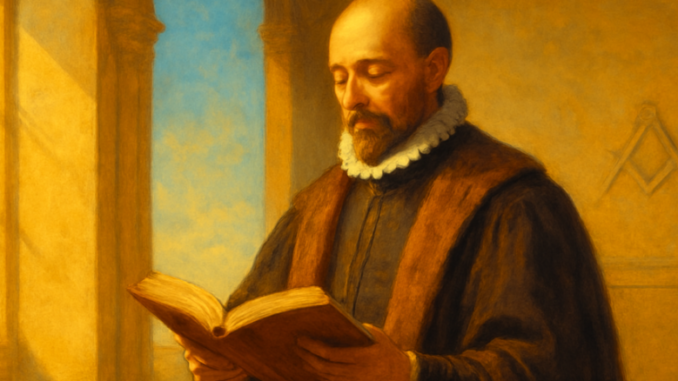
Can you truly prepare for death? And if so, how would you go about it without actually dying? Michel de Montaigne posed exactly this question in his essay ‘On Practice’ — the sixth essay of the second book of his famous Essays. What he discovered after a nearly fatal horse-riding accident changed his view of dying forever. This article offers an accessible summary of that essay and explores how Montaigne’s insights touch the very heart of Freemasonry: the practice of confronting our finitude as a path toward deeper living.
What Is This Essay Really About?
The essay ‘On Practice’ revolves around a question that has occupied humanity for centuries: can we learn to die? Montaigne opens with a stark observation — death is the one experience we can only undergo once. There is no second chance, no dress rehearsal. This makes it the ultimate trial, one for which no amount of preparation can fully equip us. And yet, he argues, there are moments in life that come close enough to death to teach us something about what dying actually means.
Montaigne distinguishes between two forms of preparation. The first is the intellectual path: studying death through philosophy. He invokes the Roman Stoic Seneca and the Greek sage Socrates as thinkers who made dying a central theme of the philosophical life. But Montaigne is honest with himself and his reader — all that reading and thinking only gets you partway there. The second path is experience itself: the bodily sensation of undergoing something that resembles death. And that, as it happens, is exactly what Montaigne went through.
What Happened to Montaigne?
At the heart of this essay lies a remarkably personal account. Montaigne describes how, during a horseback ride, he was struck by another horse charging toward him at full gallop. He was thrown from his mount and lay unconscious on the ground. His servants found him and believed him dead. He was vomiting blood, his body cold and rigid. It took hours before he gradually regained consciousness, though his mind remained suspended in a twilight zone between life and death for some time.
What struck Montaigne most was not the pain or the fear — but their absence. In that state of semi-consciousness, he experienced a certain sweetness, a gradual drifting away that held nothing terrifying. His body seemed to know what it was doing even without his mind fully engaged. He describes making automatic movements, giving orders to servants, even unbuttoning his coat — none of which he could later remember. Nature, he concludes, has granted us a kind of anaesthesia that makes the process of dying far less frightening than we imagine it to be.
What Does This Teach Us About Self-Knowledge?
Here Montaigne makes a striking turn. The essay is not only about death — it is about the limits of self-knowledge. Montaigne observes that we cannot perceive our own dying at the moment it happens. Just as we are never aware of the precise moment we fall asleep, so too do we slip into death without noticing it. This insight is both liberating and unsettling: it means that our consciousness has boundaries that no amount of intellectual effort can transcend.
With this observation, Montaigne places a critical footnote beside the entire philosophical tradition of ‘Know Thyself’ — the famous maxim inscribed at the Temple of Apollo at Delphi and elevated by Socrates to the very core of wisdom. Yes, self-knowledge is essential, but it has its own blind spots. The body knows things the mind cannot grasp. This humility is characteristic of Montaigne and elevates the essay far beyond a mere anecdote about a riding accident.
To come to know death by nearly undergoing it — that, according to Montaigne, is the only practice that genuinely prepares us for the inevitable.
What Does This Have to Do With Freemasonry?
Anyone familiar with Masonic ritual will recognise a striking parallel in Montaigne’s account. Freemasonry includes ritual moments in which the candidate symbolically dies and is reborn. This experience is not theatre — it is an inner trial designed to confront the participant with his own mortality. Just as Montaigne discovered, Brethren find that the confrontation with death, even in symbolic form, opens a deeper layer of self-knowledge that thinking alone cannot reach.
Montaigne’s conclusion that nature protects us from the full terror of dying resonates with a fundamental Masonic idea: that the mystery of death is not something to be feared, but to be lived through. The ritual practice is not a simulation. It is an invitation to face the unknown with trust rather than dread. Hiram Abiff, the legendary Master Builder of Masonic tradition, embodies exactly this attitude — faithful to his principles beyond the boundary of his own life.
The symbolic death in Masonic initiation, much like Montaigne’s brush with death, serves as a transformative experience. It strips away pretence, dissolves the ego’s comfortable certainties, and reveals something raw and essential about what it means to be alive. Both Montaigne and the Craft remind us that you cannot truly know life without acknowledging its end.
Why This Essay Still Matters Today
In an age when death is increasingly removed from daily life — hidden away in hospitals and care homes — Montaigne’s plea for practice is more relevant than ever. He does not ask us to become morbid, but to become honest. Anyone who never reflects on their own mortality, who never engages in the practice of confronting finitude, misses an essential dimension of life itself. The Stoics, particularly Marcus Aurelius in his Meditations, made the same appeal: begin each day with the awareness that it could be your last.
Yet Montaigne goes further than the Stoics. Where they sought to tame death through reason, he shows that experience itself — the bodily, physical encounter — contains a wisdom that surpasses the intellect. This makes ‘On Practice’ one of the most personal and courageous essays in the entire collection. It is a text that does not merely want to be read — it wants to be felt.
For Freemasons, this resonance runs deep. The Lodge is, in many ways, a space dedicated to exactly the kind of practice Montaigne describes. It is a place where mortality is not a taboo subject but a cornerstone of reflection, where the symbols of death — the skull, the coffin, the dark chamber — are not macabre decorations but tools for inner transformation. Montaigne would have understood the purpose of these symbols instinctively.
Montaigne’s ‘On Practice’ remains a profound meditation on the limits of human knowledge and the liberating power of confronting our own mortality. His near-death experience taught him what philosophy alone could not: that dying may be gentler than we fear, and that the body carries a wisdom the mind cannot fully access. For Freemasons, his insights affirm what the Craft has long practised through ritual — that by symbolically dying, we learn to live more deeply, more honestly, and more courageously. The practice of confronting death is not a rehearsal for the end. It is a rehearsal for a fuller, more authentic life.
Copyright text & image: devrijmetselaar.nl
Texts are based on the ideas and content of the author of devrijmetselaar.nl, reviewed, corrected, and supplemented with the assistance of OpenAI. Images are created based on the ideas of the author of devrijmetselaar.nl using OpenAI/DALL-E.
Frequently Asked Questions
What is the main topic of Montaigne's essay 'On Practice'?
Montaigne's essay explores whether humans can truly prepare for death and learn to die before actually experiencing it. He examines two paths of preparation: intellectual study through philosophy and direct experience through near-death moments. The essay ultimately questions how we can confront our finitude as a means to live more meaningfully.
What was Montaigne's near-death experience and what did it teach him?
Montaigne was thrown from his horse after being struck by another horse at full gallop and lost consciousness. During this experience, he expected to feel fear and pain, but instead found an unexpected sweetness and gradual drifting away. His body acted automatically without conscious engagement, teaching him that the actual experience of dying may be less terrifying than the anticipation of it.
How does this essay relate to Freemasonry?
Montaigne's insights about confronting finitude and mortality touch the heart of Freemasonry's practices and teachings. Both emphasize personal transformation through facing life's ultimate truths and using that confrontation as a path toward deeper living and self-understanding.

Be the first to comment