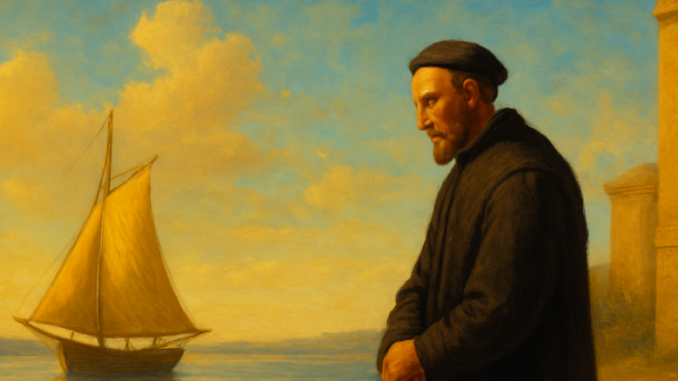
There is an ancient symbol familiar to most Freemasons: the rough ashlar. It represents the human being in an unworked state — raw, unpolished, and full of contradictions. When we turn to the very first essay in Michel de Montaigne‘s celebrated Essais, that image becomes almost tangible. In his reflections on the inconstancy of our actions, the sixteenth-century philosopher holds up a mirror in which we recognise ourselves as beings who constantly shift, act in contradiction with themselves, and in doing so reveal something profoundly human.
The Core Idea: Man as a Riddle to Himself
Montaigne opens his essay with a sharp observation. Anyone who tries to judge another person by their actions runs into a fundamental problem: our deeds constantly contradict one another. The same individual who acts with courage today may prove a coward tomorrow. The person who gives generously now may cling to possessions later. For Montaigne, this is not a moral failing — it is simply the human condition laid bare.
He resists the temptation to sort people into fixed categories. Labels like “brave” or “greedy” do not do justice to reality. We are not statues of virtue or vice, but living beings who move, stumble, and continually reshape ourselves. This insight lies at the heart of the essay: a human being is not a fixed entity, but a process.
Historical Examples as Mirror Images
To illustrate his point, Montaigne draws generously from history. He invokes great figures of antiquity whose actions stood in stark opposition to one another. A general who sent thousands of soldiers to their deaths could later weep over the loss of a single friend. A severe judge might reveal surprising tenderness at home. Montaigne uses these examples not to pass judgement, but to show how little a person’s outward behaviour tells us about their inner world.
To judge someone by a single deed is to miss the multitude that truly defines them.
This approach echoes the way symbols function in Freemasonry. A symbol is never one-dimensional. The compasses, the square, the rough ashlar — each carries multiple layers of meaning. So too does the human being. Montaigne invites us to look beyond the surface and accept the complexity that hides behind every action.
Self-Knowledge as a Life’s Work
Beneath Montaigne’s musings on inconstancy lies a deeper theme: the pursuit of self-knowledge. He wrote his essays as a form of self-examination. His aim was not to measure others, but to come to know himself. In this respect, he stands remarkably close to the Masonic tradition, in which the working of one’s own inner stone is the central endeavour.
Recognising that we are contradictory is not an endpoint but a starting point. Only when we face our own inconstancy can we begin the work of integration — not by erasing our contradictions, but by acknowledging them and entering into dialogue with them. This is precisely what the rough ashlar symbolises: not a defect to be chipped away, but potential that calls for attention.
Symbolic Depth: Man as an Unfinished Work of Art
When we read Montaigne’s essay through a symbolic lens, a striking perspective reveals itself. The inconstancy he describes is not so much a problem as an invitation. A human being is an unfinished work of art — a stone that still awaits the mason’s hand. Every contradictory action is like a new stroke of the chisel: sometimes precise, sometimes off the mark, but always part of a larger process.
In Masonic symbolism, the perfect ashlar represents the ideal — a stone hewn to perfection, ready to take its place in the greater structure. But this ideal is not a destination one arrives at. It is a direction, a point of orientation. Montaigne would likely have recognised this idea. He never sought a definitive answer to the question of who he was. Instead, he sought an honest engagement with the question itself.
Embracing Contradiction
What does all of this mean for the modern reader? Perhaps above all this: that we may free ourselves from the tyranny of consistency. In a world that constantly demands we present a clear and coherent narrative about who we are, Montaigne offers a refreshing counter-voice. It is permissible to be contradictory. It is, in fact, unavoidable.
This recognition opens the door to compassion — both toward ourselves and toward others. When we accept that we ourselves act one way today and differently tomorrow, it becomes easier to grant that same space to those around us. This may be the essay’s deepest lesson: not judgement, but understanding forms the path to wisdom.
Consider these key insights from Montaigne’s essay and its Masonic resonance:
- A human being is not a fixed character, but a process in motion.
- Contradictory actions are not moral failures, but human realities.
- Self-knowledge begins with acknowledging our own inconstancy.
- Symbols like the rough ashlar reflect this ongoing process of formation.
Michel de Montaigne’s essay on the inconstancy of our actions is far more than a philosophical observation. It is an invitation to explore our own inner landscape with the same curiosity we bring to the outer world. In the recognition that we are changeable lies not weakness, but strength — the possibility to grow, to learn, and to begin again. Just as the rough ashlar awaits the hand of the craftsman, so our inner self awaits the patient work that self-knowledge demands. Montaigne reminds us that this work is never finished, and that therein lies its beauty.
Copyright text & image: devrijmetselaar.nl
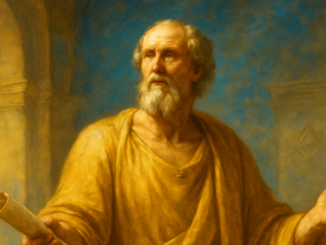
Texts are based on the ideas and content of the author of devrijmetselaar.nl, reviewed, corrected, and supplemented with the assistance of OpenAI. Images are created based on the ideas of the author of devrijmetselaar.nl using OpenAI/DALL-E.
Frequently Asked Questions
How does Montaigne's philosophy relate to Masonic teachings about self-improvement?
Montaigne's emphasis on self-knowledge and recognizing our contradictions aligns perfectly with Masonic practice, where the working of one's inner stone is central to personal growth. Both traditions teach that acknowledging our imperfections is not weakness but the essential first step toward genuine transformation and self-mastery. The rough ashlar symbolizes this exact principle: we are unfinished beings with infinite potential for development.
What does the rough ashlar symbol mean in Freemasonry?
The rough ashlar represents the human being in an unworked state—raw, unpolished, and full of contradictions. Rather than viewing this as a defect, Freemasonry sees it as tremendous potential waiting to be refined through the ongoing work of self-examination and personal development. It reminds us that we are never finished but always in the process of becoming better versions of ourselves.
Why does Montaigne say we shouldn't judge people by their actions alone?
Montaigne observed that our actions constantly contradict one another—someone brave one day may act fearfully the next, and someone generous now may be miserly later. This is not moral failure but simply the human condition; we are living, evolving beings rather than fixed statues of virtue or vice. Understanding this complexity helps us approach others, and ourselves, with greater compassion and wisdom.
How does Freemasonry use symbols to teach about human nature?
Masonic symbols like the compasses, square, and rough ashlar are deliberately multidimensional, each carrying multiple layers of meaning that reflect the complexity of human nature itself. Just as Montaigne invites us to look beyond surface appearances, Freemasonry teaches that symbols never show only one dimension—they encourage deeper reflection and self-discovery. This approach honors the richness and mystery of what it means to be human.
Is Montaigne's view of human inconsistency a pessimistic one?
Not at all—Montaigne's recognition of our inconstancy is profoundly hopeful and aligns with Masonic optimism about human potential. By acknowledging that we are not fixed and unchanging, he opens the door to genuine growth and transformation. This perspective liberates us from rigid self-judgment and invites us to engage in the lifelong work of becoming wiser, more integrated versions of ourselves.
Be the first to comment