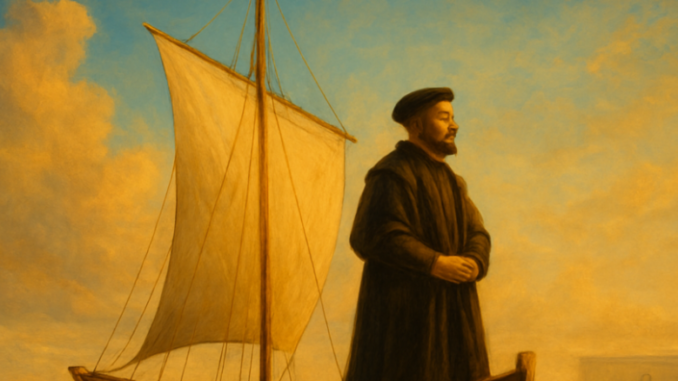
Picture a man in a stone tower library in the Dordogne, surrounded by thousands of books. He picks up a volume of Plutarch, sets it down, reaches for Sextus Empiricus, and scribbles a thought in the margin that has been haunting him for weeks: how can anyone ever be certain of their own judgment? Michel de Montaigne did not write his forty-seventh essay in an intellectual vacuum. Behind every doubting sentence lies an ancient philosophical conversation — a chain of thinkers who shaped and challenged him. This article traces that conversation back to its sources and forward to its unexpected resonance within Freemasonry.
The Skeptical Tradition as Foundation
Anyone seeking to understand the philosophical roots of Montaigne’s essay inevitably arrives at Pyrrhonian skepticism. Pyrrho of Elis, who lived in the fourth century BCE, taught that human beings cannot attain definitive knowledge about reality. He advocated for the suspension of judgment — known in Greek as epoché. Montaigne did not read these ideas directly from Pyrrho’s hand but encountered them through the writings of Sextus Empiricus, whose works were brought back into circulation during the sixteenth century thanks to the printing press. The rediscovery of these texts sent an intellectual shockwave through Renaissance Europe.
Montaigne famously had the motto Que sais-je? — “What do I know?” — engraved in his library, a phrase that captures the very essence of Pyrrhonism. His essay “On the Uncertainty of Our Judgment” fits seamlessly into this skeptical lineage. In it, Montaigne examines how people in wartime arrive at entirely opposite conclusions based on the same set of facts. He demonstrates that the outcome of a decision does not prove the judgment behind it was sound. Chance plays at least as great a role as reason. This is not nihilism — it is a deeply felt intellectual humility that reaches directly back to the ancient tradition of doubt.
Plutarch and Seneca as Conversation Partners
Montaigne called Plutarch and Seneca his two favorite authors, and their influence on Essay 47 is unmistakable. Plutarch, the Greek biographer and moralist, provided Montaigne with a treasure chest of historical examples — generals and statesmen who made seemingly brilliant decisions, yet whose success owed as much to luck as to insight. Montaigne adopted Plutarch’s method: placing contradictory examples side by side to force the reader to think for themselves, rather than imposing a single moral verdict.
Seneca, the Roman Stoic, offered Montaigne a different perspective. The Stoics believed that a person can and should train their judgment, while acknowledging that the external world lies beyond our control. Seneca’s letters to Lucilius repeatedly warn that even the wisest person can misjudge a situation. Montaigne absorbed this warning but pushed it further than Seneca ever did. Where the Stoic still trusted in the possibility of attaining wisdom, Montaigne doubted even that. He radicalized the Stoic reservation into a full acknowledgment of human fallibility.
Renaissance Humanism and the Rediscovery of the Human
The intellectual climate of the sixteenth century provided the fertile ground in which Montaigne’s doubt could flourish. Renaissance humanism, with forerunners like Francesco Petrarch and Erasmus of Rotterdam, had placed the human being back at the center of inquiry. Theology was no longer the sole frame of reference; classical antiquity was rediscovered as a source of wisdom valuable beyond the walls of the church. Montaigne stood on the shoulders of these humanists — but looked in a different direction. Where many humanists celebrated human reason, Montaigne exposed its limits.
This places him in a remarkable position. He was not an anti-humanist, but a humanist who subjected humanism itself to critical scrutiny. His essay on the uncertainty of judgment is a striking example: the person who studies themselves discovers that their intellect misleads them just as often as it illuminates. This realization is not defeatist — it is liberating. It opens the door to a posture of continual learning, a willingness to let go of the conviction that one is right. Montaigne’s philosophy of doubt is not a weakness but an act of intellectual courage: whoever acknowledges that their judgment is fallible stands open to genuine growth.
Uncertainty as a Building Block for the Freemason
Freemasonry, which took its organized form more than a century after Montaigne’s death, shares a surprising amount with his philosophical stance. The lodge is a space where brethren come together from different convictions, backgrounds, and worldviews. The foundation of that gathering is not a shared certainty but a shared desire for insight. Anyone who enters a lodge is not asked to provide answers but to ask questions, to listen, and to continually test their own judgment against that of others.
The philosophical line running from Pyrrho through Sextus Empiricus to Montaigne finds a surprising continuation in the ritual practice of Freemasonry. The ritual invites the Freemason to pause and reflect on the limits of their knowing — not in order to stop thinking, but to think more deeply. The rough ashlar that must be shaped is not merely a call to self-improvement; it is also a reminder that the work is never finished, that every judgment remains provisional. Montaigne would have recognized himself in that thought.
A Chain of Thinkers, a Chain of Brethren
The intellectual lineage of Essay 47 reveals that great ideas never arise in isolation. Pyrrho influenced Sextus Empiricus, who in turn reached Montaigne via the printing presses of the Renaissance. Montaigne went on to influence thinkers such as René Descartes, who made methodical doubt the starting point of his philosophy, and Blaise Pascal, who took Montaigne’s skepticism seriously but sought a religious answer to it. Each of these thinkers picked up the thread from the one before, adding their own insights and objections, weaving a tapestry of thought that stretches across millennia.
Freemasonry mirrors this process in its own distinctive way. The fraternal chain is not merely a symbol of solidarity; it represents the transmission of ideas, values, and questions from one generation to the next. Just as Montaigne received the wisdom of Plutarch and Seneca and transformed it into something new, so does every Freemason receive the teachings of the Craft and make them their own through personal reflection and lived experience. The lodge is, in this sense, a living library — not unlike Montaigne’s tower — where ancient questions continue to resonate and new meanings are continually forged.
Montaigne’s Essay 47 is far more than a Renaissance curiosity. It is a node in a vast philosophical network that stretches from ancient Greece to the lodges of today. The willingness to suspend judgment, to acknowledge the limits of one’s own understanding, and to remain perpetually open to growth — these are not just the hallmarks of Montaigne’s skepticism. They are the very principles that give Masonic practice its depth and vitality. In a world that often demands certainty, the courage to say “I do not know” may be the most profound wisdom of all.
Copyright text & image: devrijmetselaar.nl
Texts are based on the ideas and content of the author of devrijmetselaar.nl, reviewed, corrected, and supplemented with the assistance of OpenAI. Images are created based on the ideas of the author of devrijmetselaar.nl using OpenAI/DALL-E.

Be the first to comment