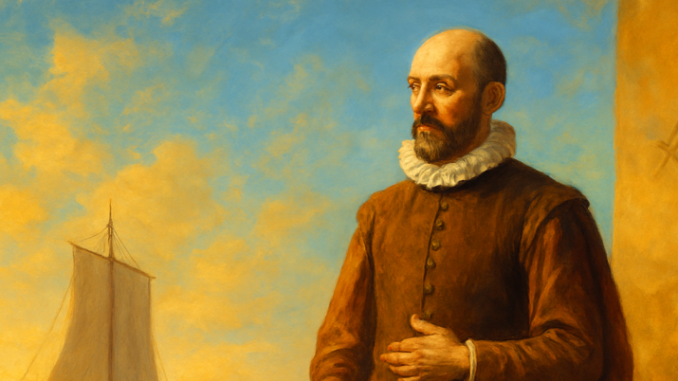
When a sixteenth-century nobleman sat down in his tower library to write about the shaky foundations of human judgment, he was drawing on an ancient river of philosophical thought. Michel de Montaigne did not compose his essay ‘On the Uncertainty of Our Judgment’ in a vacuum. Behind every paragraph lie the voices of Greek skeptics, Roman Stoics, and Renaissance humanists. What makes this essay especially fascinating for Freemasons is how naturally its central insight — that doubting one’s own certainty is not weakness but wisdom — resonates with the very principles practiced in the lodge to this day.
The Ancient World: Doubt as Philosophical Method
Montaigne’s intellectual world was saturated with classical antiquity. His library in the Château de Saint-Michel-de-Montaigne held hundreds of works by Greek and Latin thinkers, and he had their maxims carved into the wooden beams of his study. The essay ‘On the Uncertainty of Our Judgment’ reflects two great traditions above all: Pyrrhonian skepticism and Roman Stoicism.
The Greek philosopher Pyrrho of Elis, who lived around 300 BCE, argued that human beings can never truly know how things really are. His followers, the Pyrrhonists, therefore advocated a suspension of judgment. Montaigne encountered this tradition through the writings of Sextus Empiricus, whose Outlines of Pyrrhonism had been rediscovered and reprinted during the sixteenth century. The core idea was as simple as it was unsettling: for every argument, an equally strong counterargument can be made. Once you grasp that, you become far more humble in your convictions.
Plutarch and Seneca: The Moral Mirror
Where Pyrrhonism gave Montaigne the gift of doubt, Plutarch and Seneca gave him a moral framework. Plutarch, the first-century Greek biographer and essayist, was one of Montaigne’s most beloved authors. In the Moralia and the Lives of the Noble Greeks and Romans, Montaigne found a treasury of stories about generals and statesmen whose errors of judgment led to catastrophe. He used these stories not to condemn, but to show how unpredictable the outcomes of human action truly are. A brilliant military stratagem can fail because of a gust of wind; a seemingly foolish decision can lead to victory.
Seneca, the Roman Stoic, complemented this with an ethics of inner steadfastness. In his Letters to Lucilius, Seneca stressed that the wise person does not allow himself to be carried away by the illusion of certainty, but learns instead to live with the unknown. Montaigne admired this attitude, though he did not adopt it wholesale. Where Seneca still believed in the possibility of true wisdom, Montaigne remained more skeptical: even the Stoic sage can be wrong. This makes humility not a weakness, but the most honest posture a person can assume.
The Renaissance World: Rediscovery and Revision
Montaigne lived in a time of intellectual upheaval. Renaissance humanism had rediscovered the ancient sources and made them available through new translations and printed editions. Thinkers like Desiderius Erasmus had shown that critical textual analysis and healthy doubt could go hand in hand with faith and morality. Erasmus’s In Praise of Folly was itself an exercise in unmasking human vanity and self-overestimation — themes that Montaigne would carry forward in his own essays.
At the same time, the Wars of Religion between Catholics and Huguenots were raging across France. Montaigne witnessed how both sides were rock-solid in their conviction that they alone were right, and how that conviction led to horrific violence. This experience deepened his philosophical inclination toward doubt. The uncertainty of judgment was no abstract thought experiment for him; it was a bitterly necessary lesson in a world torn apart by dogmatic certainty.
The uncertainty of our judgment is not an intellectual weakness but a moral strength: whoever acknowledges that he may err opens the door to genuine wisdom and sincere tolerance.
The Perspective from the Lodge: Doubt as a Brotherly Virtue
In Freemasonry, a kindred idea echoes through the centuries. The Craft does not ask its members to accept any particular truth, but rather to be willing to examine themselves and their convictions continually. The ritual work in the lodge is essentially an exercise in suspending preconceptions. The blindfold during initiation is more than a tradition: it is a lived experience of not-knowing, an invitation to see the world afresh, unburdened by inherited judgments.
Where Montaigne drew on Pyrrho of Elis and Sextus Empiricus, Freemasons draw on a ritual tradition that stretches back to the eighteenth-century Constitutions of James Anderson and the work of Jean Théophile Desaguliers. These founders emphasized that the lodge should be a space where people of different beliefs and backgrounds could meet as equals. That is only possible when no one regards his own judgment as absolute. The Academic skepticism of Cicero, which also influenced Montaigne, thus found a practical expression in the principles of the Brotherhood.
What Both Worlds Share
The parallel between Montaigne’s philosophical project and Freemasonry is striking. Both begin from the recognition that the individual is limited in knowledge and insight. Both regard that limitation not as a cause for despair, but as an invitation to grow. And both emphasize that the very acknowledgment of ignorance is the precondition for true tolerance.
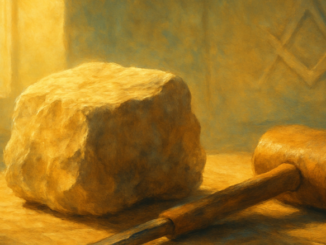
In his essay, Montaigne pointed to concrete military examples to illustrate that the outcomes of our actions can never be fully foreseen. The Stoics taught him that virtue depends not on results but on intention. Plutarch showed him that even the greatest minds can misjudge a situation completely. These lessons converge in a single insight that any Freemason will recognize: the rough ashlar is never fully polished, and the work of self-improvement is never finished.
In the lodge, this manifests in the practice of listening — truly listening — to a Brother whose views may differ radically from your own. It shows in the willingness to revisit long-held beliefs when new light is shed upon them. And it appears in the fundamental Masonic principle that no religion, no political party, and no philosophical school holds a monopoly on truth. Montaigne would have felt at home in such a setting. His entire literary life was devoted to the proposition that honest self-examination, practiced with courage and humility, is the highest form of intellectual and moral virtue.
Montaigne’s essay on the uncertainty of judgment is far more than a historical curiosity. It is a living document that speaks directly to the Masonic commitment to self-knowledge, humility, and tolerance. The philosophical roots he drew upon — Pyrrhonian skepticism, Stoic ethics, Plutarch’s moral biographies, and Renaissance humanism — all converge on a truth that Freemasons practice every time they enter the lodge: that acknowledging the limits of our own understanding is not a sign of weakness, but the very foundation of brotherhood and wisdom. In a world still riven by the dogmatic certainties that Montaigne warned against nearly five centuries ago, that lesson has never been more relevant.
Copyright text & image: devrijmetselaar.nl
Texts are based on the ideas and content of the author of devrijmetselaar.nl, reviewed, corrected, and supplemented with the assistance of OpenAI. Images are created based on the ideas of the author of devrijmetselaar.nl using OpenAI/DALL-E.


Be the first to comment