In October 2026, a news story surfaced that left many readers equal parts horrified and bewildered: a man had fired a crossbow at cats and later claimed he had only meant to scare them off. His words expressed regret — but they also raised an uncomfortable question. How sincere can remorse be when it only arrives after the consequences? That question is far from new. For centuries, thinkers and fraternal traditions have grappled with the nature of remorse, the formation of character, and the courage it takes to truly accept responsibility for one’s actions. Freemasonry, as it turns out, offers a remarkably clear framework for thinking through these issues.
Aristotle and the Line Between Ignorance and Indifference
In his Nicomachean Ethics, Aristotle drew a distinction that still cuts sharply after nearly 2,400 years. He argued that an act committed out of genuine ignorance may be forgivable, but one that stems from indifference or a lack of self-reflection is not. A person who aims a crossbow at a living creature and later claims he didn’t mean it that way finds himself right on that dividing line. Was there truly ignorance about the potential consequences? Or was there a moment of moral laziness — a silenced inner voice that should have known better?
Aristotle did not see virtue as something innate. He understood it as a skill that had to be practiced, much like a craftsman learning to master his tools. Someone who never exercises compassion, who never pauses to think through the consequences of his actions, will inevitably fail in a critical moment — not out of malice, but out of neglect of his own character. This idea of character formation as a daily discipline would, centuries later, become one of the central pillars of Freemasonry.
The Rough Ashlar: An Ancient Symbol of Imperfection
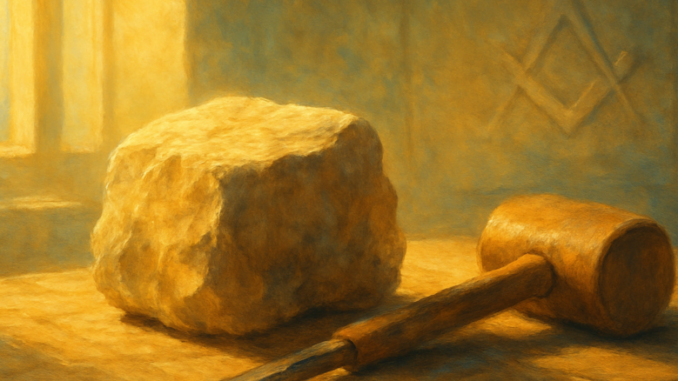
In the early eighteenth century, when James Anderson and Jean-Théophile Desaguliers drafted the first constitutions of modern Freemasonry, an old operative concept was elevated to a spiritual metaphor: the rough ashlar. Every Freemason begins his journey as an unworked stone, full of jagged edges and irregularities. The goal is not to achieve perfection — no human being ever can. The goal is to work consciously on one’s own character, day after day, blow after blow.
The rough ashlar represents exactly the kind of impulsiveness and thoughtlessness we see reflected in the news story. A person acts without pausing to consider the consequences. The pain he causes is real, and his remorse after the fact changes none of it. But the crucial question that Freemasonry poses is not “Are you guilty?” The crucial question is: “What will you do now with this insight?”
Remorse in the Lodge: Not a Free Pass but a Starting Point
It would be a mistake to think that Freemasonry treats remorse as some kind of automatic absolution. Quite the opposite. In the Masonic tradition, sincere remorse marks the beginning of a long process of self-improvement — never the end point. The Stoic philosopher Seneca, whose thought is closely aligned with Masonic ethics, wrote that a person who honestly examines his actions at the end of each day will slowly but surely become a better human being. Not through guilt, but through awareness.
In the rituals of the lodge, a candidate is asked to reflect in darkness on who he is and who he wishes to become. That darkness is not a punishment. It is an invitation to honesty. Only when someone truly dares to look at his own shortcomings in the dark can the light that follows take on genuine meaning. This ritual reflects a deeply human truth: growth does not begin with success, but with the acknowledgment of failure.
Remorse that does not lead to a change in behavior is merely a word. Only when regret translates into daily acts of self-improvement does it become a building block of character.
Montaigne on the Fickleness of Human Nature
The sixteenth-century essayist Michel de Montaigne wrote with striking candor about the unpredictability of human character. In his famous essay “On Repentance,” he argued that most people do not truly regret their actions — they regret the consequences. Real remorse, Montaigne insisted, requires that a person reject his own behavior on moral grounds, regardless of whether negative outcomes followed. Would the man in the news story have felt the same remorse if the cats had escaped unharmed? Montaigne would have had his doubts.
Yet Montaigne was no cynic. He believed that genuine self-knowledge was possible, provided one was willing to be ruthlessly honest with oneself. That conviction aligns seamlessly with what Freemasonry asks of its members: not the pretense of perfection, but the courage of honest self-examination.
From Impulse to Intention: Lessons for Today
On the surface, the news story about the man with the crossbow is a simple tale of someone who did something foolish and came to regret it. But beneath that surface, it touches on one of the oldest questions of human civilization: to what extent are we capable of shaping our own character? The Stoics — Seneca, Marcus Aurelius — believed this was life’s most important task. Aristotle built an entire philosophical system around it. And Freemasonry translated that accumulated wisdom into a practical, ritual framework that is still practiced to this day.
What all these traditions share is the conviction that a person is not defined by his worst moment, but by what he does afterward. The question is not whether we make mistakes — we all do. The question is whether we are willing to use those mistakes as the hammer and chisel with which we work upon our own rough stone. Character formation is not a destination. It is a craft you practice for a lifetime.
The deepest lesson that Freemasonry, Aristotle, and Montaigne all offer is deceptively simple: self-reflection should be a daily ritual, not a reaction triggered only by consequences. If we wait until the damage is done to examine our choices, we have already failed the test that matters most. The work on the rough ashlar is never finished — and that is precisely the point. It is in the steady, unglamorous practice of examining our intentions, questioning our impulses, and choosing to do better that true character is forged.
Copyright text & image: devrijmetselaar.nl
Texts are based on the ideas and content of the author of devrijmetselaar.nl, reviewed, corrected, and supplemented with the assistance of OpenAI. Images are created based on the ideas of the author of devrijmetselaar.nl using OpenAI/DALL-E.
Frequently Asked Questions
What is the rough ashlar and what does it symbolize in Freemasonry?
The rough ashlar is a foundational symbol in Freemasonry representing an unworked stone full of jagged edges and irregularities. It symbolizes the imperfect state in which every Freemason begins their journey. The goal is not to achieve perfection, but rather to consciously work on one's own character through daily discipline and self-improvement, much like a craftsman shaping stone blow by blow.
How does Freemasonry approach character formation and virtue?
Freemasonry, drawing from Aristotelian philosophy, views character formation as a daily discipline and practiced skill rather than something innate. Like Aristotle's concept of virtue as a craft to be mastered, Freemasonry teaches that character is developed through conscious, ongoing effort. Someone who neglects this practice of self-reflection and compassion will inevitably fail in critical moments, not out of malice but out of neglect of their own character development.
What is the distinction Aristotle made between ignorance and indifference, and why does it matter?
Aristotle distinguished between acts committed out of genuine ignorance, which may be forgivable, and those stemming from indifference or lack of self-reflection, which are not. This distinction is crucial because it challenges the sincerity of remorse that arrives only after consequences. The key question becomes whether someone's harmful action reflects true ignorance of consequences or rather moral laziness—a silenced inner voice that should have known better.


Be the first to comment