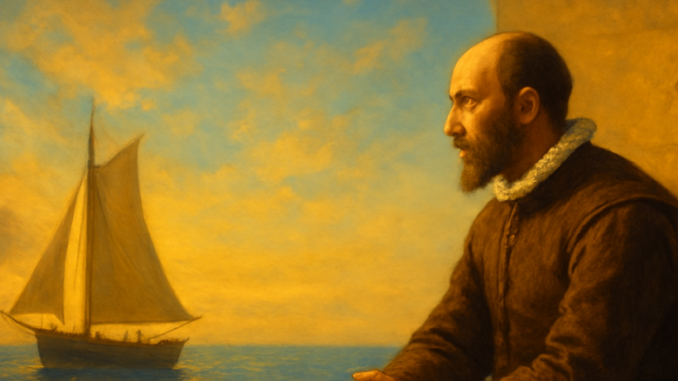
On March 2, 1590, Michel de Montaigne died at his château in the Dordogne — a man who, by his own account, had spent his entire life practicing the art of letting go. His short essay ‘On Sleep’ may be the most unexpected testament to that practice. Written during an era of religious wars and political upheaval, it examines the remarkable ability of certain individuals to sleep soundly in the face of danger. At first glance, the essay reads as a collection of historical anecdotes. But look closer, and it touches on fundamental questions about self-mastery, surrender, and trust — questions that lie at the very heart of Freemasonry.
A Battlefield for a Bedroom: The Historical Context
Montaigne opened his essay with a series of striking historical examples — great men who slept peacefully at moments when anyone else would have been wide awake with fear. He cited the Roman Emperor Augustus, who slept soundly the night before a decisive naval battle. He pointed to Alexander the Great, who was so deeply asleep on the morning of the Battle of Gaugamela that his generals had to shake him awake. And he recalled Cato of Utica, who spent the evening before his chosen death calmly reading and sleeping.
For Montaigne, these were not stories about extraordinary courage in the military sense. They were illustrations of something far deeper: an inner state in which the mind is so firmly anchored in its own convictions that no external threat can destabilize it. This idea aligns seamlessly with what the Stoics taught. Seneca — whom Montaigne read and quoted extensively — wrote at length about the imperturbability of the wise person. But where Seneca framed this as a philosophical ideal, Montaigne made it tangible by connecting it to the everyday phenomenon of sleep.
Sleep as a Mirror of Conscience
What Montaigne implied — without ever quite stating it outright — is that sleep is an unforgiving mirror. Those with a clear conscience, those who are at peace with their own choices, can sleep. Those tormented by doubt, guilt, or unresolved inner conflicts lie awake. In this reading, sleep is not a passive state but a litmus test for the quality of one’s inner life.
This idea has deep roots in Western philosophical tradition. Plato wrote in The Republic that the dreams of a just person are orderly and clear, while those of the unjust are chaotic and dark. Aristotle connected the quality of sleep to the virtuousness of daily life. Montaigne placed himself squarely in this lineage, though he did so in his characteristically personal, almost casual manner — as if these profound insights had simply occurred to him over a glass of wine.
The Freemason and the Art of Letting Go
In Freemasonry, the pursuit of self-knowledge occupies a central place. The Craft does not ask its members to accept a specific dogma but to engage in continuous self-improvement. The rough ashlar must be shaped into a perfect cube — not through outward achievement, but through inner refinement. This inner labor demands something paradoxical: both discipline and surrender.
Montaigne’s essay speaks directly to this tension. The commanders he described were not lazy or indifferent men. They were individuals who had made their decisions with the utmost care and then had the confidence to let go. They had done everything within their power and could then accept the outcome — whatever it might be. In Masonic terms, they had worked the rough stone and placed their trust in the design of the Grand Architect of the Universe.
Anyone who truly knows himself and lives at peace with his conscience finds rest, even when the world around him is in turmoil. That is the essence of both Montaigne’s wisdom and the Masonic path.
Brotherhood as an Anchor of Peace
There is another dimension of this essay that resonates with Freemasonry: the role of community. Montaigne was no hermit. He maintained deep friendships, the most famous being his bond with Étienne de La Boétie. Throughout his essays, he returned again and again to the importance of genuine human connection as a source of inner calm. To know that you are surrounded by brothers who truly know and accept you — that is the kind of assurance that allows a person to sleep more easily.
The Masonic lodge functions in a remarkably similar way — as a space of trust. The ritual creates a framework within which brothers can set aside their masks, not in the sense of public confession, but in the sense of honest self-reflection in the company of like-minded souls. This experience of brotherhood is not a luxury; it is a necessary condition for the kind of inner peace Montaigne wrote about.
From the Sixteenth Century to Today
We live in an age where sleep problems have become a public health crisis. Researchers speak of a global sleep epidemic linked to overstimulation, performance pressure, and a chronic lack of inner calm. Montaigne would not have been surprised. In his view, insomnia was not a medical problem but a signal from the soul — a sign that something is out of balance in our relationship with ourselves and the world around us.
Freemasonry offers no miracle cure for sleepless nights. But it does offer a path that points in the same direction as Montaigne’s philosophy. That path includes self-reflection as a daily practice, the courage to examine one’s own conscience honestly, the trust to release what lies beyond our control, and the strength of fraternal bonds as an anchor in turbulent times.
Three Lessons for the Modern Freemason
First, examine your conscience regularly and honestly. The quality of your sleep reveals something about the quality of your inner life. If you are lying awake, it may be worth asking not what is wrong with your body, but what is unresolved in your soul.
Second, learn the difference between taking responsibility and trying to maintain control. After careful and diligent work comes the moment of surrender. The master builder does not hover anxiously over every stone once it has been placed — he trusts the design.
Third, cherish brotherhood as a source of rest. Genuine connection with others is not a distraction from inner work — it is an indispensable part of it. The lodge exists not only for ritual and instruction, but as a community where the weight of solitary reflection can be shared and lightened.
More than four centuries ago, Michel de Montaigne wrote a seemingly simple essay about sleep. Yet beneath its anecdotal surface lies a profound meditation on what it means to live with integrity, to act with care, and to trust enough to let go. For Freemasons, his words carry a special resonance. The path from rough ashlar to polished stone is not only a journey of discipline — it is equally a journey of surrender. And perhaps the truest measure of our progress along that path is not what we achieve in our waking hours, but the peace we find when we close our eyes.
Copyright text & image: devrijmetselaar.nl
Texts are based on the ideas and content of the author of devrijmetselaar.nl, reviewed, corrected, and supplemented with the assistance of OpenAI. Images are created based on the ideas of the author of devrijmetselaar.nl using OpenAI/DALL-E.


Be the first to comment