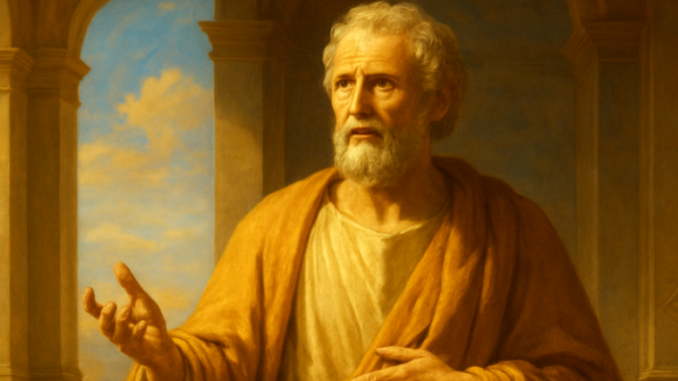
What would happen if you invited Lucius Annaeus Seneca to sit at a table with Freemasons? Would he recognize himself in their pursuit of inner growth? Would he nod approvingly at the ideal of brotherhood? Or would he — as he so often did — pose an uncomfortable question that cuts straight to the bone? In this article, we stage that imaginary conversation, using Seneca’s essay De Tranquillitate Animi (On the Tranquility of Mind) as a starting point and the Masonic values of connection and self-reflection as its counterpart.
Why Did Seneca Write About Tranquility of Mind?
The question is less obvious than it seems. Seneca didn’t write his treatise from an ivory tower. He wrote it in the thick of first-century Rome — a world of political intrigue, shifting alliances, and moral ambiguity. He was a senator, an advisor to an emperor, and at the same time a philosopher who wrestled with the very restlessness he sought to cure in others. His friend Serenus had asked him for guidance: how do you find inner peace when the world around you refuses to stand still?
Seneca’s answer does not revolve around withdrawal from the world. Instead, it centers on a conscious attitude toward life. Peace of mind doesn’t come from avoidance — it comes from seeing clearly and choosing deliberately what deserves your attention and your energy.
What Does Tranquility Have to Do With Brotherhood?
Here we touch upon something surprising. Seneca does not advocate for solitude in his essay. Quite the opposite: he emphasizes that human beings are social creatures who need others in order to truly know themselves. For him, tranquility of mind is not a solo achievement — it is something that flourishes in connection with others. He writes that we should surround ourselves with people who make us better, and that we should strive to be that same influence for them in return.
This echoes one of the most central ideas in Freemasonry: the lodge as a workshop where brothers help one another shape the rough ashlar. The other person is not a distraction from your inner work — they are the mirror that makes that work possible.
Tranquility of mind is not an escape from the world, but the fruit of conscious connection: with yourself, with others, and with the greater whole of which you are a part.
Does Freemasonry Recognize Itself in Stoic Virtue?
Without a doubt. Stoic philosophy — of which Seneca, along with Marcus Aurelius and Epictetus, was one of the great representatives — revolves around four cardinal virtues: wisdom, justice, courage, and temperance. Compare these with the pillars of Freemasonry: self-reflection, moral perfection, the search for truth, and brotherly love. The overlap is striking.
In both traditions, virtue is not an abstract ideal — it is a daily practice. Seneca explicitly warns in his essay against the trap of passivity. The point is not to retreat into contemplation, but to actively contribute to the community while maintaining the inner calm that prevents you from getting lost in the chaos.
This is precisely what a Freemason does when he leaves the lodge and returns to the outside world. The ritual work in the temple is not an end in itself. It is preparation for life beyond those walls, where the real test takes place. Seneca would recognize this principle immediately. Philosophy that is not lived, in his view, is nothing more than empty rhetoric.
What Does Seneca Say About Dealing With Uncertainty?
One of the most striking passages in the essay deals with the unexpected. Seneca advises Serenus to always be prepared for adversity — not out of pessimism, but out of realism. The Latin term he uses, premeditatio malorum, describes a practice of mentally rehearsing possible setbacks so they don’t overwhelm you when they arrive. This is not catastrophic thinking. It is a form of inner resilience that allows you to remain clear-headed when the storm hits.
Freemasonry carries a related sensibility in the awareness of mortality that runs through many of its rituals. The confrontation with finitude is not a somber moment — it is an invitation to live more consciously and to forge deeper bonds with the people around you. Those who understand that everything is temporary place greater value on genuine connection. Seneca and Freemasonry reach out to each other here: both teach that vulnerability is the gateway to true human closeness.
The Search for Light
In Freemasonry, the search for light is one of the most essential metaphors. Light represents knowledge, insight, and truth. Seneca uses remarkably similar imagery when he writes about the clarity of mind that emerges once you free yourself from unnecessary burdens — excessive possessions, superficial relationships, unfocused ambition.
The tranquility he describes is a kind of inner light that only becomes visible once you have stripped away the noise. It is not a state of emptiness, but of fullness: a clear, conscious presence in the here and now.
What Can We Take Away From This Conversation?
The dialogue between Seneca and Freemasonry doesn’t yield ready-made answers — and perhaps that is precisely its beauty. What it does offer is a set of questions worth sitting with. Am I seeking peace by shutting myself off, or by opening myself up? Am I using my brotherhood as a mirror for growth, or as a shelter for comfort? Am I willing to do what Seneca asks — to live with open eyes?
The strength of both Stoic philosophy and Freemasonry lies in their refusal to offer easy answers. Both traditions demand that their practitioners think for themselves, feel for themselves, and act for themselves. Tranquility of mind is not a gift you receive. It is an edifice you raise anew each day, stone by stone, alongside the people who are trying to do the same.
Seneca reminds us that peace of mind is born from conscious choices, not from avoidance. Connection with others is a prerequisite for inner calm, not an obstacle to it. And virtue — whether viewed through a Stoic or a Masonic lens — is never an abstract ideal. It is a daily practice, a commitment renewed with every sunrise, and a building project best undertaken in the company of brothers.
Copyright text & image: devrijmetselaar.nl
Texts are based on the ideas and content of the author of devrijmetselaar.nl, reviewed, corrected, and supplemented with the assistance of OpenAI. Images are created based on the ideas of the author of devrijmetselaar.nl using OpenAI/DALL-E.
Frequently Asked Questions
Why is Seneca's concept of tranquility of mind relevant to Freemasonry?
Seneca's De Tranquillitate Animi teaches that inner peace comes through conscious attitude and deliberate choice rather than withdrawal from the world. This aligns with Masonic values because both emphasize self-reflection and active engagement with others. Just as Seneca advocates for surrounding oneself with people who make you better, Freemasonry uses the lodge as a workshop where brothers help each other develop morally and spiritually through mutual connection and influence.
Did Seneca believe in finding peace through solitude?
No. Despite writing about tranquility of mind, Seneca explicitly rejected solitude as the path to inner peace. He emphasized that human beings are social creatures who need others to truly know themselves. He believed we should surround ourselves with people who elevate us and strive to be that same positive influence for them. This philosophy mirrors the Masonic principle that personal growth is achieved through brotherhood and connection within the lodge community.
What is the connection between Stoic virtue and Freemasonry?
Both Stoic philosophy, as represented by Seneca and other Stoic thinkers like Marcus Aurelius, and Freemasonry recognize virtue as central to their teachings. Seneca's approach to tranquility through conscious choice and deliberate living parallels Masonic ideals of self-improvement and ethical development. The article suggests that Freemasonry finds resonance in Stoic virtues, using the framework of brotherhood and self-reflection to help members achieve both inner peace and moral growth.



Be the first to comment