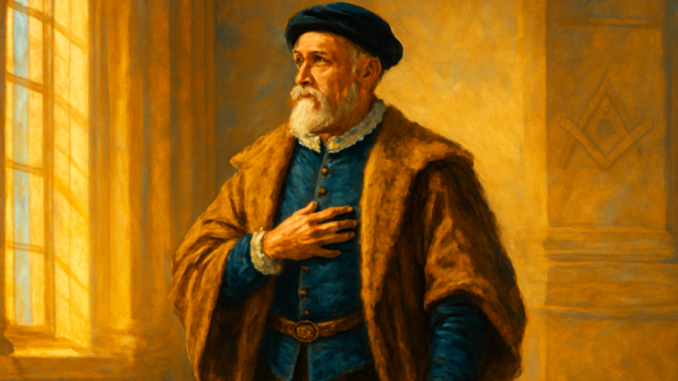
Can a person be truly faithful to themselves and to the community they belong to at the same time? Michel de Montaigne posed this question in the sixteenth century, and the answer he offered in his forty-third essay, ‘Of the Laws of Duty,’ remains uncomfortably relevant today. For Freemasons, this tension strikes at the very heart of their practice: the brotherhood demands dedication, but never at the expense of individual conscience. It sounds simple enough — but it is anything but.
The Paradox of Dual Loyalty
Montaigne opens his essay with an observation that immediately unsettles. He describes how people who occupy public roles sometimes find themselves compelled to act in ways they would abhor as private individuals. The general who captures a city through cunning, the diplomat who dissembles for the sake of national interest — they serve a higher purpose, but do they not lose something of their own integrity in the process? Montaigne refuses to answer this question with a simple yes or no. Instead, he explores the space between personal virtue and civic obligation, asking whether these two can ever be fully reconciled.
This tension will feel familiar to anyone who has been part of a brotherhood. Freemasonry has its rituals, traditions, and mutual obligations that presuppose a certain degree of loyalty. At the same time, the Craft continually emphasizes the importance of independent judgment, individual conscience, and the personal search for truth. How do you belong to a collective without losing yourself? Montaigne would say: by being honest about the limits of your obedience.
Duty as a Living Ethics
It is tempting to think of duty as something rigid — a checklist of rules to be ticked off one by one. But Montaigne firmly resists that notion. For him, duty is not the mechanical following of prescriptions but a continuous moral weighing. He draws implicitly on the Roman philosopher Marcus Tullius Cicero, whose treatise De Officiis (‘On Duties’) serves as a key source of inspiration. Where Cicero tends toward clear categories and hierarchies, however, Montaigne chooses ambiguity. He acknowledges that reality is far too complex for absolute rules.
In Freemasonry, we find a strikingly similar approach. The rituals and traditions offer a framework, but never a straitjacket. The pursuit of moral perfection is by definition unfinished — it is a journey, not a destination. The Entered Apprentice, Fellowcraft, and Master Mason progress through degrees that do not so much impose new rules as unlock ever deeper layers of self-reflection. Montaigne would recognize himself in this structure. His essays are themselves an exercise in precisely that: examining one’s own assumptions layer by layer, without ever claiming to have spoken the final word.
Conscience as a Compass
One of the most striking assertions in the forty-third essay is that no person has the right to surrender their conscience entirely to another — not to a prince, not to a state, and not to an institution. Montaigne writes that whoever submits completely to the will of another diminishes their own humanity. This is not a plea for anarchy or defiance, but for conscious, deliberate loyalty. You serve the community best by remaining an autonomous, thinking individual.
True devotion to duty begins where blind obedience ends: at the conscience that refuses to be silenced, precisely out of love for the community.
This principle stands at the center of Masonic philosophy. The brotherhood expects its members to act virtuously, but it equally expects them to think independently. The conscience is not switched off upon entering the lodge — it is sharpened. The ritual work is designed to calibrate the inner compass, not to replace it with a collective directive. Herein lies a deep kinship with what Montaigne advocates.
The Other as Mirror
Montaigne was no hermit. Despite his reputation as a withdrawn thinker who secluded himself in his tower to read and write, he was deeply engaged in public life. He served as mayor of Bordeaux and mediated between Catholics and Protestants during the French Wars of Religion. His essay on duty is saturated with that experience: the theory of obligation is tested against the messy reality of living together.
For Freemasons, this interplay between the personal and the communal is equally essential. The lodge is not an ivory tower. It is a practice space where brothers and sisters learn to translate their ideals into concrete action in the world beyond the temple. The bond that Freemasonry seeks to forge is not abstract — it comes into being through dialogue, through the willingness to listen to others, and through the courage to subject your own convictions to scrutiny. Montaigne described this attitude with a concept he borrowed from the Stoics, so eloquently expressed by Seneca: the willingness to revise your own judgment continuously.
Virtue Without Dogma
What makes the forty-third essay so valuable from a Masonic perspective is Montaigne’s refusal to turn virtue into dogma. He does not believe in a universal moral code that applies to everyone at all times. What he does believe is that every human being bears the responsibility to determine, again and again, what right action means in each new situation. This is not relativism — it is intellectual honesty. Montaigne acknowledges that moral perfection is an ideal you never fully attain, but one you can always strive toward.
Freemasonry shares this conviction. It offers no definitive answers, but a method for asking better questions. The rough ashlar that the Apprentice works on never becomes a perfectly smooth cube. The work itself is the purpose. And it is precisely in that recognition — in the willingness to accept what is unfinished and yet keep working — that Montaigne and the Masonic tradition find their deepest common ground.
Montaigne’s forty-third essay reminds us that duty is not a destination but a practice, not a fixed code but a living conversation between self and community. For Freemasons, his words carry a particular resonance: the Craft asks us to serve the brotherhood while never surrendering the conscience that makes that service meaningful. The rough stone is never finished, and neither are we. But it is in the continuous work — the honest, reflective, sometimes uncomfortable labor of becoming — that both Montaigne and Freemasonry locate the truest form of virtue.
Copyright text & image: devrijmetselaar.nl
Texts are based on the ideas and content of the author of devrijmetselaar.nl, reviewed, corrected, and supplemented with the assistance of OpenAI. Images are created based on the ideas of the author of devrijmetselaar.nl using OpenAI/DALL-E.

Be the first to comment