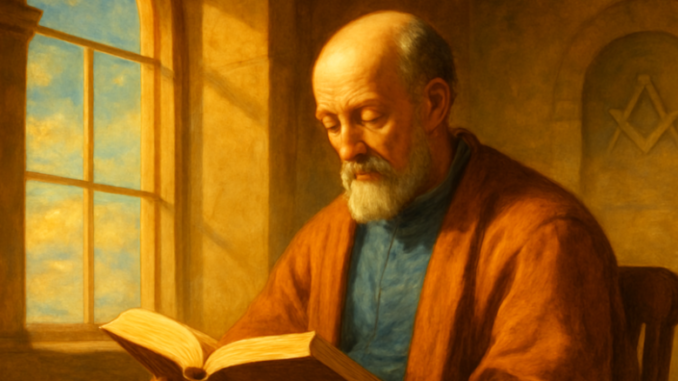
What does it say about a person who can fall asleep under the most terrifying circumstances? Is it a sign of courage, indifference, or something far more profound? In his forty-fourth essay from the first book of The Essays, Michel de Montaigne poses exactly this question. It is a short but remarkably rich piece of writing — one in which sleep is not merely a bodily need, but a window into the human soul.
What Is This Essay Really About?
The essay is titled Of Sleep and stands as one of the shorter entries in the first book of The Essays. Yet its scope is surprisingly vast. Montaigne examines how certain historical figures behaved at moments of extreme pressure, and how their ability — or inability — to sleep revealed something essential about their inner state. The central question sounds deceptively simple: can someone who stares death in the face truly sleep in peace? And what does it mean if they can?
Montaigne is not interested in sleep as a medical or biological phenomenon. He does not concern himself with how many hours of rest a person needs. What fascinates him is the moral and philosophical dimension. In his hands, sleep becomes a barometer for inner calm — a measure of how truly at peace someone is with themselves and with whatever fate awaits them.
The Classical Examples Montaigne Draws Upon
As is his custom throughout The Essays, Montaigne draws generously from classical antiquity. He mentions Alexander the Great, who reportedly slept so deeply the night before a decisive battle that his generals had to wake him. Was this arrogance? Montaigne seems to think not. He interprets it as a sign that Alexander had so completely committed himself to his course of action that there was simply no room left for doubt or fear. The decision had been made, fate accepted, and so the mind could rest.
He also refers to the Roman statesman Cato of Utica, who on the eve of his self-chosen death calmly read and then fell asleep. And there is the example of Emperor Augustus, who, despite the storms of Roman political life, was known for his regular sleeping habits. These are not random anecdotes. Montaigne weaves them into a coherent argument about the relationship between peace of mind and the acceptance of the inevitable. The message is always the same: those who are truly at peace within themselves need not lie awake at night.
The Core Idea: Sleep as the Truest Mirror
The central thesis of this essay can be distilled into an almost provocative claim: the quality of your sleep reveals more about your character than your actions during the day. A person may act heroically in public and still be tormented by restlessness at night. Conversely, a deep, undisturbed sleep at the hour of truth betrays a soul that is genuinely free from inner conflict.
Sleep, Montaigne suggests, is the most honest mirror of the soul. Words and deeds can still feign courage, but sleep never lies.
This thought resonates deeply with the Stoic tradition. Thinkers such as Seneca and Marcus Aurelius similarly emphasized the importance of inner tranquility and the distinction between what lies within our power and what does not. Montaigne shares that conviction but adds his characteristically personal touch. He openly wonders whether he himself would be capable of such calm at the supreme moment — and he honestly leaves the answer unresolved.
Why This Essay Still Matters Today
It would be tempting to regard a sixteenth-century essay on sleep as a historical curiosity. But anyone who reads carefully will discover that Montaigne touches on something timeless. In a world dominated by anxiety, performance pressure, and constant stimulation, the question of how well you sleep becomes ever more urgent. Not in terms of sleep hygiene or mattress selection, but as a philosophical question: are you at peace with the choices you have made? Can you let go of the day because you know you have acted according to your conscience?
For those familiar with Freemasonry, this essay evokes deeply recognizable themes. The Masonic tradition invites its members to pause at the end of each day and reflect upon their actions. This self-reflective practice, recommended in many lodges as a daily exercise, aligns seamlessly with what Montaigne describes. Sleep only becomes truly restorative when the mind has first given an honest account of itself — not to another person, but to oneself.
Sleep as an Ethical Practice
Montaigne reveals something in this essay that is easily overlooked: sleep is not merely passive. The ability to surrender to sleep requires a form of trust — a willingness to yield to something greater than the waking consciousness. That is no small feat. It demands that you relinquish control, that you accept not everything can be managed or engineered. In this sense, sleep becomes for Montaigne almost an ethical exercise. Whoever cannot surrender to the night, he suggests, still has work to do on themselves during the day.
This idea carries particular weight within the context of Masonic philosophy, where the working tools are metaphors for self-improvement. Just as the rough ashlar must be shaped into a smooth stone through diligent labor, so too must the inner life be refined before genuine rest — genuine peace — becomes possible. The nightly surrender to sleep mirrors the broader Masonic aspiration: to build a life of such integrity that one can face any hour, even the final one, without dread.
What Can We Take Away from This Essay?
Montaigne’s forty-fourth essay is a small meditation with large implications. It teaches us that sleep is more than rest — it is a touchstone for inner integrity. The examples of Alexander the Great, Cato, and Augustus illustrate not only historical greatness but also a universal human ideal: that of a life lived so consciously and honestly that the night need not be something to dread, but rather a welcome ally.
Montaigne invites us not to take sleep for granted but to regard it as a mirror. Those who dare to look into it may not always find a reassuring image, but they will find an honest one. And honesty, Montaigne would say, is the beginning of all wisdom.
In this brief but penetrating essay, Michel de Montaigne shows us that sleep is far more than a physical necessity. It is a moral litmus test, a silent confession made each night. For Freemasons and reflective minds alike, his message endures across the centuries: true rest is earned not by exhaustion alone, but by a conscience at peace. The question is not whether you can sleep — but whether you can sleep honestly.
Copyright text & image: devrijmetselaar.nl
Texts are based on the ideas and content of the author of devrijmetselaar.nl, reviewed, corrected, and supplemented with the assistance of OpenAI. Images are created based on the ideas of the author of devrijmetselaar.nl using OpenAI/DALL-E.
Frequently Asked Questions
What is the main subject of Montaigne's Essay 44, 'Of Sleep'?
Montaigne's Essay 44 examines sleep not as a biological need, but as a philosophical window into the human soul. He explores what a person's ability to sleep during terrifying or life-threatening circumstances reveals about their inner state, moral character, and level of inner peace. Rather than discussing the medical aspects of sleep, Montaigne uses sleep as a barometer for measuring how truly at peace someone is with themselves and their fate.
What historical figures does Montaigne use as examples in this essay?
Montaigne draws upon classical antiquity for his examples, including Alexander the Great, who slept deeply before a decisive battle; Cato of Utica, who calmly read and then fell asleep before his self-chosen death; and Emperor Augustus, known for his regular sleeping habits despite the turbulent nature of Roman political life. These examples serve to illustrate his argument about the relationship between peace of mind and acceptance of fate.
What does Montaigne believe the ability to sleep reveals about a person?
Montaigne believes that the ability to sleep peacefully in dire circumstances is not a sign of arrogance, indifference, or cowardice, but rather a sign of inner peace and complete acceptance of one's fate. He argues that those who are truly at peace within themselves and have fully committed to their course of action have no room left for doubt or fear, and therefore their minds can rest peacefully regardless of external circumstances.

Be the first to comment