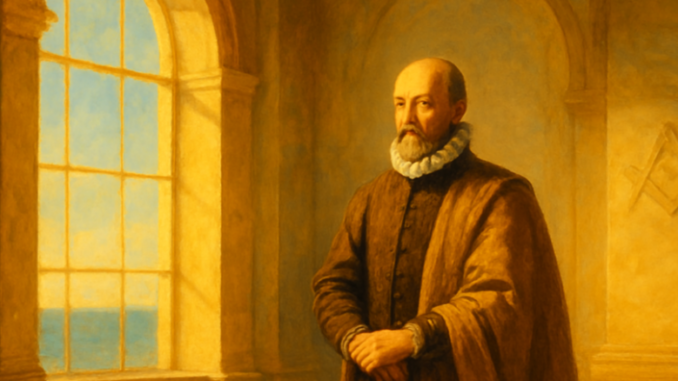
There is a chair in an empty room. No table, no book, no other person — just a chair and silence. For most people, this image stirs discomfort, perhaps even dread. But for Michel de Montaigne, that empty room was the starting point of one of his most penetrating essays: the thirty-eighth piece in the first book of his Essays, titled “On Solitude.” Behind that deceptively simple title lies a rich philosophical heritage stretching from the Roman Stoics to Renaissance humanism — one that shares surprisingly deep parallels with the inner work that Freemasonry asks of its members.
The Chair as a Mirror of the Inner Self
Imagine the empty chair not as a piece of furniture waiting to be used, but as a ritual object — an invitation. Whoever sits down in silence ultimately meets themselves. Montaigne understood this better than most. When he withdrew to his château in the Dordogne in 1571 and took up residence in his famous tower library, he was doing more than making a personal lifestyle choice. He was joining an ancient philosophical tradition that regarded solitude as the necessary precondition for self-knowledge. That tradition drew from many sources, and Montaigne drank deeply from all of them.
Seneca and the Stoic Retreat
The most visible influence on this essay is that of Lucius Annaeus Seneca. Montaigne quotes the Roman philosopher repeatedly and leans heavily on his letters to Lucilius, in which Seneca argues that true withdrawal is not geographical but spiritual. The point is not to leave the city, but to leave behind our attachment to fame, possessions, and the opinions of others. Seneca wrote that the crowd dwells within us, and that we must silence it before external solitude can be of any use. Montaigne adopts this position but adds a personal edge: he warns that anyone who retreats with a restless mind merely brings their own torments along for the journey.
This Stoic thread resonates powerfully with Freemasonry. In the ritual of the Chamber of Reflection, where the candidate is placed in isolation before initiation, the same idea is enacted symbolically. The retreat is not an escape — it is a confrontation. The rough ashlar, the central image of the Entered Apprentice degree, can only be shaped when the Mason is willing to examine his own imperfections in silence.
Epicurus and the Hidden Life
Alongside Seneca, Epicurus plays a surprising role in Montaigne’s argument. The famous Epicurean maxim lathe biōsas — “live hidden” — echoes throughout the entire essay. Epicurus taught that happiness is found not in public esteem but in a withdrawn life shared with a small circle of trusted companions. Montaigne partially embraces this idea, but he is too much of a skeptic to surrender entirely to any single school of thought. He takes from Epicurus the notion of detachment while rejecting the strict asceticism that some followers grafted onto it.
This eclectic character is one of the hallmarks of Montaigne’s thinking. He was no dogmatist. He selected from each tradition whatever seemed useful and left the rest behind. That quality makes him a thinker who fits remarkably well within the spirit of Freemasonry, where members from different philosophical and religious backgrounds come together without any single doctrine claiming a monopoly on truth.
Plutarch and the Art of Listening to Yourself
A third pillar supporting the essay is the work of Plutarch, the Greek moral philosopher whose Moralia Montaigne treated as a personal handbook. Plutarch emphasized that virtue is not abstract but practical: it reveals itself in daily choices, in how we conduct ourselves when no one is watching. In his treatise “On Tranquility of Mind,” Plutarch describes how inner calm does not depend on external circumstances but on the attitude with which we meet those circumstances.
Montaigne translates this into his own context. Solitude is not an end in itself but a practice ground. It is the place where we learn, as Plutarch might put it, to be our own companion. In Freemasonry, we find a kindred idea in the concept of the “inner temple” — the notion that every person carries a sanctuary within that requires maintenance and attention, independent of the outside world.
Skepticism as the Connecting Thread
What binds all these influences together in Montaigne’s work is his fundamental skepticism. Shaped by the Pyrrhonist tradition and the writings of Sextus Empiricus, Montaigne refused to proclaim definitive truths. His personal motto, Que sais-je? — “What do I know?” — is not merely a rhetorical question but a way of life. In “On Solitude,” this manifests as his refusal to prescribe any single form of retreat as the correct one. He offers no recipe, only an inquiry.
This skeptical inquiry connects closely with what Freemasonry sometimes calls the “Royal Art”: the ongoing, never-completed process of self-development. The Mason who believes he has finished building has stopped learning. Montaigne would have wholeheartedly agreed.
Renaissance Humanism and the Dignity of the Individual
Finally, the essay must be placed within the broader current of Renaissance humanism. Thinkers such as Francesco Petrarca and Giovanni Pico della Mirandola had already argued that human beings create their own dignity through conscious choices. Petrarca’s De vita solitaria is a direct precursor to Montaigne’s argument: Petrarca, too, saw solitude as the fertile ground for intellectual and moral growth. Montaigne knew this work and built upon it, but he shifted the emphasis from poetic contemplation to everyday self-knowledge.
This shift matters. Montaigne was not interested in solitude as a lofty ideal reserved for monks and poets. He was interested in the practical question of how an ordinary person — a landowner, a father, a former magistrate — could learn to live honestly with himself. That democratic impulse, the conviction that the examined life is available to everyone willing to do the work, mirrors one of Freemasonry’s most fundamental principles: that the tools of self-improvement are offered to all who seek them sincerely.
True solitude is not an empty room but a furnished mind — the capacity to dwell honestly with yourself in silence, without the need for applause or distraction. Montaigne drew on Seneca, Epicurus, Plutarch, and the Renaissance humanists to articulate what many Freemasons recognize intuitively: that the most important work happens not in the noise of the world but in the quiet of the inner chamber. The rough stone cannot be shaped in a crowd. It asks for patience, stillness, and the courage to look inward. That chair in the empty room is not waiting for someone to sit in it. It is waiting for someone brave enough to stay.
Copyright text & image: devrijmetselaar.nl
Texts are based on the ideas and content of the author of devrijmetselaar.nl, reviewed, corrected, and supplemented with the assistance of OpenAI. Images are created based on the ideas of the author of devrijmetselaar.nl using OpenAI/DALL-E.
Frequently Asked Questions
What is the main philosophical argument Montaigne makes in his essay 'On Solitude'?
Montaigne argues that solitude is essential for self-knowledge and inner spiritual development, drawing from Stoic philosophy. He emphasizes that true withdrawal is not merely geographical but spiritual—one must silence internal attachments to fame, possessions, and others' opinions. The goal is self-confrontation and examination of one's imperfections, not escape from the world.
How does Montaigne use Seneca's Stoic philosophy in his essay?
Montaigne heavily quotes and relies on Seneca's letters to Lucilius, adopting Seneca's core argument that the crowd dwells within us and must be silenced before external solitude can be meaningful. However, Montaigne adds his own insight: that retreating with a restless mind merely brings one's own torments along, making genuine solitude impossible without mental discipline.
What are the connections between Montaigne's concept of solitude and Freemasonry?
The Chamber of Reflection in Masonic initiation rituals enacts the same philosophical principle that Montaigne describes—solitude as confrontation rather than escape. Similarly, the rough ashlar symbol in the Entered Apprentice degree represents self-examination and the shaping of one's imperfections through silent introspection, paralleling Montaigne's belief that solitude enables personal transformation and self-knowledge.

Be the first to comment