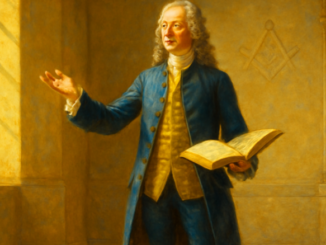
Open book showing Voltaire's Candide with garden and Masonic symbolism
Symbolism & Rituals

Voltaire and Candide: The Philosophical Roots of the Garden

You have probably heard the famous closing line of Voltaire’s Candide: “We must cultivate our garden.” It is a sentence that has made people think for nearly three centuries. But where did this deceptively simple idea come from? Which philosophers and intellectual currents shaped Voltaire’s razor-sharp pen when he wrote this satirical masterpiece? Beneath the surface of what appears to be a lighthearted adventure story lies a rich web of philosophical thought — one that resonates deeply with anyone who has ever worked at shaping the rough stone of their own character. Leibniz and the Optimism Voltaire Fought Against At the philosophical heart of Candide lies a direct attack on the optimism of Gottfried Wilhelm Leibniz. This German philosopher championed the idea that we live in “the best of all possible worlds.” God, as a perfect being, could not have created anything less. Voltaire considered this position not merely naive but outright dangerous. The character of Pangloss in Candide is a biting caricature of Leibniz — a man who, no matter how many catastrophes befall him, insists that everything is for the best. Voltaire wrote Candide shortly after the devastating Lisbon earthquake of 1755, which killed tens of thousands of […]

Ancient philosophical texts symbolizing Seneca's teachings on inner freedom
Lucius Annaeus Seneca – Letters to Lucilius

Seneca’s Letter VII: The Philosophical Roots of Inner Freedom

You know the feeling: after a day spent in traffic, crowds, or back-to-back meetings, you come home feeling drained and irritable. Lucius Annaeus Seneca described this exact phenomenon two thousand years ago in his seventh letter to Lucilius. But where did his ideas come from? Which philosophical traditions shaped his thinking about the influence of the crowd on our inner life? This article uncovers the intellectual roots behind Seneca’s warning — and shows how these insights remain remarkably applicable today, not least within the practice of Freemasonry. The Stoic Foundation: Mastery Over the Inner World Seneca wrote from within the Stoic tradition, a philosophical school founded by Zeno of Citium around 300 BCE. At the heart of Stoicism lies a simple but powerful distinction: some things are within our control, and others are not. Our thoughts, judgments, and responses belong to the first category. The behavior of others — the crowd included — belongs to the second. In Letter VII, Seneca applies this principle to an everyday situation. He describes how attending gladiatorial games left him morally damaged. The excitement of the mob, the cries for blood, the collective cruelty — all of it invaded his mind without his consent. […]

Ancient Greek temple columns symbolizing Plato's philosophy and Freemasonry
Plato – Philosophical Background

Plato’s Protagoras and the Masonic Quest for Virtue

In fifth-century Athens, an intellectual battle was raging that would permanently reshape Western civilization. On one side stood the Sophists — traveling teachers of wisdom who claimed they could teach virtue for a fee. On the other stood Socrates, a man who questioned every certainty. Their clash, immortalized by Plato in the dialogue Protagoras, touches on a question that remains central to Freemasonry today: can a person truly learn to become virtuous, or is moral excellence something that must grow from within? The Sophists and the Teaching of Virtue To understand the Protagoras, we need to return to Greece around 450 BCE. Athenian democracy was flourishing, and with it arose a new demand: citizens wanted to learn the arts of rhetoric, persuasion, and political participation. The Sophists stepped in to fill this gap. Protagoras of Abdera was the most famous among them. He openly claimed that he could teach young men political virtue — the art of good citizenship. This was revolutionary. Traditionally, the Greeks believed that virtue was inherited through noble birth or bestowed by the gods. Protagoras broke with this view entirely. He argued that virtue was a skill, comparable to carpentry or playing music, that anyone could […]

Open book of Montaigne's Essays with Masonic symbols and philosophical imagery
Michel de Montaigne – Philosophical Background

Montaigne on Laughter and Tears: Philosophical Roots Exposed

Why do we sometimes laugh when we really want to cry? And why can tears of grief suddenly give way to a liberating burst of laughter? Michel de Montaigne posed this very question in his eighteenth essay, but he was far from the first thinker to wrestle with the capriciousness of human emotion. Behind his elegant prose lies a rich philosophical tradition reaching back to the ancient Greeks and Romans. Let us explore the thinkers and intellectual currents that inspired Montaigne when he wrote this fascinating essay — and consider what their insights mean for Freemasons committed to the work of self-knowledge. Which Classical Thinkers Whispered in Montaigne’s Ear? Montaigne was a voracious reader of classical antiquity. His library, housed in the tower of his château, contained hundreds of works, and the ceiling beams of his study were inscribed with quotations from his favourite authors. For this particular essay, he drew heavily on the writings of Seneca, the Roman philosopher who wrote so penetratingly about the instability of human feelings. Seneca described how the very same event can provoke completely opposite reactions in different people — or even in the same person at different moments. But there was another voice […]

Ancient Roman bust of Marcus Aurelius representing Stoic philosophy and wisdom
Marcus Aurelius – Content & Summary

Marcus Aurelius Book III: The Good and Nature Summarized

In the year 170 AD, somewhere along the northern frontier of the Roman Empire, an emperor wrote words that still resonate almost two millennia later. Marcus Aurelius — the philosopher on the throne — was not keeping a diary for posterity. He was writing for himself, as an exercise in self-discipline and wisdom. Book III of his Meditations offers a profound exploration of what it means to live well according to the laws of nature. This text provides not only a window into the mind of a Stoic emperor, but also a mirror for anyone searching for meaning and inner peace. The Historical Context of Book III Marcus Aurelius composed his Meditations during one of the most turbulent periods of his reign. The Marcomannic Wars raged along the empire’s borders, plague devastated the population, and the emperor found himself far from Rome, stationed at the Danube frontier. It was precisely amid this chaos and uncertainty that Book III came into being — a collection of reflections on the transience of life and the urgency of living each moment with full awareness. The Meditations were originally titled Ta eis heauton, which translates literally as “to himself.” This deeply personal character is […]

A sunlit garden symbolizing Voltaire's Candide and the Masonic path of self-cultivation
Symbolism & Rituals

Voltaire’s Candide: The Garden as a Key to the Art of Living

After an odyssey of disasters, wars, and bitter disillusionment, Candide finally arrives at a small garden. There he speaks the famous words: “We must cultivate our garden.” This deceptively simple conclusion to Voltaire’s satirical masterpiece contains a philosophy of life that is both profoundly practical and deeply meaningful. What does it truly mean to tend your own garden? And how can this insight be applied concretely in your life today? Candide’s Journey: A Whirlwind Overview Voltaire wrote Candide in 1759 as a razor-sharp attack on the philosophical optimism of his era — specifically the doctrine that we live in “the best of all possible worlds.” The protagonist, Candide, grows up under the tutelage of the philosopher Pangloss, who instills this optimism in him with unwavering conviction. Voltaire then proceeds to plunge his hero into a relentless cascade of misfortunes: war, earthquake, the Inquisition, slavery, and betrayal. Every time Candide believes things cannot possibly get worse, reality proves him wrong. The story takes the reader from Lisbon to South America, from Paris to Constantinople. Along the way, Candide encounters a gallery of characters who each embody the absurdity of human existence in their own way. Cunégonde, his beloved, loses both her […]

A quiet space for reflection symbolizing Seneca's lessons on inner freedom
Lucius Annaeus Seneca – Content & Summary

Seneca on the Crowd: Lessons for Inner Freedom

You return from a busy day in the city. Voices, opinions, and advertisements have been competing for your attention at every turn. You feel exhausted — not from walking, but from being constantly influenced. Nearly two thousand years ago, the Roman philosopher Lucius Annaeus Seneca described this exact phenomenon in his seventh letter to his friend Lucilius. His insights into how the crowd affects our inner peace are more relevant today than ever before. The Core Idea: Guard Your Character Seneca opens his letter with a blunt warning: nothing is as harmful to good character as spending time in a crowd. No matter how innocent you believe yourself to be when you join the masses, you always return carrying something you didn’t have before — a new greed, a subtle cruelty, a weakened moral compass. This is not misanthropy or a disdain for people. Seneca is pointing specifically at the dynamic that emerges when large groups come together without a higher purpose. The crowd acts as an amplifier of our worst tendencies. Where solitude allows you to reflect on your choices, the group pulls you into a current of impulsiveness and superficiality. The Gladiator Games: A Case Study in Crowd […]

Ancient Greek philosophers debating virtue in a classical setting
Plato – Content & Summary

Plato’s Protagoras: Can Virtue Be Taught?

Before dawn, young Hippocrates pounds on the door of Socrates, his eyes blazing with excitement. The famous sophist Protagoras has arrived in Athens, and Hippocrates is desperate to become his student. But Socrates asks a question that changes everything: what exactly do you expect to learn? This moment launches one of Plato’s most vivid dialogues — a work that wrestles with a question as urgent today as it was in ancient Athens: is virtue something that can be taught, or is it an innate quality that some simply possess and others do not? The Encounter Between Socrates and Protagoras In the luxurious home of the wealthy Callias, Socrates meets the renowned sophist Protagoras, surrounded by admiring students and other celebrated thinkers such as Hippias and Prodicus. Protagoras is no ordinary teacher — he charges substantial fees for his instruction and claims he can train young men to become better citizens. Socrates, ever the critical questioner, issues a challenge: if virtue can truly be taught, why do great statesmen consistently fail to make their own sons as virtuous as themselves? This is no mere academic exercise. It strikes at the heart of what it means to be a good person and […]

Open book of Montaigne Essays with symbolic light representing emotional complexity
Michel de Montaigne – Content & Summary

Montaigne on Laughter and Tears: The Capriciousness of Emotion

A man stands at the grave of his beloved. His eyes are dry, his face expressionless. Hours later, when he finds a lock of her hair tucked inside a forgotten drawer at home, he breaks down sobbing. Michel de Montaigne would nod knowingly at this scene. In his eighteenth essay from the first book of the Essays, he examines precisely this mystery: why our emotions so rarely appear when we expect them, and why laughter and tears are often far closer neighbors than we care to admit. The Core Idea of the Essay In this short but powerful essay, Montaigne argues that human emotions are fundamentally unpredictable and contradictory. We do not always weep when sorrow seems called for, and we sometimes laugh at the most unexpected moments. The very title contains a paradox: we do not respond uniformly to the same event. What moves us to tears today may leave us unmoved tomorrow. Montaigne investigates why this happens and what it reveals about the human mind. The French philosopher contends that emotions are rarely pure. When someone weeps at a funeral, is it genuine grief alone, or is there also an element of relief that suffering has ended? When […]

Ancient Roman bust of Marcus Aurelius with Masonic square and compass symbolism
Marcus Aurelius – Freemasonry & Connection

Marcus Aurelius on Reason: A Stoic Mirror for Freemasonry

Picture a Roman emperor sitting alone by candlelight after a grueling day of affairs of state and military decisions. He reaches not for a sword, but for a stylus. In the stillness of the night, he writes words meant for no one else — only for himself. Words about reason, about the inner life, about what it truly means to be human. Nearly two thousand years later, Freemasons gather in their lodges to wrestle with the very same questions, searching for the same light that Marcus Aurelius sought in the quiet hours before dawn. Reason as an Inner Compass In the third book of his Meditations, Marcus Aurelius turns his attention to the essence of human existence: the ruling faculty, or hegemonikon. This inner capacity is what sets human beings apart from all other creatures. It enables us to distinguish truth from illusion, substance from noise. The emperor writes not to impress or instruct others, but to remind himself of what genuinely matters. That personal quest for inner truth runs remarkably parallel to the Masonic journey. For the Freemason, every journey begins in darkness. The candidate is symbolically blindfolded before receiving the light — a light that is not physical, […]

Candle illuminating a garden symbolizing Voltaire's Masonic lessons on hope
Symbolism & Rituals

Voltaire on Suffering and Hope: Lessons for Freemasons

A candle flickers in the lodge as a brother takes the floor. He speaks of setbacks — of moments when life felt unbearable. The others listen in silence. Outside, the world rushes on, but here, in this space of reflection, suffering is not dismissed. It is acknowledged, weighed, and ultimately transformed into something that gives direction. This is precisely the movement that Voltaire captures so brilliantly in his masterwork Candide: the journey from naïve optimism, through the deepest misery, toward a hopeful yet realistic outlook on life. The Illusion of a Carefree Existence Candide begins his life in a castle where everything appears perfect. His tutor Pangloss teaches him that this is the best of all possible worlds — a philosophy that explains away every misfortune as part of a greater, benevolent plan. Voltaire is not merely mocking the philosophical optimism of Leibniz here; he is skewering the deeply human tendency to deny or trivialize suffering. For the Freemason, this is the first point of recognition. The search for truth begins with shedding illusions. Anyone who enters the lodge as a seeker must be willing to let go of comfortable certainties. The rough ashlar that must be worked upon is […]

Candle and old book of Seneca's letters in a Masonic lodge setting
Lucius Annaeus Seneca – Freemasonry & Connection

Seneca on Philosophy and Humanity: A Masonic Reflection

A candle flickers softly as a Freemason lingers after lodge, turning the yellowed pages of Seneca’s letters. He reads Letter V and recognizes something deeply familiar in the Roman philosopher’s words — a call to authenticity that echoes the very rituals he just experienced. Two thousand years ago, Seneca wrote about how philosophy connects us to humanity without alienating us from our fellow human beings. This idea holds up a surprising mirror for the modern Freemason. The Paradox of Standing Out by Blending In In his fifth letter to his student Lucilius, Seneca warns against two extremes. On one hand, there is the temptation to make such a show of philosophical practice that you repel ordinary people. On the other, there is the danger of conforming so completely to the crowd that you abandon your inner work altogether. Seneca advocates a middle path: live according to your principles, but without theatrical display. The true philosopher differs from others not by his clothing or outward behavior, but by the quality of his inner life. This tension is intimately familiar to every Freemason. The fraternity does not operate discreetly out of secrecy for its own sake, but from an understanding that inner […]

Ancient Greek philosophical dialogue symbolizing Masonic search for virtue
Plato – Freemasonry & Connection

Plato’s Meno and Freemasonry: Discovering Virtue by Asking

Picture yourself in lodge after an initiation ceremony. A brother turns to you and asks: what is virtue, really? You open your mouth to answer — and then realize you don’t quite know. This moment of not-knowing is exactly where Plato’s dialogue Meno begins, and where the Freemason’s most important work can take place. A Question That Changes Everything In the Meno, the Thessalian nobleman Meno poses a seemingly simple question to Socrates: can virtue be taught? Socrates responds with a counter-question that drives the entire dialogue: how can we teach something if we don’t even know what it is? This question isn’t meant to frustrate. It opens the door to deeper understanding. For the Freemason, this dynamic is deeply familiar. With every degree advancement, you encounter symbols and rituals whose meaning is never directly explained. You must search for yourself, ask questions, and discover that the question is often more important than the answer. Plato called this the method of elenchus — the systematic examination of what you think you know, until you discover what you truly know. Knowledge Already Within You One of the most celebrated passages in the Meno is the exchange between Socrates and a young […]

Rough ashlar stone in candlelight symbolizing Masonic self-reflection
Michel de Montaigne – Freemasonry & Connection

Montaigne on Fear: Lessons for Today’s Freemason

You’re about to make a major decision. Your stomach tightens, your thoughts race. Fear is a primal force that every human being knows intimately — whether you lived in sixteenth-century France or in the modern world today. Michel de Montaigne, the French thinker celebrated for his profoundly introspective essays, devoted an entire chapter to this very subject. His insights turn out to be remarkably relevant, especially for those committed to personal growth and brotherhood. So what can Freemasons learn from his reflections on fear? How Fear Works According to Montaigne In his essay “Of Fear,” Montaigne describes how anxiety influences our behavior in unpredictable ways. He recounts stories of soldiers who froze on the battlefield, of people who fled without knowing where they were going. Fear can paralyze us, but it can also drive us to reckless action. Montaigne observes that fear often causes more damage than the danger itself. It is not the threat that breaks us — it is our reaction to it. This insight applies directly to everyday life. How many opportunities do we let slip away out of fear of rejection? How many conversations do we avoid because we dread conflict? Montaigne invites us to face […]

Ancient stone bust of Marcus Aurelius symbolizing Stoic philosophy and inner peace
Marcus Aurelius – Meditations

Marcus Aurelius Book III: Philosophical Roots of Inner Peace

You wake up in the morning and the day is already overflowing with obligations, expectations, and unexpected twists. How do you maintain your inner calm amid all that chaos? This was the very question that occupied Marcus Aurelius when, as Roman Emperor, he wrote the personal notes we now know as the Meditations. In his third book, he turns his focus specifically to reason and the inner life. But where did these ideas come from? Which thinkers and philosophical traditions shaped his mind? By understanding the philosophical background, we can apply his insights more concretely in our own lives. The Stoic Tradition as Foundation Marcus Aurelius did not write in a vacuum. He stood on the shoulders of centuries of Stoic wisdom. This philosophical school, founded by Zeno of Citium around 300 BCE, had built a rich tradition by the second century. The core of Stoicism revolves around one supremely practical insight: we have no control over external events, but we do have control over our response to them. This is not an abstract philosophical principle — it is a daily exercise. In Book III, Marcus Aurelius applies this by continually pointing to the importance of reason as an inner […]

Open copy of Voltaire's Candide with Masonic symbols and garden imagery
Symbolism & Rituals

Voltaire’s Candide: Philosophical Roots of Suffering and Hope

When Voltaire published his satirical masterpiece Candide in 1759, he set off a philosophical earthquake. The work confronts the reader relentlessly with human suffering, yet refuses to abandon hope entirely. How can a thinker who depicts misery with such razor-sharp clarity still leave a path open toward meaning? The answers lie in a rich intellectual heritage stretching from the Stoic philosophers to the Enlightenment salons of Paris — and they connect in surprising ways to the ideals cherished by Freemasonry. Two Perspectives on Evil To understand Voltaire’s treatment of suffering, we need to set two fundamentally different worldviews side by side. On one hand stands the optimism of Gottfried Wilhelm Leibniz, the German philosopher who claimed that we live in the best of all possible worlds. According to Leibniz, God — as a perfect being — necessarily created the most harmonious universe. Every evil serves a higher purpose; every instance of suffering fits neatly into a grand cosmic plan. On the other hand stands Voltaire himself, who dissected this optimism with biting irony. After the devastating Lisbon earthquake of 1755, which killed tens of thousands of people, he could no longer accept the notion that all suffering has divine justification. […]

Ancient Roman scroll symbolizing Seneca's Stoic letters and Masonic wisdom
Lucius Annaeus Seneca – Letters to Lucilius

Seneca’s Fifth Letter: Roots of Wisdom and Brotherhood

In his fifth letter to Lucilius, the Roman philosopher Seneca tackles what seems like a straightforward question: how should a philosopher relate to the rest of humanity? Beneath this apparent simplicity lies a rich intellectual tradition stretching back to the early Stoics — and forward to later brotherhoods that place wisdom and human connection at their very center. This letter stands as a pivotal text bridging personal virtue and social responsibility, and its resonance with Freemasonry is striking. The Stoic Legacy: From Athens to Rome To fully appreciate Seneca’s Fifth Letter, we need to understand the philosophical currents that shaped his thinking. Stoicism, founded by Zeno of Citium around 300 BCE, provided the foundation for Seneca’s worldview. Teaching from the Stoa Poikile — the painted colonnade in Athens — Zeno argued that the human soul forms part of a greater cosmic whole. This idea that all people are connected through a universal reason, the logos, lies at the very heart of Letter V. Seneca inherited this tradition through Roman intermediaries. His teacher Attalus and the writings of Posidonius introduced him to a form of Stoicism that had merged with practical Roman wisdom. Where Greek Stoicism sometimes leaned toward abstract contemplation, […]

Ancient Greek philosophical dialogue connecting Plato's Meno to Freemasonry
Plato – Philosophical Background

Plato’s Meno: Philosophical Roots of Virtue and Knowledge

Can virtue be taught, or does every person already carry it within? This question, posed by Meno to Socrates in one of Plato’s most celebrated dialogues, touches on fundamental issues that still resonate today. The Meno offers not only a philosophical investigation into the nature of knowledge and morality but also opens a window into the intellectual world in which Plato wrote. For Freemasons, this dialogue strikes a particularly familiar chord: the quest for inner illumination, the role of symbols in unveiling hidden wisdom, and the conviction that true knowledge does not come from without but is awakened from within. The World of Plato: Athens and the Sophists To understand the Meno, we first need to step into the intellectual arena in which Plato operated. Fifth-century Athens was buzzing with philosophical activity. Sophists like Gorgias and Protagoras traveled the Greek world, teaching rhetoric, political skills, and what they called “virtue” to wealthy young men. Their approach was pragmatic: virtue, in their view, was a skill that could be learned, much like writing or arithmetic. Socrates, Plato’s teacher, took a radically different stance. Where the Sophists confidently claimed to sell wisdom, Socrates began every conversation by acknowledging his own ignorance. This […]

Open book with classical philosophical texts relating to Montaigne and fear
Michel de Montaigne – Philosophical Background

Montaigne on Fear: The Philosophical Roots of Essay 17

Michel de Montaigne did not write his essay ‘On Fear’ in an intellectual vacuum. Behind his seemingly personal observations about anxiety lies a rich philosophical tradition stretching back to Greek and Roman antiquity. By tracing these roots — Stoicism, Skepticism, and the moral psychology of Plutarch — we can better understand how sixteenth-century thinking about fear connects to the contemplative practice that also lies at the heart of Freemasonry. Stoicism as the Foundation Stoic philosophy is arguably the most important undercurrent in Montaigne’s thinking about fear. Seneca, whose letters Montaigne studied closely, regarded fear as a passion born from false judgments about reality. For the Stoics, fear arises when we treat external events as threats to our well-being, when true well-being resides in virtue alone. Epictetus put it sharply: it is not things themselves that disturb us, but our judgments about those things. Montaigne absorbs this Stoic insight but transforms it at the same time. Where Seneca aims for complete mastery over the passions, Montaigne is more modest. He acknowledges that fear is a human reality that cannot simply be reasoned away. This nuance makes his essay far more approachable than the sometimes severe Stoic treatises. He does not ask […]

Ancient Roman statue of Marcus Aurelius symbolizing Stoic wisdom and inner life
Marcus Aurelius – Content & Summary

Marcus Aurelius Book III: On Reason and the Inner Life

In the year 167 AD, somewhere along the northern frontier of the Roman Empire, Emperor Marcus Aurelius sat down to write his most private reflections. Book III of his Meditations opens with a confronting truth: our bodies decay, but our minds can remain sharp until the very last moment. These thoughts, penned amid the chaos of military campaigns, still offer a compass for anyone seeking inner peace and wisdom — including those of us who walk the path of Freemasonry. The Historical Context of Book III Marcus Aurelius never intended his Meditations to be published as a philosophical treatise. They were personal exercises in the art of living — spiritual journal entries written for an audience of one. Book III was most likely composed during his stay at Carnuntum, a Roman legionary fortress on the Danube, where he directed the Marcomannic Wars. Surrounded by disease, death, and the crushing weight of empire, he turned to the Stoic philosophy he had learned as a young man from his teacher Junius Rusticus. The Stoics, whose intellectual lineage stretches back to Zeno of Citium and was later refined by Epictetus and Seneca, taught that the only thing we truly possess is our own […]