Seneca's Letter III on true friendship and trust in Masonic brotherhood
Lucius Annaeus Seneca – Content & Summary

Seneca on True Friendship: Letter III to Lucilius Explained

What makes someone a true friend? And how do you know whether you can really trust them? These are the questions Lucius Annaeus Seneca posed to his student Lucilius nearly two thousand years ago. In his third letter from the celebrated collection Letters to Lucilius, the Stoic philosopher examines the paradox of trust and friendship — and his answers remain strikingly relevant, especially for those who reflect on brotherhood, initiation, and the symbolism of human connection. What Is This Letter Actually About? Seneca writes to Lucilius in response to a practical concern: is it wise to share everything with a friend? Lucilius had apparently confided something sensitive to someone he called a friend, only to second-guess the decision afterward. Seneca cuts straight to the heart of the matter. The problem, he argues, is not what you shared — it’s how you understand friendship itself. The central idea is clear: true friendship demands complete trust, but that trust must first be carefully built. You cannot pour out your heart to someone you barely know and then call that person a friend. Nor can you treat someone you fully trust as though they were still a stranger. Seneca warns that both extremes […]

Ancient Greek columns symbolizing duty and Masonic brotherhood
Plato – Freemasonry & Connection

Plato’s Crito: What Duty Teaches Us About Brotherhood

Imagine this: an old friend offers you a chance to escape your death sentence. The guards have been bribed, the plan is flawless, and everyone who loves you is begging you to flee. What do you do? This is precisely the situation Socrates faces in Plato’s dialogue Crito. His answer strikes at the very heart of what it means to be a person of integrity — and resonates deeply with values that Freemasons have cherished for centuries. Why Does Socrates Refuse to Flee? The dialogue opens in the early hours of morning, when Crito slips into Socrates’ prison cell with an urgent plea. The execution is drawing near, but there is still time to escape. Crito has arranged everything. He appeals to friendship, to Socrates’ responsibility toward his sons, to his own reputation. Yet Socrates refuses. His reasoning is as simple as it is immovable: it does not matter what others think of you — only whether your actions are just. Socrates has lived his entire life in Athens and accepted the city’s laws. To flee now would violate those laws and, in doing so, undermine his own life’s work. The question is not whether the laws are perfect, but […]

Masonic brotherhood symbolizing connection and community resilience
Personal Development & Leadership

Leipzig Airport Explosives: Why Brotherhood Is Our Best Defense

Yesterday, the discovery of an explosive-laden drone at Leipzig airport dominated the headlines. While security services investigate who is responsible, a deeper question emerges: how do we build communities that are resilient against such threats? The answer doesn’t lie solely in better technology or stricter controls. It lies in something Freemasons have practiced for centuries — the active cultivation of brotherhood as the foundation of a safer society. When Trust Evaporates Imagine standing in an airport terminal. Thousands of people surround you, each with their own destination, their own story. And somewhere in that crowd is someone who doesn’t seek connection — but destruction. This is the reality we live in. The incident in Leipzig is not an isolated event. It is a symptom of a deeper problem: the erosion of mutual trust in our society. The question is not merely how we detect drones or disarm explosives. The real question is how we build a world in which fewer people are driven to such acts in the first place. And here, Freemasonry offers a surprisingly practical perspective. Brotherhood as a Concrete Practice In Masonic lodges around the world, people come together who might never cross paths in everyday life. […]

Firefighting helicopters over Athens illustrating Masonic themes of sacrifice and service
Spiritual Traditions

When Rescuers Fall: Spiritual Lessons from Athens

On a summer day above Athens, two firefighting helicopters collided while battling wildfires. A Danish and a Greek pilot lost their lives trying to save others. This tragic event touches something fundamental — the question of what it truly means to place yourself in service of a greater whole. For Freemasons, this moment of sacrifice raises spiritual questions deeply rooted in the tradition of the Craft. The Paradox of Sacrifice Firefighters, rescue workers, and pilots who battle wildfires live a daily reality most of us will never experience. They choose to run toward danger while everyone else runs away. That choice is not abstract. It is a concrete, physical act that demands courage, training, and something harder to name — an inner conviction that protecting others matters more than protecting yourself. In Freemasonry, we speak of shaping the rough ashlar. That shaping does not happen in isolation. It happens in relation to others, in the understanding that personal development gains meaning when it serves the community. The two pilots above Athens, each from a different country, worked together toward the same goal. Their nationality was irrelevant. What mattered was their shared commitment. What Service Really Means in Practice Spirituality in […]

Firefighters working together during Greek wildfires symbolizing brotherhood
Personal Development & Leadership

Greek Wildfires: What Fire Teaches Us About Brotherhood

Seventy wildfires are currently raging across Greece. Residents in suburbs around Athens are being evacuated. The flames consume everything in their path — without regard for property or status. And yet, amid the destruction, something remarkable emerges: strangers reach out to one another. Firefighters from across Europe rush to help. Neighbors open their doors to people they’ve never met. Isn’t this precisely what Freemasonry speaks of when it invokes brotherhood — not as an abstract ideal, but as a lived reality that only becomes visible when everything goes up in flames? The Paradox of Destruction and Connection There is an unsettling truth in the way disasters bring people together. The Greek philosopher Heraclitus, who saw fire as the primordial element from which all things arise and to which all things return, would perhaps not be surprised. Fire destroys — but in its destruction, it also reveals what truly endures. Possessions burn in minutes. But the impulse to help a stranger, to risk your own safety for another — that impulse proves fireproof. This is not a romanticization of suffering. The images from Greece are heartbreaking. Families are losing everything. Landscapes that served as home for generations are scorched black. But […]

Rough ashlar and working tools symbolizing Masonic self-improvement and compassion
Michel de Montaigne – Freemasonry & Connection

Montaigne on Cruelty: How Compassion Makes You a Better Man

You’re stuck in traffic when someone cuts you off, and irritation flares instantly. At work, a colleague dismisses your idea, and your thoughts drift toward resentment. These are small moments, but they reveal something larger: how quickly we harden ourselves against others. Michel de Montaigne addressed this very mechanism in the sixteenth century in his essay “Of Cruelty.” His conclusion? Cruelty is not a sign of strength — it is a sign of weakness. And compassion is not softness — it is the highest form of human civilization. For Freemasons, who dedicate themselves to moral refinement and brotherhood, Montaigne holds up a practical mirror: how gentle are we, really, in our daily conduct? What Montaigne Teaches Us About Cruelty In his essay, Michel de Montaigne examines why human beings are cruel — not only to one another, but also to animals. He observes that cruelty often grows from habit and indifference. Once a person becomes accustomed to inflicting pain, he argues, the capacity for empathy gradually erodes. This is not some abstract philosophical puzzle. It speaks directly to how we treat colleagues, family members, strangers on the street, and even ourselves. Montaigne notes that hunters who kill animals without hesitation […]

Ancient letter symbolizing Paul's Epistle to the Philippians and Masonic wisdom
Christianity

Philippians: Joy in Captivity and the Masonic Path

Somewhere around the year 62 AD, a man sat in a Roman prison cell, chained to a soldier, uncertain of his fate. Yet from that confinement he produced one of the most joyful texts in Western history. Paul of Tarsus wrote to the faith community in Philippi — a Roman colony in northern Greece — and the letter he composed would be read for centuries as a masterwork on inner freedom amid outer constraint. For Freemasons, devoted to building the inner temple, this ancient text contains remarkably timely insights. A Letter From a Roman Dungeon The city of Philippi owed its name to Philip II of Macedon, father of Alexander the Great. By the first century, it had become a thriving Roman veterans’ colony on the Via Egnatia — the great trade route connecting East and West. It was here, around 50 AD during his second missionary journey, that Paul established a small community. The Philippians remained loyal supporters, even after he was imprisoned in Rome. They sent him gifts and dispatched a trusted companion named Epaphroditus to care for him. The letter Paul wrote in return is remarkably personal in tone. Unlike his other epistles, Philippians contains almost no […]

Mountain climbers roped together ascending a snowy peak at dawn
Freemasonry & Society

The Mountain as Mirror: Climbing Tragedy and Brotherhood

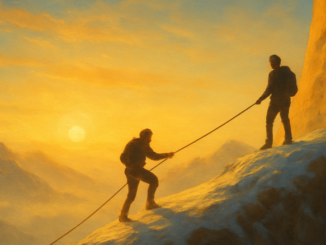
Somewhere high in the Karakoram, bodies lie beneath the snow. A renowned climber is missing, and the world waits in uncertainty. The mountain refuses to reveal who it has taken. In the tension between hope and grief, between knowing and not knowing, there lies a deeper lesson about what connects us as human beings — a lesson that reaches far beyond any summit, straight into the heart of every community built on trust. The Rope That Binds Mountaineers know a simple truth: you are only as strong as the weakest link on your rope. The line that connects climbers is more than a safety device. It is a promise — a promise not to let go when the abyss beckons, when the storm rises, when strength begins to fail. In that promise, Freemasons recognize something deeply familiar. We too are bound by an invisible cord, woven from ritual, trust, and mutual devotion. The tragedy in Pakistan confronts us with the fragility of that bond. When one link in the rope falls, the entire group feels the shock. The bodies in the snow are not merely individuals — they are links in a chain of relationships: families, friends, climbing partners who […]

Racing cars on a circuit symbolizing Masonic brotherhood through adversity
Personal Development & Leadership

Falling and Rising: What Racing Teaches About True Brotherhood

Picture two drivers on the same circuit, facing the same conditions, carrying the same ambitions. One pulls a flawless line through the corners of the Ardennes; the other ends up in the barriers. It’s an image you might recognize from your own life — moments where you perform brilliantly while someone beside you stumbles, or the other way around. What do you do then? How do you handle that inequality of fortune? And what does your response reveal about the nature of true connection? The Circuit as a Mirror of Life A racetrack is more than asphalt and curves. It’s a concentrated version of existence itself — risk, choices, timing, and the eternal dance between control and surrender. During a training session in the Belgian Ardennes this week, two experienced drivers had entirely different experiences. One drove smoothly and with composure; the other lost grip and crashed. Neither could have predicted the outcome beforehand. You probably know that feeling. You’re in the same meeting as a colleague, following the same training, facing the same challenge. Yet things go differently for you than for the person beside you. Sometimes you’re the one who falls. Sometimes you’re the one who keeps going. […]

A moving train symbolizing the shared human journey and Masonic brotherhood
Personal Development & Leadership

When Connection Breaks: Lessons From a Train Incident

Picture this: you’re standing in a moving train, tensions rising, words turning into weapons, and before you know it, the unthinkable happens. A railway employee falls from the train during an altercation with a passenger. The news from Germany is shocking — but it also raises deeper questions. How can an everyday encounter spiral so far out of control? And what does it tell us about the fragile threads that bind us together as human beings? The Thin Line Between Order and Chaos You’ve probably experienced it yourself: standing in a crowded train, someone pushes, another grumbles, and you feel the atmosphere shift. Most of the time, it ends with an angry glance or a muttered remark. But sometimes — very rarely — it escalates. The incident involving a German railway worker who fell from a moving train during a dispute with a passenger shows just how quickly the thin line between order and chaos can vanish. It reminds us that every encounter, no matter how fleeting, carries the potential to heal or to wound. In Freemasonry, we often speak of building a better world, stone by stone. But what happens when those stones collide? What happens when the structure […]

Broken golden chain symbolizing Freemasonry brotherhood and ethical labor
Personal Development & Leadership

The Broken Chain: Luxury, Labor, and True Brotherhood

A golden chain around the neck. A handbag of supple leather. A timepiece built to last generations. These objects radiate craftsmanship, tradition, and a connection to the artisan who created them. But what if that chain doesn’t only link gold — what if it also conceals a shadow chain of exploitation? Recent police raids on renowned Italian fashion houses force us to confront a fundamental question: what does true connection actually mean? The Jewel and Its Shadow Every piece of jewelry tells two stories. The first is visible: the sparkle, the design, the status it projects. The second story lies hidden in the journey the object took before it reached the display window. In workshops — sometimes far removed from the gleaming boutiques — hands bend over workbenches. Those hands have names, faces, families. The question raised by the Italian investigations is simple yet deeply unsettling: are those hands treated as brothers, or as tools? In Freemasonry, the chain is a powerful symbol. Brothers stand in a circle, hands clasped together, as a sign of unbreakable unity. That chain is not a hierarchy, not a production line. It is a horizontal bond of equality. Every link carries equal weight. When […]

Freemasons in lodge discussing different perspectives in brotherhood
Personal Development & Leadership

Two Opinions, One Goal: Psychology and Brotherhood

In 1958, a sports psychologist advised the Brazilian national football coach to leave two young players at home before the World Cup. Those players would go on to become legends. The advice was ignored, Brazil won the tournament, and the psychologist faded into the shadows of history. Yet hidden within this story lies a deeper truth about brotherhood, trust, and the courage to offer a dissenting opinion — even when the world seems to prove you wrong. The Outsider’s Perspective Imagine you are a scientist — a pioneer in the field of sports psychology at a time when the discipline is barely taken seriously. You are tasked with evaluating the mental readiness of a group of footballers. After careful analysis, you arrive at a conclusion that runs directly counter to what everyone wants to hear. Two young players, however talented, show signs of emotional instability that, according to your tests, make them unfit for the pressure of a World Cup. You know your recommendation will be unpopular. You know your reputation is on the line. And yet you speak what you believe to be true. This is the outsider’s perspective: someone who is not part of the group, who has […]

Firefighter helmet and Masonic square and compasses symbolizing brotherhood
Personal Development & Leadership

Arsonist in Uniform: When Brotherhood Fails

The siren wails through the night. A firefighter pulls on his jacket, jumps on the engine, and races toward a blaze he himself has set. Six arrests later — including one of their own — France is left in shock. This isn’t just a story about fire. It’s a story about trust going up in smoke, and about the urgent question of how we protect brotherhood when someone undermines it from within. The Shock of Betrayal From Within When we learn that someone who swore an oath to protect has become the very source of destruction, it shakes our faith in institutions to the core. For most people, the fire service is a symbol of unconditional service. These are the men and women who run into burning buildings while everyone else runs out. They form a tightly knit community — a brotherhood in every sense of the word. And yet, one of them betrayed the trust of colleagues and citizens in the most fundamental way imaginable. Events like these don’t just affect the people directly involved. They sow doubt in every community built on mutual loyalty. How can any group function when the bonds of trust can no longer be […]

Referee whistle symbolizing judgment and Masonic self-reflection
Freemasonry & Society

The Referee’s Whistle: When the Crowd Becomes the Judge

A match ends. The ball rolls to a stop. And then something erupts that has nothing to do with sport. The recent decision by a national football association to file complaints against hateful messages directed at players after a World Cup elimination reveals a deeper societal issue. How is it that people who were cheering moments ago can transform, in the blink of an eye, into judges who strip fellow human beings of their dignity? Behind this phenomenon lies a symbolic truth that Freemasons have explored for centuries: the struggle between the lower and higher self, and the choice that every moment demands of us. The Whistle as a Symbol of Final Judgment A referee’s whistle is a small object. Metal, simple, functional. Yet it carries an enormous symbolic weight. The moment it sounds, a match is frozen into a result. Win or lose. Hero or scapegoat. The complexity of ninety minutes of effort, dozens of decisions, and countless variables is reduced to a single number. This is the paradox of every judgment: it brings clarity, but it sacrifices nuance. In Freemasonry, we know a comparable symbol: the gavel. The Worshipful Master strikes it at decisive moments — not to […]

Open Volume of Sacred Law with Masonic square and candle in a lodge setting
Christianity

Micah and Freemasonry: Do Justice, Love Faithfulness

The candle flickers softly as a Brother opens the Volume of the Sacred Law. His fingers trace the pages until they rest on a passage he has read dozens of times before — yet tonight, the words seem to carry a different weight. “What does the Eternal require of you?” he reads aloud, and the question lingers in the stillness of the lodge room. The Book of Micah, written by a prophet in the eighth-century Kingdom of Judah, poses a question that has echoed through millennia. What does it truly mean to live a good life? The answer Micah offers is deceptively simple and yet infinitely demanding: do justice, love faithfulness, and walk humbly. For anyone familiar with the traditions of Freemasonry, these words resonate like echoes of deeply familiar principles. The Heart of Micah’s Message Micah prophesied during a time of profound social inequality. The wealthy enriched themselves at the expense of the poor, judges accepted bribes, and religious leaders sold their services to the highest bidder. Against this backdrop, the prophet raised his voice — not with elaborate theological arguments, but with a clear moral appeal. His most famous pronouncement appears in the sixth chapter: “He has told […]

Football captain wearing armband leading team symbolizing Masonic leadership
History

The Captain as Master Builder: Leadership on the Field

A green pitch, twenty-two players, and somewhere among them a figure who sets the direction. When a nation achieves a historic victory, all eyes turn to the captain — the armband, the gesture toward teammates, the calm gaze amid the chaos. In those moments, an ancient pattern unfolds, one that Freemasons recognize instinctively: the captain as Master Builder, someone who does not merely play but builds something far greater than any individual could alone. The Armband: A Symbol of Responsibility Anyone who has watched a football match knows the image of the captain’s armband. A simple strip of fabric, usually in the colors of the nation or the club, worn around the upper arm. At first glance, it seems unremarkable. But look deeper. That band distinguishes one player from the other ten. It is not a decoration — it is a commission. The one who wears it takes responsibility for the whole. In Freemasonry, we have comparable symbols of responsibility. The apron, worn by every Brother, serves as a reminder of labor and dedication. But the officers of a Lodge wear additional insignia: jewels, collars, specific regalia. These are not status symbols in the worldly sense. They are reminders of […]

Search dog working through building rubble symbolizing Masonic brotherhood
Personal Development & Leadership

The Search Dog as Teacher: Finding Brotherhood in the Rubble

A search dog picks its way through the rubble of an exploded building in Amsterdam. The footage circulated across the Netherlands this past week, drawing millions of eyes. But for those willing to look beyond the headlines, the images reveal something far more profound than breaking news: a creature moving without hesitation toward what has been lost. In that unconditional devotion lies a lesson Freemasons have been trying to understand for centuries — what does it truly mean to show up for another person? Searching Without Knowing What You Will Find The search dog knows no doubt. It follows its nose, trusts its training, and surrenders completely to the task at hand. Whether the search will lead to a living person, a body, or nothing but emptiness — the animal does not know. And yet it searches. This posture of unconditional action without any guarantee of results strikes at one of the core paradoxes of human connection. We humans hesitate because we cannot see the outcome. The dog reminds us that true devotion needs no certainty. In Freemasonry, we speak of the search for light — a symbolic journey toward insight and truth. But just like the search dog, the […]

Stone fortress wall symbolizing Masonic steadfastness and inner strength
Freemasonry & Connection

When Your Walls Fall: Montaigne and the Art of Steadfastness

Imagine you’re under pressure. Maybe it’s a conflict at work, a fracture in a friendship, or a season when everything seems to be crumbling around you. You feel besieged — surrounded by circumstances you can’t fully control. In moments like these, a single question emerges: how do you stand your ground without losing yourself? Michel de Montaigne, the sixteenth-century philosopher, wrestled with exactly this question in his short but powerful essay on the commander of a besieged fortress. His reflections offer surprisingly practical guidance for anyone seeking steadfastness and human connection in times of adversity. The Heart of the Dilemma In this essay, Montaigne describes a situation that appears military on the surface but is universal at its core. A commander of a besieged fortress must choose: when do you negotiate, when do you hold firm, and when do you yield? It’s not just about walls of stone — it’s about the inner walls we build when we feel threatened. The philosopher asks what honor, courage, and wisdom truly mean when the pressure becomes unbearable. You may never have commanded a garrison, but you’ve almost certainly faced your own version of this dilemma. Think of a moment when you had […]

Vrijmetselarij - Binnenkijken bij de Vrijmetselarij Hilversum
Personal Development & Leadership

Inside a Masonic Lodge: Open Evening in Hilversum 2026

What really goes on behind the closed doors of a Masonic lodge? What motivates the men who belong to this centuries-old fraternity? On Monday, March 23, 2026, you can find out for yourself during a special open evening hosted by Loge Opgang in Hilversum, the Netherlands. A Rare Glimpse Inside a Historic Lodge Building During this open evening, the members of Loge Opgang welcome visitors into their monumental lodge building at Oude Enghweg 19 in Hilversum. Guests will receive a guided tour of the premises, an introduction to the history and symbolism of Freemasonry, and personal stories from lodge members. What has Freemasonry brought them? Why did they choose to join? And what does membership actually involve? Ask Questions and Meet the Members The evening offers plenty of opportunity to ask questions. The Freemasons are happy to engage in open conversation about their motivations, ideals, and practices. As one of the members put it: “Everyone with an open and curious mindset is welcome. We hope to give visitors a clear picture of who we are and what we do.” Who Is This Evening For? This event is primarily aimed at men from the Hilversum and ‘t Gooi region who are […]

Vrijmetselarij - Vrijmetselarij en Zelfontwikkeling – Groeien naar de Beste Versie van Jezelf
Personal Development & Leadership

Freemasonry and Self-Development: Becoming Your Best Self

Freemasonry carries an air of mystery for many people. Some imagine secret rituals behind closed doors; others picture an exclusive, impenetrable society. But anyone who looks beneath the surface discovers something quite different: a practical, time-tested path for personal growth. Freemasonry and self-development are, in fact, inseparable — not as theory or dogma, but as a living practice of self-knowledge, reflection, and purposeful action. So what makes Freemasonry such a unique wellspring of self-development? In this in-depth guide, you’ll discover how this centuries-old tradition helps you bring out the best in yourself — and why that may matter more today than ever before. Self-Development: The Backbone of Freemasonry Self-development isn’t a luxury — it’s a necessity. In a world saturated with distraction, superficiality, and relentless pace, Freemasonry offers a powerful alternative. It’s a space where you’re encouraged to pause, reflect on your life, examine your behavior honestly, and take deliberate steps toward inner growth. In Freemasonry, everything revolves around who you truly are — not what you own or what title you hold. Whether you’re a CEO or a carpenter, an academic or an artist, only one question really matters: are you willing to work on yourself? Working the Rough […]