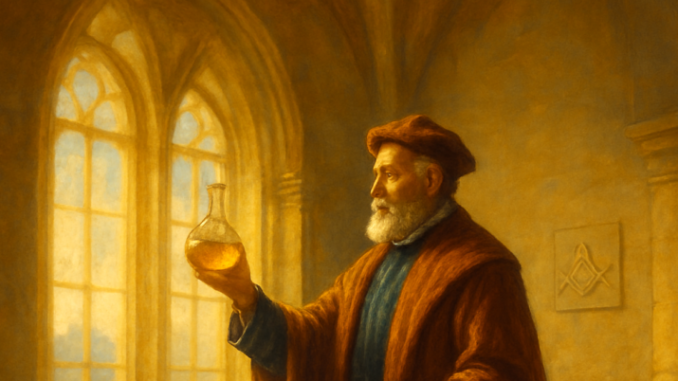
What if a sixteenth-century emperor had already discovered the secret of eternal transmutation — and what if that secret still lies hidden somewhere in Prague? That is the provocative question Dan Brown raises in his thriller The Secret of Secrets. But how do the claims in this novel hold up against what we actually know about Emperor Rudolf II and his alchemical court? And what does any of this have to do with the foundations of Freemasonry? These are questions worth exploring, one by one.
What Exactly Does Dan Brown Claim About Rudolf II?
In The Secret of Secrets, Dan Brown portrays late sixteenth-century Prague under Emperor Rudolf II as an epicenter of hidden knowledge. The novel presents the imperial court as a place where alchemists, astrologers, and Hermetic philosophers converged — not merely to turn base metals into gold, but to unlock a deeper, spiritual secret. Brown suggests that Rudolf II was far more than an eccentric collector: he allegedly built a deliberate network of sages around himself that would later serve as the cradle for secret societies.
The book presents the Prague court as a laboratory where science and mysticism had not yet parted ways. Rudolf II is cast as the guardian of an ancient wisdom tradition stretching back to antiquity — one that, through his court, supposedly formed an unbroken line leading directly to the rituals and degree systems of later brotherhoods, including Freemasonry.
Did Rudolf II Really Gather Alchemists at His Court?
Yes — and this is well documented by historians. Rudolf II of Habsburg, who reigned from 1576 to 1612, moved his residence from Vienna to Prague and transformed the city into a magnet for scholars, artists, and indeed alchemists. Figures such as Edward Kelley and John Dee spent time at his court. The celebrated astronomer Tycho Brahe worked there, as did his successor Johannes Kepler. Rudolf II also possessed a legendary Kunstkammer — a cabinet of curiosities filled with artworks, scientific instruments, and rare objects that reflected his boundless intellectual appetite.
But this is where the line between fact and fiction begins to blur. Historians emphasize that Rudolf’s fascination with alchemy was entirely consistent with the intellectual culture of his era. Alchemy was not a fringe pursuit; it was a serious discipline closely intertwined with early chemistry, medicine, and natural philosophy. Paracelsus, the Swiss physician and alchemist who lived a generation earlier, had already prepared the intellectual ground. Rudolf II was, in essence, an enlightened patron of the arts and sciences — not the mystical gatekeeper Dan Brown makes him out to be.
Is There Really a Line from Prague’s Alchemy to Freemasonry?
This may be the most fascinating question The Secret of Secrets raises. In the novel, Brown draws a direct connection between the Hermetic thought cultivated at Rudolf’s court and the later emergence of Freemasonry in the seventeenth and eighteenth centuries. He suggests that Masonic rituals, degree systems, and core concepts have their origins in the alchemical traditions of Prague.
Historically, this claim requires significant nuance. Freemasonry as we know it took its organized form with the founding of the Grand Lodge of London in 1717 — more than a century after Rudolf’s reign. James Anderson, who compiled the first constitutions of the fraternity, and Jean Théophile Desaguliers, one of its key intellectual driving forces, operated in a very different cultural context. That said, it is true that Hermetic and alchemical ideas found their way into the broader esoteric tradition through the Rosicrucian movement — a tradition from which Freemasonry also drew inspiration.
Alchemy did not merely seek to transform lead into gold; it sought the transformation of the human being — and it is precisely this aspiration that it shares with Freemasonry.
Where Does History End and Myth Begin?
Dan Brown is a master at weaving historical facts together with speculative fiction, and The Secret of Secrets is no exception. The novel takes real historical elements — Rudolf’s Kunstkammer, the Golden Lane on Prague Castle, the documented presence of well-known alchemists — and builds a fictional narrative around them that goes far beyond what historical sources can support. The suggestion that Rudolf II guarded a coded document containing the ultimate secret of spiritual transmutation is a novelistic invention, not a historical claim.
And yet, Brown touches on something essential. The historical reality of the Prague court was extraordinary in its own right. Rudolf II created an environment where the search for hidden truth was actively encouraged. That spirit of inquiry — the courage to look beyond the surface — is a spirit that also lies at the heart of Freemasonry. Whether or not a secret line runs from Prague to London, the ideal of inner transformation connects both traditions at a profound level.
What Can Freemasons Learn from All This?
It would be tempting to dismiss Dan Brown’s claims as mere entertainment, but doing so means missing an opportunity. The Secret of Secrets invites readers to reflect on the relationship between knowledge and secrecy, between outward form and inner meaning. These are questions that arise in every lodge. The alchemist in his laboratory and the Freemason in his workshop share a fundamental conviction: that the human being is not a finished product, but a work in constant progress.
The philosophers Rudolf II gathered around him stood in a tradition reaching back to Hermes Trismegistus — one that shaped the Renaissance through thinkers like Marsilio Ficino and Giovanni Pico della Mirandola. The idea that the microcosm mirrors the macrocosm, that the human being reflects the universe itself, is a concept deeply embedded in both the alchemical and Masonic worldview. It is not about whether Brown’s fictional plotlines are historically accurate; it is about recognizing the enduring power of the ideas that inspired them.
Alchemy, Rosicrucianism, and Freemasonry may differ in form and historical origin, but they share a common thread: the belief that seeking wisdom and pursuing self-improvement are among the noblest of human endeavors. Rudolf II’s Prague, real or romanticized, serves as a powerful reminder that the quest for light is as old as civilization itself.
Dan Brown’s portrayal of Emperor Rudolf II and his alchemical court makes for compelling fiction, but the real history is no less remarkable. Prague under Rudolf was a genuine crucible of intellectual daring, where the boundaries between science, philosophy, and mysticism were fluid. While the direct lineage Brown draws to Freemasonry is more literary invention than established fact, the deeper connection — the shared pursuit of transformation, knowledge, and hidden truth — is undeniable. For Freemasons, the story of Rudolf II is not just historical curiosity; it is a mirror reflecting the very ideals the Craft continues to uphold.
Copyright text & image: devrijmetselaar.nl
Texts are based on the ideas and content of the author of devrijmetselaar.nl, reviewed, corrected, and supplemented with the assistance of OpenAI. Images are created based on the ideas of the author of devrijmetselaar.nl using OpenAI/DALL-E.
Frequently Asked Questions
What does Dan Brown claim about Emperor Rudolf II and alchemy in 'The Secret of Secrets'?
Dan Brown portrays Rudolf II's late sixteenth-century Prague court as an epicenter of hidden knowledge where alchemists, astrologers, and Hermetic philosophers gathered to unlock spiritual secrets. Brown suggests Rudolf deliberately built a network of sages that supposedly formed the cradle for secret societies, including Freemasonry, and that he was the guardian of an ancient wisdom tradition stretching back to antiquity.
Did Emperor Rudolf II actually have alchemists at his court?
Yes, this is well documented by historians. Rudolf II (1576-1612) moved his residence to Prague and attracted renowned scholars including alchemists Edward Kelley and John Dee, astronomer Tycho Brahe, and Johannes Kepler. He also maintained a legendary Kunstkammer (cabinet of curiosities) filled with artworks, scientific instruments, and rare objects. However, historians emphasize that his interest in alchemy was consistent with the intellectual culture of his era, as alchemy was a serious discipline intertwined with early chemistry, medicine, and natural philosophy.
How does the article distinguish between Dan Brown's claims and historical facts about Rudolf II?
While the article confirms that Rudolf II did gather alchemists and scholars at his court—a documented historical fact—it notes that 'this is where the line between fact and fiction begins to blur.' The article suggests that Brown's claim of a direct, deliberate connection between Rudolf's court and the founding of Freemasonry goes beyond what historians can substantiate, presenting fiction as fact.

Be the first to comment