
What drives a Roman statesman to write a treatise on inner peace in the midst of first-century political chaos? And why does that text, nearly two thousand years later, still feel like a conversation you could have at your own dinner table? In this article, we uncover the philosophical roots of Lucius Annaeus Seneca’s essay On the Tranquility of Mind, trace the thinkers and traditions that shaped him, and ask a question that resonates deeply within Freemasonry: how do you build an unshakeable inner foundation?
Why Did Seneca Write About Tranquility?
The essay On the Tranquility of Mind (in Latin: De Tranquillitate Animi) takes the form of a dialogue between Seneca and his friend Serenus, a young public official struggling with restlessness, self-doubt, and the seduction of luxury. Serenus asks Seneca for guidance: how does one achieve that stable state of mind where you are no longer tossed back and forth by fortune? At first glance, the question sounds deeply personal — but it actually strikes at the heart of a centuries-old philosophical tradition. Seneca answers not with abstract theories, but with a carefully woven tapestry of insights drawn from multiple schools of thought.
The Philosophical Traditions Behind Seneca’s Thinking
The most important foundation is, of course, Stoicism. Seneca places himself firmly in the tradition of Zeno of Citium, the founder of the Stoic school, along with his successors Cleanthes and Chrysippus. The core idea is clear: tranquility arises not from controlling the external world, but from shaping your own judgment about it. It is not circumstances that disturb you, but your interpretation of them. Seneca takes this principle as his starting point — but he is no slavish follower. He adapts it, adds nuance, and enriches it with insights from other traditions.
The influence of Plato, for instance, is unmistakable. Plato’s tripartite division of the soul — with its rational, spirited, and appetitive parts — echoes throughout Seneca’s description of how inner division leads to unrest. Serenus is exactly such a divided soul: he knows what is good, but feels drawn to what is merely pleasant. Seneca’s therapy aims to bring these parts of the soul back into harmony, an echo of Plato’s ideal in the Republic.
Aristotle, too, plays a role in the background. The Peripatetic doctrine of the golden mean — the idea that virtue lies in the balance between extremes — is clearly recognizable in Seneca’s advice not to expect too much or too little from life, from possessions, and from other people.
Was Seneca Simply a Stoic?
This is a fair question, and the answer is both yes and no. Seneca called himself a Stoic, but he was what scholars term an eclectic thinker. He drew freely from the work of Epicurus, the philosopher typically regarded as the Stoics’ counterpart. In On the Tranquility of Mind, Seneca explicitly praises the Epicurean ideal of inner calm — ataraxia — even though the path to reach it differs. Where Epicurus recommends withdrawing from public life, Seneca argues for engagement, but with the right inner attitude.
Seneca was also familiar with the work of Democritus, who had written earlier about euthymia — a good disposition of the soul — a concept Seneca literally takes as his starting point in this essay. He also references Athenodorus, a Stoic philosopher who served as an adviser to Emperor Augustus, and his views on the balance between public duty and personal peace.
For Seneca, tranquility of mind is not passive resignation. It is an active inner architecture: the conscious construction of a soul that holds firm, regardless of what fortune brings.
The Connection to Freemasonry
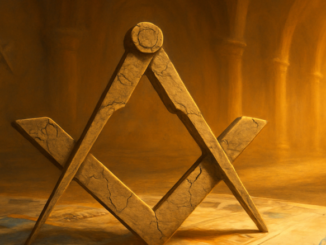
This is where the conversation becomes truly compelling. Freemasonry embraces the ideal of the “rough ashlar” that must be shaped into a “perfect cube” — a process of inner refinement that bears a remarkable resemblance to what Seneca describes. Where Seneca speaks of forming one’s own judgment, tempering desire, and finding balance, the Freemason speaks of self-knowledge, brotherhood, and working on one’s inner temple. The ethical undertone is closely related. Both traditions view virtue not as an abstract ideal but as something that must be practiced daily — as a craft.
Masonic ritual emphasizes that true peace does not come from without, but from within. That is precisely the core of Seneca’s argument. In this sense, the lodge serves as a training ground for what Seneca calls euthymia: a space where you learn not to be disturbed by the superficial, but to focus on what is essential. Michel de Montaigne, who repeatedly referenced Seneca in his own essays and has himself been a source of inspiration for many freethinkers, would recognize this as the art of learning to live with oneself.
Historical Context: Power, Vulnerability, and Philosophy
Seneca likely wrote On the Tranquility of Mind around 60 AD, during the period when he served as adviser to Emperor Nero and stood at the height of his political influence — yet at the same time experienced firsthand the arbitrary cruelty of the imperial court. This tension between power and powerlessness, between engagement and detachment, gives the essay its urgency. It is no academic exercise; it is a text born of personal necessity. The philosophical traditions he invokes — from the early Stoa to Plato, from Democritus to Epicurus — serve as tools with which he tries to gain a foothold in a world that is inherently uncertain.
During the Renaissance, Seneca was rediscovered by humanists such as Petrarch and Justus Lipsius, who combined his work with Christian ethics and shaped what became known as Neostoicism. This Neostoic movement, in turn, influenced the intellectual culture from which modern Freemasonry emerged in the eighteenth century. The thread that runs from Seneca through the Renaissance humanists into Masonic philosophy is not merely coincidental — it reflects a continuous tradition of seeking inner stability through moral self-cultivation.
Building the Inner Temple: Seneca’s Enduring Relevance
What makes Seneca’s essay endure is not just its philosophical depth, but its practical applicability. His advice is concrete: choose your companions wisely, do not accumulate more than you need, engage with the world but protect your inner life, accept impermanence without surrendering your agency. These are not dusty precepts from antiquity — they are living principles that any thoughtful person, and certainly any Freemason committed to self-improvement, can apply today.
The Masonic journey from rough stone to polished ashlar mirrors Seneca’s vision of tranquility as an ongoing project rather than a final destination. Both the philosopher and the Freemason understand that the work is never truly finished — and that this is precisely where its meaning lies. Inner peace is not a state you arrive at once and for all; it is a discipline you practice, a temple you build stone by stone, day by day.
Seneca’s On the Tranquility of Mind is far more than a historical curiosity. It is a living document that speaks across the centuries to anyone seeking a stable inner foundation in an unstable world. Its philosophical roots — Stoic, Platonic, Aristotelian, and Epicurean — form a rich soil from which profound insights continue to grow. For Freemasons, the resonance is especially striking: the language may differ, but the aspiration is the same. To build an inner temple that stands firm. To shape the rough stone with patience and purpose. To find tranquility not by escaping the world, but by meeting it with a well-ordered soul.
Copyright text & image: devrijmetselaar.nl
Texts are based on the ideas and content of the author of devrijmetselaar.nl, reviewed, corrected, and supplemented with the assistance of OpenAI. Images are created based on the ideas of the author of devrijmetselaar.nl using OpenAI/DALL-E.
Frequently Asked Questions
What is the main topic of Seneca's 'On the Tranquility of Mind'?
Seneca's essay, written as a dialogue with his friend Serenus, explores how to achieve inner peace and stability of mind in the face of fortune and external circumstances. Rather than offering abstract theories, Seneca provides practical guidance drawn from multiple philosophical traditions, addressing how one can maintain an unshakeable inner foundation despite life's uncertainties.
Which philosophical traditions influenced Seneca's work on tranquility?
Seneca's thinking is primarily rooted in Stoicism, the school founded by Zeno of Citium, which teaches that tranquility comes from shaping one's judgment rather than controlling external events. However, Seneca also incorporates influences from Plato's tripartite division of the soul and Aristotle's doctrine of the golden mean, creating a nuanced synthesis of multiple philosophical schools.
Why is Seneca's ancient Roman text still relevant today?
Despite being written nearly two thousand years ago during first-century political chaos, Seneca's essay on tranquility remains relevant because it addresses timeless human struggles with restlessness, self-doubt, and the pursuit of luxury. The text resonates with modern readers as a practical conversation on building inner peace, and its insights particularly resonate within Freemasonry's emphasis on developing an unshakeable inner foundation.



Be the first to comment