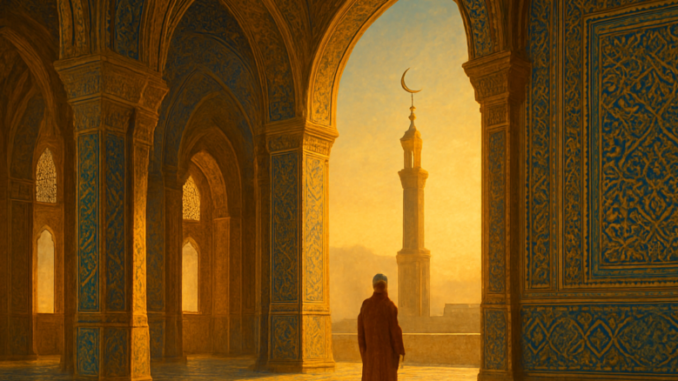
What if the path to enlightenment isn’t a straight line, but a series of steps you must climb one at a time? Surah 70 of the Quran, known as Al-Ma’arij — The Ways of Ascent — describes how the human soul can elevate itself through patience, compassion, and moral steadfastness. At first glance, this ancient text might seem far removed from the rituals of a Masonic lodge. But look more closely and a striking kinship emerges: the idea that spiritual growth demands a conscious, gradual ascent. In this article, we engage with this centuries-old scripture and ask what it has to say about the inner journey that also lies at the heart of Freemasonry.
What Is The Ways of Ascent Really About?
Surah 70 is a relatively short but powerful text of 44 verses, revealed in Mecca. Its title refers to the “ways of ascent” by which angels and the Spirit rise toward God. The surah opens with someone demanding divine punishment, as though the inevitable judgment were a distant abstraction. The text then confronts humanity with its own impatience, its greed, and its tendency to turn away from higher things.
But there is hope. The surah also describes those who persist in prayer, who show compassion, who master their desires, and who remain faithful to their promises. In short, it holds up a mirror showing human beings both what they are and what they could become.
The image of the “ways of ascent” is particularly striking. This is not about a single leap, but about a deliberate, sometimes arduous climb. The angels traverse this distance in “a day the measure of which is fifty thousand years” — a formulation that underscores the immensity of the spiritual journey. There is no promise of quick salvation here, only an invitation to patient, persevering effort.
Where Freemasonry and Surah 70 Meet
The question naturally arises: what does any of this have to do with Freemasonry? The Craft is not a religion and does not base itself on any single holy book. But therein lies its richness — the Masonic tradition invites its members to recognize wisdom in all great spiritual traditions. The central theme of Surah 70, the gradual ascent of the individual toward higher consciousness, resonates deeply with the path a Freemason walks. From Entered Apprentice through Fellow Craft to Master Mason, each degree represents a rung on a ladder that reaches not so much toward heaven as toward a deeper understanding of oneself and the world.
Jacob’s Ladder, an image found across many Masonic traditions, offers a fascinating parallel. Like the “ways of ascent” in the surah, this ladder symbolizes the connection between the earthly and the celestial. The philosopher Plato described a similar movement in his Allegory of the Cave: the person who breaks free from shadows and climbs step by step toward the light. Aristotle, too, emphasized that virtue is not a fixed state but a continual practice — a daily ascent. It is precisely this idea that permeates both the Quranic text and the Masonic experience.
Is Patience the Greatest Secret?
In a sense, yes. Surah 70 devotes remarkable attention to human impatience. “Indeed, mankind was created anxious,” reads verse 19. When adversity strikes, he is filled with despair; when good fortune comes his way, he is miserly. It is a sharp psychological observation that has lost none of its force fourteen centuries later.
Patience is also a core value in Freemasonry, even when it is not always named explicitly. The ritual itself is an exercise in slowing down — the deliberate repetition of words and actions, the silence at the right moment, the act of listening before speaking. The great seventeenth-century thinker Baruch Spinoza wrote that true freedom is not the following of impulses, but the ability to act from reason and insight. That ability demands time, practice, and indeed, patience. The surah and the lodge speak the same language here, though with different words.
Spiritual growth is not a sudden illumination but a patient climb: step by step, degree by degree, day after day.
Compassion as a Mark of Spiritual Maturity
The surah draws a clear distinction between those who are swept along by their baser instincts and those who consciously strive for good. The latter group includes those who feed the needy, who keep their promises, and who remain steadfast in their devotion. This is not about outward display but about inner sincerity. In this text, compassion is not weakness — it is proof of spiritual maturity.
Here we recognize one of the fundamental pillars of Freemasonry: Brotherly Love, or in a broader sense, genuine concern for the welfare of others. James Anderson, whose Constitutions of 1723 serve as the founding document of modern Freemasonry, already stressed that a true Mason has a duty to relieve the distress of his fellow human beings. Goethe, himself an active Freemason, expressed it in his literary work as the necessity of being perpetually “active” in the service of humanity. The Ways of Ascent sketches precisely the same ideal: the person who does not settle for personal comfort but rises up and acts.
Universal Patterns Beyond the Boundaries of Faith
Reading Surah 70 as a Freemason — or as someone interested in the Masonic tradition — is not an exercise in theological comparison. It is an invitation to recognize universal patterns. The way upward, the overcoming of impatience, the cultivation of compassion, and the faithfulness to one’s inner compass: these are themes that know no boundaries of creed or culture.
In Freemasonry, life itself is understood as a building project. Each day is a stone that is laid, each action a chisel strike that shapes the rough ashlar of character. The Ways of Ascent reminds us that this construction is not completed in a single day. The distance between who we are and who we aspire to become may feel as vast as fifty thousand years. But every step matters. Every conscious choice to be patient rather than impulsive, compassionate rather than indifferent, faithful rather than fickle, is a step upward on that ancient ladder.
The beauty of engaging with texts from traditions outside one’s own is that they often illuminate what we already sense but have not yet put into words. Surah 70 does not ask us to adopt a particular theology. It asks us to look honestly at ourselves — at our impatience, our selfishness, our capacity for goodness — and to choose the ascending path. That is a message any Freemason can take to heart.
The Ways of Ascent offers a profound reminder that the spiritual journey is neither quick nor easy — but it is infinitely worthwhile. Whether expressed through the imagery of Quranic angels ascending toward the Divine, the rungs of Jacob’s Ladder in a Masonic lodge, or the slow and steady work of shaping the rough stone of character, the message is the same: true growth comes through patience, compassion, and unwavering commitment to the climb. For the Freemason, this ancient surah is not a foreign text but a familiar echo — a voice from another tradition affirming what the Craft teaches in every degree: that we are all builders on the ascending path, and that every step upward matters.
Copyright text & image: devrijmetselaar.nl
Texts are based on the ideas and content of the author of devrijmetselaar.nl, reviewed, corrected, and supplemented with the assistance of OpenAI. Images are created based on the ideas of the author of devrijmetselaar.nl using OpenAI/DALL-E.




Be the first to comment