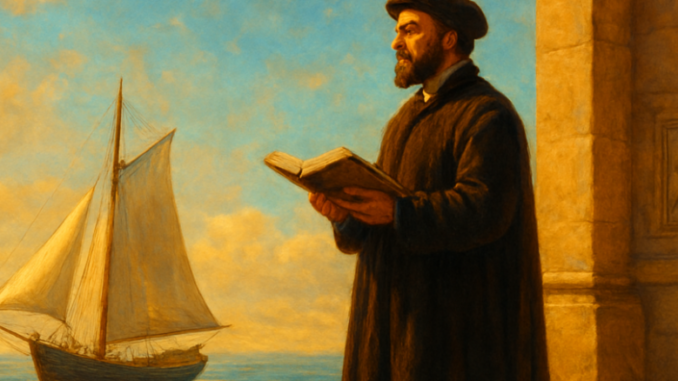
Imagine this: you’re at work, facing a difficult dilemma. Your manager asks you to do something that technically falls within the rules — but your inner compass tells you it’s unjust. What do you do? Follow your formal duty, or listen to your own conscience? This tension between outward obedience and inner ethics is exactly the terrain Michel de Montaigne explores in his essay ‘On the Laws of Duty.’ Written centuries ago, it remains remarkably practical — and shares striking common ground with the ethical foundations of Freemasonry.
What Is This Essay About?
In Essay 23 of the first book of his famous Essays, Michel de Montaigne examines the nature of duty. What do we truly owe others? Where are the boundaries of loyalty to a ruler, a friend, or an ideal? Montaigne argues that duties are never absolute. There is always a tension between what society expects of us and what our personal conscience dictates. The essay is brief but powerful, touching on fundamental questions about loyalty, honesty, and moral courage.
Montaigne wrote this against the backdrop of the French Wars of Religion — a period in which people were constantly forced to choose between warring factions. Loyalty to one lord automatically meant betrayal of another. In that context, reflecting on duty was not an abstract philosophical exercise but a matter of life and death. That urgency is palpable in every sentence.
The Core Idea: Duty Has Its Limits
Montaigne’s central argument is clear: no duty should ever lead us to betray our fundamental humanity. He acknowledges that we have obligations to our rulers, our country, and our fellow human beings. But those obligations are not without limits. The moment an order compels us to act against our conscience, we have not only the right but also the duty to refuse.
To illustrate this point, Montaigne draws on examples from Roman and Greek history — generals and statesmen who placed boundaries on their loyalty when it conflicted with their personal honor. He references the Roman commander Publius Cornelius Scipio and the philosopher-emperor Marcus Aurelius, both of whom restrained their power through an inner ethical awareness. Montaigne admires them not for their military victories, but for their ability to say no when the situation demanded it.
This admiration fits within his broader philosophy: true virtue lies not in following rules, but in the capacity to take personal responsibility for your choices.
True devotion to duty begins where blind obedience ends — at the moment your own conscience becomes the measure of your actions.
Key Examples and Arguments
Montaigne uses several historical examples to strengthen his case, employing a method characteristic of his writing style: he layers stories and observations not as proof in a strict sense, but as invitations to reflection. The main threads of his argument can be summarized as follows:
Loyalty to a ruler is valuable — but becomes immoral when that ruler demands unjust acts. A servant who carries out every order without thinking is not a loyal servant but a mere instrument.
Personal honor stands above formal obedience. Montaigne argues that a person who sacrifices their conscience to fulfill a command ultimately loses themselves.
Public morality differs from private morality. What is considered acceptable in public life may be reprehensible in personal life, and vice versa. Montaigne urges us to consciously distinguish between these two spheres.
No single party holds a monopoly on truth. In any conflict, both sides deserve critical examination — never blind devotion.
This nuance is what makes the essay remarkably timeless. Montaigne avoids every form of dogmatism. He invites the reader to judge for themselves, and to continuously test that judgment against reality.
Practical Lessons for Everyday Life
What can you actually do with Montaigne’s insights? More than you might think. His essay offers three practical tools you can apply starting today:
1. Ask yourself at every important decision: am I acting out of conviction or out of obedience? If the answer is obedience, examine whether that obedience is truly justified.
2. Dare to set boundaries on your loyalty. Whether it concerns your employer, a circle of friends, or an organization — loyalty that forces you to deny who you are is not loyalty at all. It is submission.
3. Practice distinguishing between public and personal morality. What “everyone does” doesn’t necessarily align with what you believe is right. Montaigne teaches us to recognize that gap and deal with it consciously.
The Connection With Freemasonry
Anyone familiar with the ethical foundations of Freemasonry will recognize a striking kinship in Montaigne’s essay. Freemasonry regards the personal conscience as the highest guide for moral action. Just like Montaigne, the Masonic tradition holds that blind obedience is no virtue. A Freemason is invited to think independently, to judge for themselves, and to take responsibility for their actions. The rituals repeatedly emphasize that the practice of duty must always go hand in hand with inner freedom.
The working tools used in Freemasonry as ethical guides mirror precisely the balance Montaigne describes. The square, symbolizing righteousness and fair dealing, and the compasses, which mark the boundaries of proper conduct, reflect the same equilibrium between duty and conscience. Duty without conscience is like a pair of compasses without a pivot point — it cannot draw a true circle.
The Lodge functions as a practice ground where Brethren learn to fulfill their duties without losing their inner compass. This practice brings Montaigne’s philosophy vividly to life within the Masonic workspace, making his centuries-old reflections feel as immediate and relevant as ever.
Montaigne’s essay on the laws of duty is far more than a historical curiosity. It is a living text that challenges us to examine the foundations of our own moral choices. In a world that still regularly demands blind loyalty — to institutions, ideologies, or social expectations — his message resonates with enduring power: true duty begins with conscience. For Freemasons and non-Masons alike, his insights serve as a timeless reminder that the most courageous act of loyalty is sometimes the willingness to say no.
Copyright text & image: devrijmetselaar.nl
Texts are based on the ideas and content of the author of devrijmetselaar.nl, reviewed, corrected, and supplemented with the assistance of OpenAI. Images are created based on the ideas of the author of devrijmetselaar.nl using OpenAI/DALL-E.



Be the first to comment