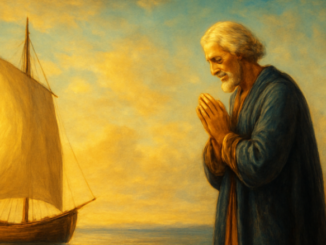
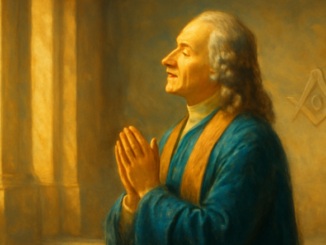
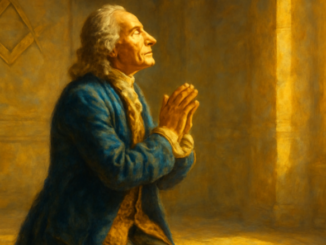
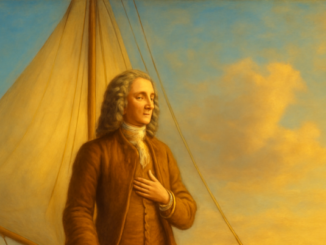
Symbolic contrast of darkness and light representing Voltaire and Pascal
Symbolism & Rituals

Voltaire vs Pascal: Optimism as a Bridge to Brotherhood

There are moments when the weight of the world feels unbearable — moments when you wonder whether humanity is simply destined for misery. Blaise Pascal, the brilliant seventeenth-century thinker, wrote from exactly that conviction. But what happens when another mind reads those same texts and arrives at radically different conclusions? Voltaire took up the challenge, and in his Philosophical Letters he delivered a response that not only ignited one of the great intellectual debates in Western thought but also articulated a philosophy of life that runs remarkably close to the heart of Freemasonry. Two Thinkers, Two Visions of the Human Condition Pascal saw humanity as a species torn between greatness and insignificance, trapped in a universe that appears deaf and blind to our existence. His famous Pensées breathe an atmosphere of existential unease: without God, man is lost, and even with faith, existence remains a precarious balancing act. When Voltaire read these fragments, he felt resistance rising within him — not because he underestimated Pascal’s intelligence, but because he held a fundamentally different view of what it means to be human. Where Pascal emphasized human weakness, Voltaire saw possibility. Where Pascal warned against the vanity of worldly pursuits, Voltaire celebrated […]

Symbolic contrast of light and darkness representing Voltaire and Pascal
Symbolism & Rituals

Voltaire vs Pascal: Two Visions of Human Nature

In his fifth Philosophical Letter, Voltaire took aim at one of the seventeenth century’s most influential thinkers: Blaise Pascal. Where Pascal saw humanity as a wretched creature lost between infinity and nothingness, Voltaire offered a radically different portrait. This was no dry academic dispute — it was a collision between two worlds: Jansenist pessimism and the rising confidence in human reason and progress. For the Freemason, who seeks light in the darkness and the elevation of the human spirit, this confrontation offers surprisingly relevant insights. The Intellectual World of Voltaire To understand Voltaire’s critique of Pascal, we must first understand the intellectual sources that shaped him. Voltaire was a child of the early Enlightenment, deeply influenced by the English empiricists John Locke and Isaac Newton. During his exile in England, he discovered an intellectual climate that was radically different from the dogmatic atmosphere of France. Locke’s idea that the human mind begins as a blank slate stood in direct opposition to Pascal’s notion of humanity stained by original sin. Newton demonstrated that the universe obeyed comprehensible laws rather than impenetrable mysteries. Voltaire also drew from the skeptical tradition of Michel de Montaigne, whose essays he studied closely. Montaigne’s gentle doubt […]

Reeds bending in wind symbolising Voltaire and Pascal philosophical dialogue
Symbolism & Rituals

Voltaire on Pascal: The Fifth Philosophical Letter Explored

A thinking reed. With this single image, Blaise Pascal captured the human condition — insignificant amid the vastness of the universe, yet elevated by the capacity for thought. Voltaire read these words and felt compelled to respond. In his fifth philosophical letter, he enters into dialogue with a thinker who both fascinated and unsettled him. The result is a text that still invites profound reflection: is humanity truly as wretched as Pascal claimed? The Heart of Pascal’s Thought Blaise Pascal wrote his famous Pensées as groundwork for a defence of the Christian faith. At its centre lies his conviction that humanity without God is lost. He describes human nature as broken, torn between greatness and insignificance. We seek distractions so we need not feel the void within. We entertain ourselves to forget death. Pascal’s analysis is saturated with a deep pessimism about humanity’s capacity for happiness outside divine grace. Voltaire acknowledges Pascal’s brilliance as both mathematician and prose stylist. At the same time, he resists Pascal’s bleak vision of human nature. In the fifth letter, he methodically dissects Pascal’s propositions and sets his own perspective against them. This is not destructive criticism — it is a dialogue between two fundamentally […]

Prism splitting light into a spectrum symbolizing Masonic pursuit of truth
Symbolism & Rituals

Voltaire on Newton: Light, Science, and Masonic Wisdom

What happens when a philosopher encounters a scientist who changes the world forever? Voltaire posed this question to himself when he wrote about Isaac Newton in his Letters on the English. But why should this matter to a Freemason in 2026? Perhaps because Voltaire’s admiration for Newton illuminates the very values that are cherished in the lodge: the pursuit of light, reverence for truth, and the understanding that knowledge only gains meaning when it is shared. Why Was Voltaire So Fascinated by Newton? In the early eighteenth century, Voltaire spent several years in England, where he encountered an intellectual climate radically different from what he had known in France. While the continent was still deeply immersed in the ideas of René Descartes, Newton had already sparked a revolution across the Channel. His laws of gravity and his groundbreaking work on light left a profound impression on Voltaire. Here was a thinker who did not merely speculate — he measured, proved, and demonstrated. What captivated Voltaire above all was Newton’s method. Newton did not begin with grand theories and then force the facts to fit. He observed, experimented, and let nature speak for itself. For Voltaire, this was a masterclass in […]

Voltaire and Newton symbolizing Enlightenment philosophy and Freemasonry
Symbolism & Rituals

Voltaire on Newton: Philosophical Roots of the Enlightenment

Imagine living in Paris in 1733. The salons are buzzing with new ideas, yet the Church and the State maintain a firm grip on what you are allowed to think and say. Then a book appears that turns everything upside down: Voltaire’s Philosophical Letters. His fourth letter, devoted to Isaac Newton, is far more than a tribute to a scientist. It is a philosophical manifesto that lays the foundation for an entirely new way of thinking about humanity, nature, and the cosmos — a way of thinking that resonates powerfully with the principles of Freemasonry. The Intellectual World Voltaire Wrote In To understand why Voltaire’s letter on Newton was so revolutionary, you need to step into the intellectual landscape of early eighteenth-century France. The Cartesian philosophy of René Descartes still dominated the academies. Descartes had promoted a mechanistic worldview in which nature operated like an enormous clock, driven by swirling particles in a filled universe. For the French elite, this was the officially sanctioned framework of thought. Voltaire returned from his English exile carrying a radically different message. During his stay in London, he had encountered the empirical philosophy of John Locke and the scientific revolution set in motion by […]

Prism splitting white light into a spectrum symbolizing Masonic enlightenment
Symbolism & Rituals

Voltaire on Newton: Light as a Symbol of Insight

When a ray of light passes through a prism and splits into a rainbow of colors, we witness more than a physical phenomenon — we witness a revelation. Voltaire understood this profoundly when he introduced Isaac Newton’s ideas to continental Europe in his fourth Philosophical Letter. What he described was not merely science, but an entirely new way of seeing reality — one that resonates deeply with the symbolic language of Freemasonry. The Context of Voltaire’s Admiration Voltaire wrote his Philosophical Letters after a period of forced exile in England between 1726 and 1729. Those years changed his thinking fundamentally. Back in France, the natural philosophy of René Descartes still held sway, with its vortex theories and mechanistic explanations of the universe. Newton offered a radically different perspective: no speculation about invisible matter, but measurable forces and mathematical laws. Voltaire saw in Newton far more than a scientist — he saw a liberator of the human mind. His fourth letter reads as a tribute, but one that consistently invites the reader to investigate for themselves. What made Voltaire’s approach remarkable was his ability to make Newton’s complex work accessible without oversimplifying it. He described the discovery of gravity, the laws […]

Symbolic representation of Voltaire, Locke, and Freemasonry's pursuit of light
Symbolism & Rituals

Voltaire on Locke: Knowledge and Connection in Freemasonry

Can a person truly know anything, or are we merely grasping at shadows? This is the question Voltaire raises in his third philosophical letter, where he examines the ideas of John Locke. His answer — a radical rejection of innate ideas and a full embrace of sensory experience as the source of all knowledge — touches on a fundamental tension that lives at the very heart of Freemasonry. How do knowledge and mystery relate to one another? And what does it mean to search for truth within a brotherhood that acknowledges both light and darkness? The Blank Slate and the Searching Mind Voltaire presents Locke as the philosopher who finally had the courage to say aloud what others had only whispered: the human mind is not born as a storehouse of eternal truths, but as a blank slate. All knowledge arises from experience — from the impressions our senses deliver and the reflections our minds perform upon them. While this idea was not entirely new in the history of philosophy, Locke gave it a systematic treatment that Voltaire deeply admired. For the Freemason, this image of the tabula rasa stirs a remarkable sense of recognition. The candidate enters the lodge […]

Philosophical books representing Voltaire and Locke's Enlightenment ideas
Symbolism & Rituals

Voltaire on Locke: Philosophical Roots of the Third Letter

What is it about a seventeenth-century philosopher that still echoes through modern conversations about knowledge, freedom, and the limits of human understanding? When Voltaire devoted his third philosophical letter to John Locke, he did far more than introduce an English thinker to a French audience. He opened a door to an entirely new way of philosophizing — a method that would leave its mark on Enlightenment thought and, perhaps less obviously, on the principles embraced within Freemasonry. Why Did Voltaire Choose Locke as His Guide? The question is worth pausing over. In early eighteenth-century France, the ideas of René Descartes still dominated intellectual life. His rationalism — with its emphasis on innate ideas and the certainty of thought — formed the bedrock of philosophical culture. But during his exile in England from 1726 to 1728, Voltaire encountered a radically different approach. John Locke had argued in his Essay Concerning Human Understanding that the human mind at birth is a blank slate, a tabula rasa. All knowledge, Locke maintained, arises from sensory experience and our reflection upon it. This empiricism appealed deeply to Voltaire. It offered an antidote to what he saw as the hollow speculations of scholasticism and the dogmatic […]

Rough ashlar and open book symbolizing Locke's blank slate in Freemasonry
Symbolism & Rituals

Voltaire on Locke: The Soul as a Blank Slate

In a dimly lit London study sometime in the 1720s, a young French exile bent over the works of an English philosopher who had died just decades earlier. François-Marie Arouet — better known as Voltaire — discovered in the writings of John Locke a revolutionary idea: the human mind is born a blank slate. No innate ideas, no predetermined truths, only the pure possibility of growth through experience. This discovery would change Voltaire forever, and it forms the heart of his third philosophical letter. The Context of Voltaire’s Exile When Voltaire lived in England between 1726 and 1728, he was fleeing not only the Bastille but also the suffocating intellectual climate of Louis XV’s France. In England, he encountered a society where freethinkers could debate openly, where Isaac Newton’s science was celebrated, and where John Locke’s philosophy was considered common knowledge. He later gathered these experiences into his Philosophical Letters, a collection of essays that introduced English thought to the French public. The third letter, devoted to Locke, stands out because Voltaire does more than simply report on scientific discoveries. He poses a fundamental question about human nature itself: Who are we, and how do we arrive at our knowledge? […]

Voltaire reflecting on religious tolerance and Freemasonry in England
Symbolism & Rituals

Voltaire on the Anglicans: Religious Freedom and Brotherhood

What happens when one of history’s sharpest minds flees his homeland and discovers, in exile, a society where religious diversity leads not to chaos but to prosperity? François-Marie Arouet — better known as Voltaire — had exactly that experience in England. He wrote about it in his Letters on the English, and his second letter, devoted to the Anglicans, paints a religious landscape that filled him with both astonishment and admiration. For those familiar with Freemasonry, his observations resonate in a remarkably powerful way. Voltaire touches on values the Craft has cherished for centuries: tolerance, the art of living together, and the ability to bridge differences without erasing them. The Paradox of a State Church Voltaire opens his letter with an apparent contradiction. England has a state church — the Church of England — which officially claims to represent the one true faith. Yet at the same time, he observes a society in which dissenters, Catholics, Quakers, and Jews live and trade alongside one another. How can a state church exist without producing the tyranny Voltaire knew so well from France? This question forces us to reconsider the very nature of religious institutions. Is a church by definition an instrument […]

Voltaire writing at a desk with philosophical texts and Anglican church in background
Symbolism & Rituals

Voltaire on the Anglicans: Philosophical Roots and Influences

When Voltaire fled to England in 1726, forced into exile by political circumstances, he carried more than just his razor-sharp pen. He brought with him a mind shaped by the great thinkers of his era. His observations on the Anglican Church, recorded in his famous Letters on the English (also known as the Philosophical Letters), were far more than superficial travel writing. They revealed a deeply rooted philosophical vision of religion, tolerance, and human freedom. What intellectual currents and thinkers shaped that vision? And what can modern seekers of wisdom — including those who walk the Masonic path — learn from the sources Voltaire drew upon? The Legacy of John Locke: Reason as the Measure of All Things No thinker influenced Voltaire’s view of religion more profoundly than John Locke. The English philosopher, whose works Voltaire studied extensively during his exile, had put forward a revolutionary thesis: religious convictions must be able to withstand the test of reason. In his Letter Concerning Toleration, Locke argued that the state has no right to impose matters of conscience. Voltaire embraced this principle wholeheartedly and saw in Anglican practice an embodiment of this rational approach. Where the Catholic Church of Voltaire’s homeland based […]

Voltaire reflecting on the Anglican Church and religious tolerance in England
Symbolism & Rituals

Voltaire on the Anglicans: Tolerance as a Religious Virtue

In his second philosophical letter, Voltaire turns his sharp gaze toward the Anglican Church. Having already shared his observations on the Quakers, he now examines an established state church that, despite its official status, displays a remarkable degree of religious tolerance. By placing two worlds side by side — the rigid French Catholicism of his era and the pragmatic English approach to faith and state power — Voltaire reveals not only differences in ecclesiastical organization, but touches on deeper questions about freedom, hierarchy, and the symbolic meaning of religious institutions. The Heart of Voltaire’s Argument Voltaire describes the Anglican Church as a curious blend of Protestant theology and Catholic aesthetics. The bishops still wear their mitres, the cathedrals retain their grandeur, and the liturgy carries a solemnity reminiscent of Rome. Yet the doctrine is fundamentally different. The monarch stands at the head of the church, not the Pope. This institutional break with Rome, Voltaire argues, has not led to chaos but rather to a workable order in which religious disagreements are far less likely to result in bloodshed. The central theme of this letter is the relationship between state power and religious authority. Voltaire observes that the English have found […]

Voltaire meeting a Quaker symbolizing brotherhood and equality in Freemasonry
Symbolism & Rituals

Voltaire and the Quakers: Brotherhood Without Dogma

In 1726, François-Marie Arouet — better known as Voltaire — fled to England. What he found there would permanently reshape his thinking. It wasn’t the Anglican cathedrals or the royal courts that left the deepest impression, but a small community of plainly dressed believers who addressed everyone as equals and refused to remove their hats for anyone. The Quakers, or the Society of Friends, showed Voltaire a radically different way of coming together. His observations, recorded in the first of his Letters on the English, contain strikingly relevant insights into what genuine human connection truly means — insights that resonate deeply with the principles of Freemasonry. An Encounter That Changed Everything In his letters, Voltaire describes visiting a Quaker in London and being astonished by the man’s behavior. The Quaker remained seated when Voltaire entered, kept his hat on, and spoke without any trace of subservience. Where the French philosopher expected politeness shaped by hierarchy, he found equality instead. The Quaker explained that their community had no priests, performed no rituals, and accepted no authoritative interpretation of sacred texts. Every person, they believed, carried an inner light that provided direct access to truth. This experience struck Voltaire profoundly — not […]

Voltaire meeting a Quaker in 18th-century England, symbolizing tolerance
Symbolism & Rituals

Voltaire on the Quakers: Philosophical Roots of Tolerance

Imagine stepping ashore in England in 1726 as a French writer, fresh from exile and the shadow of the Bastille, only to have your very first encounter be with a Quaker who refuses to remove his hat in your presence. No bow, no title — just a plain “thou.” For Voltaire, this moment was far more than a cultural oddity. It marked the beginning of a philosophical quest into the foundations of tolerance, one he would later weave into his celebrated Letters on the English. But what intellectual traditions shaped the lens through which he viewed this remarkable religious community? The Legacy of Skepticism When Voltaire composed his first letter on the Quakers, he was drawing from a deep well of philosophical skepticism. Two centuries earlier, Michel de Montaigne had already posed the essential question: who are we to pass judgment on the customs of others? In his famous essay on cannibals, Montaigne demonstrated how seemingly strange practices reveal their own internal logic upon closer inspection. Voltaire applied precisely this method to the Quakers. Rather than dismissing their refusal to swear oaths, their rejection of ecclesiastical hierarchy, or their austere dress as foolishness, he presented these as elements of a […]

Voltaire meeting a Quaker in a simple English home, symbolizing Enlightenment ideals
Symbolism & Rituals

Voltaire on the Quakers: Philosophy, Simplicity & Tolerance

When Voltaire set foot in England in 1726, he encountered a community that fascinated him profoundly: the Quakers. His first Philosophical Letter is far more than a traveler’s curiosity piece about an unusual religious group. It is a carefully constructed mirror held up to French society — and, by extension, to any society that confuses outward ceremony with genuine virtue. For anyone interested in the deeper currents of Freemasonry, Enlightenment thought, and the quest for authentic inner truth, Voltaire’s encounter with the Quakers remains remarkably relevant. The Encounter: A Philosopher Among the Quakers Voltaire opens his letter with a vivid scene. He visits an elderly Quaker at his home, perhaps expecting an exotic encounter with an eccentric. Instead, he finds a man of modest prosperity — calm, receptive, and entirely free of the customary social formalities. The Quaker does not remove his hat. He addresses Voltaire with the familiar “thou” rather than the formal “you.” There is no trace of deference or subservience. For Voltaire, accustomed to the rigid hierarchical etiquette of the French court, the experience is both refreshing and unsettling. These seemingly trivial details form the heart of Voltaire’s argument. The hat that stays on is not a […]

A sunlit garden symbolizing Voltaire's Candide and Masonic ideals of shared labor
Symbolism & Rituals

Voltaire’s Candide: The Garden as a Masonic Ideal

What did Voltaire really mean by that famous closing line? “Il faut cultiver notre jardin” — we must cultivate our garden. Is it a call to withdraw from the world, a retreat into comfortable isolation? Or does it point to something deeper, something that touches the very heart of what Freemasons strive for: connection through shared labor? Let’s sit with this question as if gathered around a table with a good glass of wine and an open mind. Why Does Candide End in a Garden? Candide has crossed the entire world. He has witnessed wars, survived earthquakes, listened to philosophers, and won and lost fortunes. And where does he ultimately end up? On a small farm on the outskirts of Constantinople, tilling the earth alongside his companions. Voltaire — who was deeply connected to Enlightenment thinkers and moved in circles where Freemasons were well represented — chose this ending deliberately. No triumph, no palace, no philosophical certainty. Just a garden. This raises an essential question: is the garden a retreat, or is it actually a starting point? For Voltaire, the answer seems carefully nuanced. The garden is not an escape from the world but a redefinition of what meaningful action […]

Open book showing Voltaire's Candide with garden and Masonic symbolism
Symbolism & Rituals

Voltaire and Candide: The Philosophical Roots of the Garden

You have probably heard the famous closing line of Voltaire’s Candide: “We must cultivate our garden.” It is a sentence that has made people think for nearly three centuries. But where did this deceptively simple idea come from? Which philosophers and intellectual currents shaped Voltaire’s razor-sharp pen when he wrote this satirical masterpiece? Beneath the surface of what appears to be a lighthearted adventure story lies a rich web of philosophical thought — one that resonates deeply with anyone who has ever worked at shaping the rough stone of their own character. Leibniz and the Optimism Voltaire Fought Against At the philosophical heart of Candide lies a direct attack on the optimism of Gottfried Wilhelm Leibniz. This German philosopher championed the idea that we live in “the best of all possible worlds.” God, as a perfect being, could not have created anything less. Voltaire considered this position not merely naive but outright dangerous. The character of Pangloss in Candide is a biting caricature of Leibniz — a man who, no matter how many catastrophes befall him, insists that everything is for the best. Voltaire wrote Candide shortly after the devastating Lisbon earthquake of 1755, which killed tens of thousands of […]

A sunlit garden symbolizing Voltaire's Candide and the Masonic path of self-cultivation
Symbolism & Rituals

Voltaire’s Candide: The Garden as a Key to the Art of Living

After an odyssey of disasters, wars, and bitter disillusionment, Candide finally arrives at a small garden. There he speaks the famous words: “We must cultivate our garden.” This deceptively simple conclusion to Voltaire’s satirical masterpiece contains a philosophy of life that is both profoundly practical and deeply meaningful. What does it truly mean to tend your own garden? And how can this insight be applied concretely in your life today? Candide’s Journey: A Whirlwind Overview Voltaire wrote Candide in 1759 as a razor-sharp attack on the philosophical optimism of his era — specifically the doctrine that we live in “the best of all possible worlds.” The protagonist, Candide, grows up under the tutelage of the philosopher Pangloss, who instills this optimism in him with unwavering conviction. Voltaire then proceeds to plunge his hero into a relentless cascade of misfortunes: war, earthquake, the Inquisition, slavery, and betrayal. Every time Candide believes things cannot possibly get worse, reality proves him wrong. The story takes the reader from Lisbon to South America, from Paris to Constantinople. Along the way, Candide encounters a gallery of characters who each embody the absurdity of human existence in their own way. Cunégonde, his beloved, loses both her […]

Candle illuminating a garden symbolizing Voltaire's Masonic lessons on hope
Symbolism & Rituals

Voltaire on Suffering and Hope: Lessons for Freemasons

A candle flickers in the lodge as a brother takes the floor. He speaks of setbacks — of moments when life felt unbearable. The others listen in silence. Outside, the world rushes on, but here, in this space of reflection, suffering is not dismissed. It is acknowledged, weighed, and ultimately transformed into something that gives direction. This is precisely the movement that Voltaire captures so brilliantly in his masterwork Candide: the journey from naïve optimism, through the deepest misery, toward a hopeful yet realistic outlook on life. The Illusion of a Carefree Existence Candide begins his life in a castle where everything appears perfect. His tutor Pangloss teaches him that this is the best of all possible worlds — a philosophy that explains away every misfortune as part of a greater, benevolent plan. Voltaire is not merely mocking the philosophical optimism of Leibniz here; he is skewering the deeply human tendency to deny or trivialize suffering. For the Freemason, this is the first point of recognition. The search for truth begins with shedding illusions. Anyone who enters the lodge as a seeker must be willing to let go of comfortable certainties. The rough ashlar that must be worked upon is […]

Open copy of Voltaire's Candide with Masonic symbols and garden imagery
Symbolism & Rituals

Voltaire’s Candide: Philosophical Roots of Suffering and Hope

When Voltaire published his satirical masterpiece Candide in 1759, he set off a philosophical earthquake. The work confronts the reader relentlessly with human suffering, yet refuses to abandon hope entirely. How can a thinker who depicts misery with such razor-sharp clarity still leave a path open toward meaning? The answers lie in a rich intellectual heritage stretching from the Stoic philosophers to the Enlightenment salons of Paris — and they connect in surprising ways to the ideals cherished by Freemasonry. Two Perspectives on Evil To understand Voltaire’s treatment of suffering, we need to set two fundamentally different worldviews side by side. On one hand stands the optimism of Gottfried Wilhelm Leibniz, the German philosopher who claimed that we live in the best of all possible worlds. According to Leibniz, God — as a perfect being — necessarily created the most harmonious universe. Every evil serves a higher purpose; every instance of suffering fits neatly into a grand cosmic plan. On the other hand stands Voltaire himself, who dissected this optimism with biting irony. After the devastating Lisbon earthquake of 1755, which killed tens of thousands of people, he could no longer accept the notion that all suffering has divine justification. […]