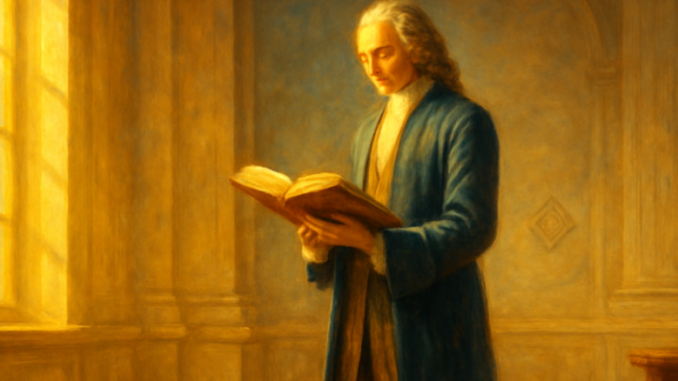
What did Voltaire actually mean when he wrote about God? And why do Freemasons feel such a strong kinship with his ideas? In his Philosophical Dictionary, the French thinker tackles a question that has occupied seekers for centuries: how do human reason and the divine relate to one another? Let us sit across the table from Voltaire himself and explore where his philosophy intersects with the Masonic path.
What Did Voltaire Really Write About God?
Voltaire was no atheist, despite what his critics often claimed. In his entry “On God” in the Philosophical Dictionary, he argues that the existence of an ordering force in the universe is entirely reasonable. He observes nature — the regularity of the stars, the mathematical precision of natural laws — and concludes that behind it all lies a formative principle. But here is the crucial point: Voltaire explicitly rejects the anthropomorphic God of many religious traditions. He speaks instead of a Supreme Being that manifests in the harmony of the cosmos, not through dogmas or revelations.
This position places him squarely within the tradition of deism — the belief that God created the world but does not actively intervene in human affairs. For Voltaire, this was not a cold or distant vision. On the contrary, he saw in it a profound space for human responsibility and moral growth.
Why Does This Resonate With Freemasons?
Here we touch on something essential. Freemasonry does not require its members to subscribe to a specific image of God. What it does ask is an acknowledgment of a higher ordering principle, often referred to as the Grand Architect of the Universe. This concept is deliberately broad. It offers room for the Christian, the Jew, the Muslim, the Buddhist — and yes, the deist in Voltaire’s tradition.
Freemasonry does not seek the right answer to the question of God. It seeks the right attitude toward the mystery.
Voltaire’s emphasis on reason and moral autonomy aligns seamlessly with Masonic values of self-reflection and personal development. The Craft encourages its members to think for themselves — not to blindly follow tradition, but to arrive at insight through personal inquiry. This is precisely what Voltaire advocated.
What Does This Have to Do With Virtue?
An excellent question. Voltaire was convinced that morality does not depend on religious revelation. A person can live virtuously by following reason and cultivating empathy. In his essay, he emphasizes that belief in God only becomes valuable when it leads to righteous action. A God who is vengeful or arbitrary, Voltaire argues, does not deserve worship.
Freemasonry shares this ethical focus. In lodge work, the emphasis is not on belief but on conduct. The rituals and symbols serve as tools for moral refinement. The rough ashlar that must be shaped into a perfect cube, the plumb line that symbolizes uprightness, the compasses that keep us within due bounds — these are not decorations. They are daily reminders of the inner work every Mason must undertake.
How Does the Search for Truth Relate to Light?
Voltaire was an Enlightenment thinker in the truest sense of the word. He believed that knowledge and reason could liberate humanity from superstition and tyranny. The light of reason was to dispel the darkness of ignorance. This image of light as a metaphor for insight and truth is deeply embedded in Freemasonry.
During initiation, the candidate literally receives light. This is not a magical moment but a symbolic reminder that the search for truth begins with acknowledging one’s own ignorance. Socrates would recognize this; so would Plato. And Voltaire would nod approvingly. The lodge thus becomes a space where the Enlightenment ideal takes tangible form through ritual and brotherhood.
Is Brotherhood the Key?
Voltaire did not write his Philosophical Dictionary in isolation. He corresponded with countless thinkers, monarchs, and artists. He believed in the power of intellectual community. While his membership in a Masonic lodge is not historically proven beyond all doubt, he moved in circles where many Freemasons were active — men like Benjamin Franklin and other Enlightenment thinkers who championed the ideals of reason, tolerance, and fraternity.
In Freemasonry, this sense of connection is made concrete. Brethren from diverse backgrounds meet as equals. The lodge transcends social hierarchies. This is not a utopian ideal — it is a working practice that has endured for centuries. Voltaire would appreciate it as a realization of his philosophical convictions.
The Shared Pillars of Voltaire and Freemasonry
When we distill the connections between Voltaire’s philosophy and Masonic tradition, four pillars emerge clearly. First, reason as a compass for moral action. Second, acknowledgment of a higher order without dogmatism. Third, virtue as a daily practice rather than an abstract ideal. And fourth, community as a vehicle for personal growth. These are not merely theoretical overlaps — they are lived principles in lodges around the world.
What Can We Learn From This Conversation Today?
Voltaire’s essay “On God” invites self-reflection. Not the adoption of a position, but the asking of honest questions. What do I truly believe? How do I live my convictions? Am I willing to examine my certainties? Freemasonry provides a framework within which such questions can be asked without a definitive answer being imposed.
In an age dominated by polarization, this attitude is refreshing. Voltaire and Freemasonry remind us that the search itself has value — that we are bound together by our questions, not only by our answers. And that the true art of building begins within ourselves.
Voltaire’s thoughts on God continue to invite conversation centuries after they were written. His emphasis on reason, virtue, and tolerance forms a natural bridge to the Masonic path. Both traditions share the conviction that human beings are capable of moral growth — provided they are willing to examine themselves honestly. The question is not whether we find a definitive answer, but whether we have the courage to keep searching.
Copyright text & image: devrijmetselaar.nl
Texts are based on the ideas and content of the author of devrijmetselaar.nl, reviewed, corrected, and supplemented with the assistance of OpenAI. Images are created based on the ideas of the author of devrijmetselaar.nl using OpenAI/DALL-E.

Be the first to comment