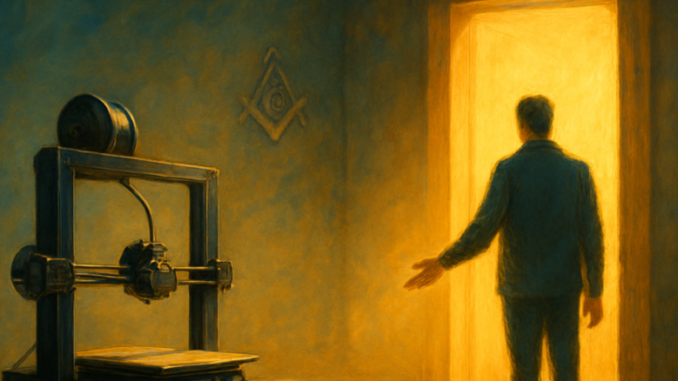
Police recently discovered a collection of homemade firearms and knuckle dusters inside a Dutch apartment — all manufactured with a standard household 3D printer. The technology once celebrated for turning creative ideas into tangible objects was being used to fabricate instruments of destruction. The incident raises an uncomfortable question: what is missing in the life of someone who produces weapons in total isolation? And more importantly, what can any of us do to prevent that kind of loneliness from taking hold — in our own lives and in the lives of those around us?
Alone Behind a Closed Door
Picture the scene. Someone sits alone, night after night, surrounded by spools of plastic filament and the monotonous hum of a printer building a weapon layer by layer. No colleague asking how they are doing. No friend ringing the doorbell with coffee. No brother saying, “Tell me — what’s on your mind?” The image is haunting, not because of the technology involved, but because of the profound loneliness it reveals.
Research confirms it time and again: social isolation is one of the strongest predictors of radicalization and destructive behavior. Not ideology. Not poverty. The absence of genuine human connection. This is not an attempt to downplay the seriousness of illegal weapons possession. It is an invitation to look deeper. Behind every headline about violence is a human being who, somewhere along the way, lost their connection to others. And that is precisely where the territory of brotherhood begins.
What Brotherhood Really Means
In Freemasonry, brotherhood is not an abstract ideal hanging on a wall. It is a daily practice. When brethren meet, they do more than exchange ritual phrases. They look each other in the eye. They listen. They hold up a mirror — not to judge, but to help one another grow.
The eighteenth-century clergyman and Freemason James Anderson established in his Constitutions of 1723 that the lodge should be a place where men of diverse backgrounds meet as equals. Not to agree on everything, but to recognize each other’s humanity. Brotherhood is not a luxury for those who are comfortable; it is a necessity for those who risk losing their way. Especially in an age of isolation and digital seclusion, the outstretched hand of a fellow human being is the most powerful weapon against destruction.
Johann Wolfgang von Goethe, himself a Freemason and member of Lodge Amalia in Weimar, described how the lodge provided him with a space to test his ideas against those of others without fear of condemnation. That sense of safety is never a given. It must be actively built, maintained, and protected. And it begins not inside a lodge building, but in everyday life.
Three Practical Steps to Practice Brotherhood
You do not need to be a Freemason to activate the power of brotherhood in your own community. Here are three actions you can put into practice today.
1. Reach Out to the Quiet One
Everyone knows someone who has slowly dropped off the radar. The neighbor you haven’t seen in weeks. The former colleague who stopped responding to messages. The cousin who never shows up to family gatherings anymore. Send them a message today — not with a question that is easy to dodge (“How are you?”), but with a concrete invitation: “I’m walking through the park Saturday morning — want to join me?” In Freemasonry, this is known as seeking the lost brother. It is one of the oldest and most practical forms of care the Craft teaches.
2. Create a Regular Moment of Connection
Lodges convene on fixed evenings — not because it happens to be convenient, but because regularity is the foundation of trust. Apply this principle in your own life. Arrange with a small group of friends or acquaintances to share a meal, take a walk, or discuss a book every two weeks. The format matters less than the repetition. It is the predictability that gives people the feeling they belong somewhere.
3. Listen Without Trying to Fix
One of the most powerful lessons embedded in Masonic ritual is the art of silence at the right moment. When someone shares their worries, the first impulse is often to offer a solution. Train yourself to simply listen. Nod. Ask a follow-up question. Let the silence exist. Aristotle taught that true friendship is not about utility or pleasure, but about the mutual recognition of each other’s character. That recognition begins with the willingness to hear what the other person is truly saying.
Technology Is Neutral — People Are Not
The 3D printer found in that Dutch apartment is neither good nor evil in itself. The same technology is used to manufacture prosthetics for children in conflict zones, to create works of art, and to build architectural models. The difference never lies in the tool. It always lies in the hands that hold it and in the heart that guides those hands.
The legendary master builder Hiram Abiff, the central figure in Masonic tradition, used his tools to construct a temple that would inspire generations. His story teaches us that craftsmanship only gains true value when it serves something greater than self-interest. Without community, without a sense of responsibility toward others, creation quickly deteriorates into destruction.
The Lodge as a Blueprint for Connection
What Freemasonry has offered for over three centuries is a structure in which men of all backgrounds, faiths, and professions meet on equal footing. Not to govern the world, as persistent myths suggest, but to improve themselves in the company of others. Wolfgang Amadeus Mozart found in his Viennese lodge Zur Wohltätigkeit a circle of kindred spirits who challenged him not only artistically but also on a deeply human level. That combination of personal growth and communal purpose is what distinguishes brotherhood from superficial social contact.
The news story from the Netherlands is a stark reminder that in a hyper-connected digital world, genuine human connection is becoming increasingly rare — and increasingly vital. The lodge model offers a time-tested blueprint: a dedicated space, a consistent rhythm of meeting, a commitment to honest dialogue, and an unwavering belief that every person carries within them the potential for something better. These are not quaint traditions. They are survival strategies for a fragmented age.
A 3D printer can build a weapon or a prosthetic hand. The difference is never about the machine — it is about the person behind it and the community, or lack thereof, that surrounds them. Brotherhood is not a relic of the past. It is an urgent, practical, and profoundly human response to the isolation that corrodes modern life. Whether you are a Freemason or not, the principle remains the same: reach out, show up, and listen. Because the most powerful tool against destruction has never been a technology — it has always been a genuine human connection.
Copyright text & image: devrijmetselaar.nl
Texts are based on the ideas and content of the author of devrijmetselaar.nl, reviewed, corrected, and supplemented with the assistance of OpenAI. Images are created based on the ideas of the author of devrijmetselaar.nl using OpenAI/DALL-E.


Be the first to comment