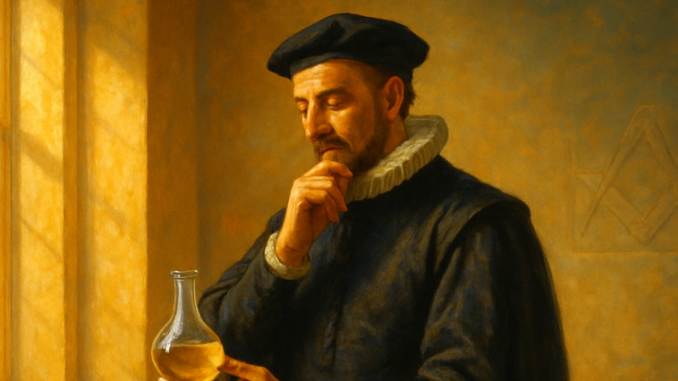
Picture this: a man steps out of the lodge after a long evening into the cool night air. He breathes deeply. The scent of wood and wax still clings to his clothing, mingled with something he cannot quite name. Yet that fragrance immediately summons the warmth of the brotherhood he has just left behind. No words, no images — only that fleeting impression reconnects him to everything the evening meant. It is precisely this kind of invisible bond that Michel de Montaigne wrote about in his short but remarkably profound essay “On Smells.”
An Unexpected Essay on the Intangible
In the fifty-fifth essay of the first book of his famous Essays, Montaigne turns his attention to something most thinkers of his era ignored entirely: scent. While philosophers such as Aristotle and Plato elevated reason and sight to the noblest of the senses, Montaigne deliberately chose the most fleeting and underestimated sense of all. He describes how certain smells strike him as pleasant or repulsive, how he considers the finest scent to be the absence of scent, and how a person’s natural body odor may reveal something about their inner character. The essay is brief, almost casually written, yet within that very brevity lies a richness that only becomes visible when you connect it to a deeper question: what truly makes connection between human beings possible?
The Honesty of the Body
What fascinates Montaigne about scent is its unvarnished honesty. You can choose your words carefully, control your facial expressions, and dress to suit the occasion. But your scent does not lie. Montaigne references ancient stories in which great generals like Alexander the Great were said to exude a sweet bodily fragrance, as though their inner virtue literally manifested through the skin. Whether or not such accounts are historically reliable is beside the point — the heart of Montaigne’s observation touches something essential: there are forms of communication that escape our conscious control. And those forms are often more honest than anything we deliberately construct.
For Montaigne, this is no trivial aside. It fits squarely within his lifelong project of self-reflection and honesty. Across all his essays, he searches for whatever lies hidden behind the façade of human behavior. Seen in this light, scent becomes a metaphor for authenticity — the uncontrollable residue of who a person truly is.
The Invisible Bond in Freemasonry
In Freemasonry, the concept of connection plays a central role. Brothers gather in a space that is ritually sealed off from the outside world. Within that space, something emerges that is difficult to put into words: a sense of shared presence, of mutual trust that extends far beyond spoken agreements. Like a scent, this bond is intangible yet unmistakably present. It is not enforced by rules or constitutions, but grows organically from the shared experience of ritual, silence, and openness of heart.
James Anderson, who drafted the first constitutions of modern Freemasonry in 1723, emphasized that the Craft is not about outward display but about inner qualities. Jean-Théophile Désaguliers, his contemporary and fellow founding figure, added that the lodge must be a space where men meet one another beyond rank and origin, on the basis of what connects them inwardly. That inner connection is precisely what Montaigne means when he writes that the finest scent is the one you do not consciously perceive, yet which moves you nonetheless.
True brotherhood, like true scent, does not impose itself — it permeates everything. It is strongest when it need not be named.
Self-Reflection as Purification
Montaigne writes that he prefers not to wear perfume and is suspicious of excessive artificial fragrances. In doing so, he points to a deeper principle: a distrust of anything that masks reality. Freemasonry shares a strikingly similar aspiration. The search for truth and light — core values within the Craft — requires a willingness to remove one’s own masks. The rough ashlar, that classic Masonic symbol for the unworked self, must be smoothed not by applying a coat of paint, but by chipping away what is superfluous to reveal what is essential beneath.
This process of inner purification demands exactly the attitude Montaigne practices throughout his essays: ruthless yet gentle self-examination. He observes himself without judgment, describing his preferences and aversions with a candor that was extraordinary in his time. In doing so, he anticipates what Freemasonry would later formalize through its degrees and rituals: the gradual process of knowing oneself as a prerequisite for genuine connection with others.
Three Points of Convergence
When we place Montaigne’s essay alongside the principles of Freemasonry, three striking parallels emerge.
Authenticity over display. Both Montaigne and Freemasonry value what is genuine above what is constructed. The scent that is not imposed is purer than the heaviest perfume. In the lodge, a brother who speaks from the heart will always resonate more deeply than one who merely performs.
The invisible as the carrier of connection. Brotherhood does not arise from visible signs alone, but from a shared inner awareness that — like a scent — is unnameable yet unmistakable. The grip, the word, the sign all point toward something deeper that cannot be fully captured in any external form.
Self-reflection as the path to virtue. Montaigne’s method of honest self-inquiry runs parallel to the Masonic pursuit of moral perfection through continuous inner work. Both traditions hold that only by truly knowing yourself can you meet another with integrity.
The Scent That Lingers
The remarkable thing about scent is that it evokes memories more powerfully than any image or word. Modern neuroscience has thoroughly documented this phenomenon, but Montaigne understood it intuitively centuries earlier. He knew that the most fleeting impressions often leave the deepest traces.
In the context of Freemasonry, this is a powerful insight. The moments in the lodge that stay with us longest are rarely the grand speeches or formal proceedings. They are the silences, the glances of recognition, the unspoken understanding that passes between brothers who have shared something real. These moments, like the finest scent, are impossible to bottle — and yet they linger long after the lodge has closed and the night air has carried the last trace of candlewax away.
Montaigne would have appreciated the Masonic lodge. Not for its symbols or its ceremonies, but for its aspiration to create a space where men can be — even if only for a few hours — authentically present to one another. Where the masks come off and what remains is not performance, but presence. Not perfume, but the real thing.
In the end, what connects us most deeply as Freemasons is not what we say, display, or even consciously create. It is the invisible residue of shared experience — a bond as subtle as a fragrance and as enduring as memory itself. Montaigne’s brief meditation on scent reminds us that the most powerful forces in human connection are the ones we cannot see, cannot name, and cannot control. They simply are. And in recognizing them, we come closer to understanding what brotherhood truly means.
Copyright text & image: devrijmetselaar.nl
Texts are based on the ideas and content of the author of devrijmetselaar.nl, reviewed, corrected, and supplemented with the assistance of OpenAI. Images are created based on the ideas of the author of devrijmetselaar.nl using OpenAI/DALL-E.

Be the first to comment