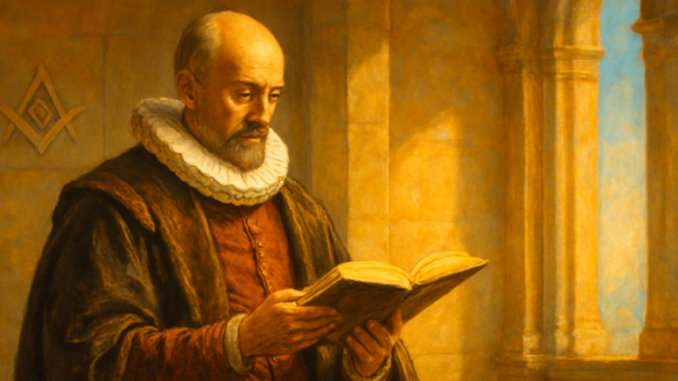
Picture a man kneeling in a sixteenth-century chapel, hands folded, lips moving in prayer. But even as the sacred words leave his mouth, his mind drifts — to the wine harvest, to an unpaid debt, to the face of someone he has wronged. Michel de Montaigne would have allowed himself a subtle smile at such a scene. For it is precisely this tension between what we say and what we truly feel that lies at the heart of his essay On Prayers.
The Core of the Essay
In the fifty-sixth essay of the first book of his celebrated Essays, Montaigne turns his unflinching gaze on one of the most commonplace yet most intimate of human acts: prayer. Written against the backdrop of fierce religious conflict in France, this essay is no theological treatise. It is, rather, a philosophical meditation on whether people truly mean what they pray, and whether their actions align with their words. Montaigne does not question prayer itself — he questions the sincerity with which it is uttered.
Montaigne begins with a simple observation: many people treat prayer as a kind of automatism, a ritual gesture stripped of inner engagement. They murmur the right words at the right moments, but their hearts and minds are elsewhere. For Montaigne, this is no minor issue. It touches on a fundamental question about human honesty: if we cannot be sincere even before the divine, how can we possibly be sincere with one another?
The Lord’s Prayer as a Touchstone
The Lord’s Prayer occupies a special place in this essay. Montaigne considers it the most perfect prayer in existence, precisely because its simplicity encompasses everything a person truly needs. He argues that Christians should recite it more often and more consciously, rather than relying on countless other formulas that, in his view, distract more than they deepen.
For Montaigne, the Lord’s Prayer functions as a mirror. Anyone who truly understands it and feels its meaning cannot help but confront their own shortcomings. After all, the prayer asks for forgiveness — which presupposes that the person praying acknowledges their own faults. It is a moment of radical self-examination disguised as a few familiar lines.
The Gulf Between Word and Deed
The sharpest part of the essay is Montaigne’s critique of the hypocrisy he sees all around him. He describes how people pray devoutly on Sunday and return to their lies, their deceit, and their cruelty on Monday. This duality is not, in his eyes, merely a weakness — it is a form of self-deception that corrodes the entire fabric of society.
Montaigne invokes the Apostle Paul, who warned that outward piety without inner transformation is worthless. He also draws on the Roman philosopher Seneca, who wrote that a good life begins with knowing yourself, not with uttering fine words. The message is clear: a prayer without sincerity is like a temple without a foundation — it may look impressive, but it cannot stand.
Importantly, Montaigne makes clear that he is not opposed to prayer. On the contrary, he considers it a potentially powerful instrument for self-knowledge and moral growth. But only when the person praying is willing to be truly honest — with themselves and with whatever is greater than themselves. A prayer spoken merely out of habit or fear of punishment holds, in his estimation, no value whatsoever.
Historical Context: The French Wars of Religion
It is impossible to read this essay without considering its historical background. Montaigne wrote during a period when France was torn apart by the Wars of Religion between Catholics and Huguenots. Both sides invoked God, both prayed for victory, and both committed atrocities in the name of their faith.
Montaigne, himself a Catholic but a friend to thinkers on both sides of the divide, witnessed how prayer was wielded as a weapon rather than offered as a bridge. This experience colors his entire argument. He does not explicitly condemn either camp, but he leads the reader to an inescapable conclusion: a God invoked by murderers cannot be the same God of mercy addressed in the Lord’s Prayer.
Resonance with Freemasonry
The themes Montaigne explores in this essay resonate in a striking way with the core values of Freemasonry. In the lodge, every brother is called upon to be sincere — not only in words but above all in deeds. Masonic ritual, much like the prayer Montaigne describes, is only truly meaningful when experienced with inner conviction. A ritual performed as mere formality loses its transformative power, just as a prayer without sincerity remains hollow.
Freemasonry also holds a deep respect for the personal beliefs of each member. Where Montaigne argues for prayer that springs from the heart rather than from dogma, Freemasonry likewise welcomes brethren of all faiths and backgrounds. What matters is not the specific words a person speaks, but the sincerity and moral intention behind them. James Anderson, who drafted the first constitutions of modern Freemasonry in 1723, similarly emphasized that it is not outward form but inner disposition that makes a person a worthy member of the brotherhood.
In this sense, Montaigne’s essay reads almost as a proto-Masonic text. His insistence on self-knowledge, his distrust of empty ritual, and his belief that genuine moral life demands honest self-examination — these are principles that any Freemason would recognize as foundational to the Craft.
Key Sources and References
Montaigne draws on a diverse range of sources to strengthen his argument. Among the most important are: the Lord’s Prayer as the model of a perfect, sincere prayer; the Apostle Paul on the necessity of inner purity; Seneca on self-knowledge as a prerequisite for a virtuous life; the Wars of Religion as an example of the abuse of religious language; and Plato, who argued that true piety begins with righteous action, not with sacrifices to the gods. Each of these references serves the same purpose: to expose the gap between outward devotion and inner truth, and to challenge the reader to close it.
Montaigne’s essay on prayer remains as relevant today as it was in the sixteenth century. His central question — do we truly mean what we say when we speak to the divine? — extends far beyond the chapel walls. It is a question about authenticity, about the courage to face ourselves as we really are. For Freemasons, this essay offers a powerful reminder that the rituals we practice and the values we profess only carry weight when they are rooted in genuine conviction. The temple we build is not made of words alone; it must be built on the bedrock of sincerity.
Copyright text & image: devrijmetselaar.nl
Texts are based on the ideas and content of the author of devrijmetselaar.nl, reviewed, corrected, and supplemented with the assistance of OpenAI. Images are created based on the ideas of the author of devrijmetselaar.nl using OpenAI/DALL-E.


Be the first to comment