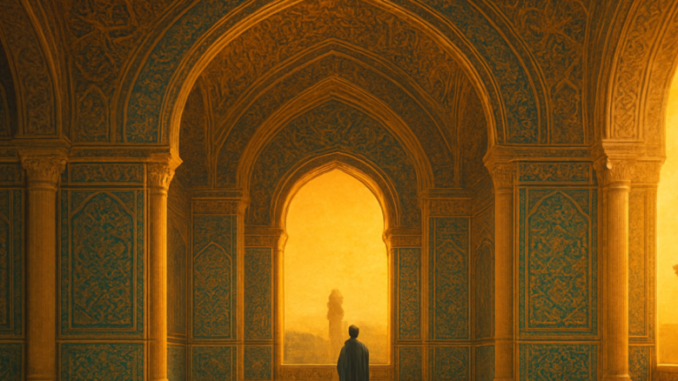
Imagine standing at a market stall, buying a kilo of apples. The vendor places them on the scale but subtly tampers with the weight. You walk away with eight hundred grams but pay for a full kilo. You might not even notice. But something feels off — and deep down, you sense it. This everyday image lies at the heart of the eighty-third Surah of the Quran, known as Al-Mutaffifin, or The Cheaters. It speaks of people who demand full measure for themselves but shortchange others. It is a theme that sits remarkably close to what Freemasons strive to practice every day: sincerity and fairness as the foundation of a well-lived life.
What Does This Surah Tell Us?
Al-Mutaffifin is a short but powerful chapter from the final section of the Quran. It addresses those who insist on receiving full measure when it benefits them, yet skimp when giving to others. The Arabic word in the title literally refers to those who falsify weights and measures. But the message reaches far beyond the marketplace. It points to an inner disposition: are you willing, in every exchange — whether of goods, attention, or honesty — to give what you yourself would want to receive?
The Surah warns that this kind of deception does not go unnoticed. It speaks of a register, a book in which all deeds are recorded. Those who cheat find their actions inscribed in a dark ledger. Those who live with integrity are recorded in a luminous book. This idea of cosmic accounting — an invisible scale that registers everything — is an image that resonates across many spiritual traditions.
The Level and the Scale
For Freemasons, the imagery of honest measuring and weighing is deeply familiar. The level is one of the most important working tools in the lodge. It teaches the Mason to meet others on equal ground — neither elevating himself above his fellow human beings nor shortchanging them. Where the Surah warns against falsifying the measure, the level reminds us that integrity begins with equality.
Aristotle wrote that justice is the virtue that encompasses all other virtues. Without honesty in our dealings with others, every other good quality loses its foundation. The Cheaters aligns seamlessly with this idea: those who deceive in small things undermine the great edifice of trust that holds a community together. In Freemasonry, this is called building the temple of humanity. Every dishonest stone makes the whole structure unstable.
Honest measuring is not merely a market transaction — it is a way of life. It is the willingness to give another person exactly what you yourself would wish to receive.
Familiar Forms of Unfair Measure
Falsifying the measure is hardly limited to the greengrocer’s stall. In our daily lives, we constantly apply double standards — often without realizing it. Consider these recognizable situations:
You expect a colleague to respond to your messages promptly, but you let hours or days pass before replying yourself. You demand honesty from your partner, yet conceal small, uncomfortable truths. You criticize someone for a mistake you would easily forgive in yourself. You take up plenty of space in a conversation but grow impatient when the other person speaks. You expect loyalty, yet are quick to judge others behind their backs.
None of these examples make someone a bad person. But they reveal how subtly the habit of measuring with two different scales creeps into our daily conduct. The Surah invites us to face this pattern — not as condemnation, but as an invitation to grow.
Three Steps Toward Fairer Measure
The power of The Cheaters lies in the simplicity of its message. You don’t need to be a theologian or philosopher to put it into practice. Here are three concrete steps you can apply today, inspired by both this Surah and the Masonic tradition:
1. The Mirror Before Judgment
Before you judge someone for a shortcoming, ask yourself: how would I want someone to respond to this same flaw in me? Freemasons know this as working the rough ashlar — smoothing your own imperfections before scrutinizing those of another. Try this for one week at every moment of irritation or judgment. You will notice how often your standards shift depending on whom you are evaluating.
2. Give Full Measure in Attention
Honest measuring is not only about material things. Montaigne observed that truly listening to another person is one of the rarest and most valuable forms of generosity. Commit to genuinely listening in your next three conversations — without interrupting, without already formulating your reply. Give the other person the full measure of your attention. This simple gesture transforms the quality of every relationship.
3. The Evening Register
The Surah speaks of a register in which deeds are recorded. In many Masonic traditions, a similar practice exists: the nightly self-reflection. Take five minutes each evening to review your day. Where did you give full measure? Where did you cut corners? This is not an exercise in self-punishment, but in awareness. Marcus Aurelius, the Roman emperor-philosopher, did precisely this in his personal meditations. He examined himself not to condemn, but to live a little better the next day.
A Universal Call to Integrity
What makes The Cheaters so remarkable is that its message is not bound to any single faith or tradition. The call to measure honestly echoes in the ethics of Aristotle, in the personal meditations of Marcus Aurelius, in the essays of Montaigne, and in the ritual of the Freemason who is reminded at every meeting of his duty to act justly. It is a message that belongs in every workplace, every family, every heart willing to honestly confront itself.
Freemasonry teaches that spiritual growth is not about grand gestures or abstract ideals. It is about the small, daily choices we make — the moments when no one is watching and we decide whether to give full measure or quietly take more than our share. The level on the lodge floor is not just a symbol. It is a daily challenge: will you meet the world with the same fairness you demand from it?
The ancient wisdom of The Cheaters and the timeless teachings of Freemasonry converge on a single, powerful truth: honesty is not a rule imposed from outside — it is a way of life cultivated from within. Every interaction is an opportunity to place something on the scale. The question is never whether someone is watching. The question is whether you can look at yourself in the mirror at the end of the day and know that you gave full measure. That is the real work of the Mason — and it begins anew every morning.
Copyright text & image: devrijmetselaar.nl
Texts are based on the ideas and content of the author of devrijmetselaar.nl, reviewed, corrected, and supplemented with the assistance of OpenAI. Images are created based on the ideas of the author of devrijmetselaar.nl using OpenAI/DALL-E.
Frequently Asked Questions
What is Al-Mutaffifin and what does it teach about honesty?
Al-Mutaffifin, meaning 'The Cheaters,' is the eighty-third Surah of the Quran that addresses people who demand full measure for themselves but shortchange others. It uses the metaphor of merchants tampering with scales to illustrate deception in everyday life. The Surah teaches that dishonesty—whether in goods, attention, or dealings—is recorded in a cosmic ledger and warns that true integrity requires treating others with the same fairness you would want for yourself.
How does the Masonic symbol of the level relate to the teachings of Al-Mutaffifin?
The level is one of the most important working tools in Masonic lodges and serves as a direct parallel to the Surah's message about honest measuring. While Al-Mutaffifin warns against falsifying measures and weights, the level teaches Masons to meet others on equal ground—neither elevating themselves above others nor shortchanging them. Both emphasize the importance of equality and fairness as the foundation of ethical living.
Why does Freemasonry consider honesty so fundamental to its principles?
Freemasonry views honesty and sincerity as essential to building what it calls 'the temple of humanity.' Drawing on Aristotle's concept that justice encompasses all other virtues, Freemasonry teaches that dishonesty in small matters undermines the trust that holds communities together. Without honesty in our dealings, every other good quality loses its foundation, making the entire structure of community and character unstable.




Be the first to comment