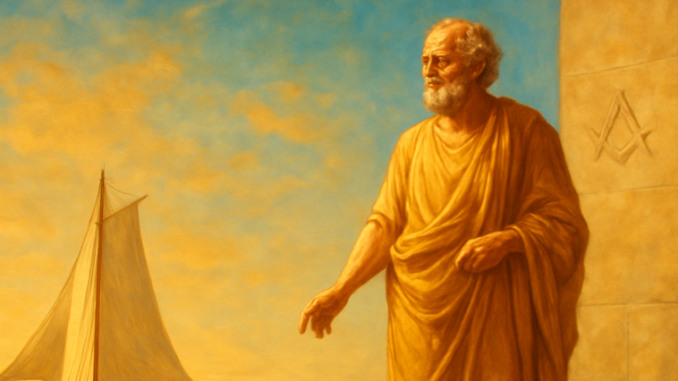
What drives a Roman philosopher to critically question the very arts his entire civilization glorifies? When Seneca examines the liberal arts in his eighty-eighth letter to Lucilius, he does not speak from a vacuum. Behind his words lie centuries of philosophical debate, stretching from the Athenian academies to the Stoic schoolrooms. By tracing the intellectual sources that nourished Seneca’s thinking, we can discover how this ancient wisdom still resonates with anyone engaged in the genuine pursuit of knowledge and self-improvement.
Why Was Seneca So Critical of Widely Praised Knowledge?
The question demands an immediate answer: why would a man who himself excelled in rhetoric and letters challenge the liberal arts? The answer lies at the very heart of Stoicism. For Seneca, as for his predecessors Zeno of Citium and Chrysippus, philosophy was never about intellectual exercises. It was about attaining wisdom that leads to a good life. The Stoics drew a sharp distinction between knowledge that enriches the soul and knowledge that merely entertains the mind.
Seneca inherited this critical stance from the early Stoics, but he refined it considerably. Where Zeno had sternly rejected all non-philosophical knowledge, Seneca showed more nuance. He acknowledged the value of the liberal arts as preparation for wisdom, but he refused to elevate them to an end in themselves. This distinction between means and ends forms the backbone of Letter LXXXVIII — and it carries implications that reach far beyond ancient Rome.
Which Philosophical Traditions Shaped Seneca’s Thinking?
Seneca’s intellectual world was richer than Stoicism alone. He drank from multiple springs, like a wise traveler who takes the clearest water from every source he finds. Three traditions deserve special attention: Stoicism as his foundation, Platonic idealism as his inspiration, and Skepticism as his testing stone.
Stoicism taught him that virtue is the only true good and that all knowledge must contribute to moral progress. Plato’s distinction between the world of the senses and the world of ideas gave Seneca a framework for distinguishing between higher and lower forms of knowledge. Pyrrhonian Skepticism, though not fully embraced by Seneca, sharpened his ability to unmask false wisdom and intellectual pretension.
Particularly influential was Posidonius of Apamea, the Stoic encyclopedist who lived a generation before Seneca. Posidonius had attempted to integrate the liberal arts into a larger philosophical system, arguing that they held genuine philosophical value. Seneca responded to this position — partly agreeing, partly pushing back. In Letter LXXXVIII, we see him wrestling openly with the legacy of Posidonius, testing his predecessor’s conclusions against the demands of Stoic ethics.
What Did Seneca Mean by ‘Liberal Arts’?
The Latin term artes liberales refers to the arts worthy of a free man, as opposed to the practical skills of craftsmen or slaves. In Seneca’s day, these typically included grammar, rhetoric, dialectic, arithmetic, geometry, music, and astronomy. They were the building blocks of a civilized education — the curriculum that shaped every aspiring Roman gentleman.
Seneca’s provocation lay in his assertion that these arts, despite their noble name, do not truly liberate. Grammar teaches you to speak correctly, but not to live well. Music may delight the ear, but it cannot purify the soul. Only philosophy, he argued, leads to genuine liberation from fear, desire, and ignorance. As he memorably put it, the liberal arts do not truly free the mind — only philosophy makes a person inwardly free.
This is a radical claim, especially in a culture that prized rhetorical skill and intellectual accomplishment above almost everything else. Seneca was not dismissing education; he was redefining its purpose. Learning, in his view, must serve transformation — not decoration.
How Did Seneca Relate to His Greek Predecessors?
Aristotle had elevated the theoretical sciences to the highest form of human activity, finding intrinsic value in contemplation. Plato placed dialectic — the ability to reason one’s way to truth — at the summit of education. Seneca respected these traditions, but he shifted the emphasis decisively. Where the Greeks often valued knowledge for its own sake, Seneca demanded practical application. Knowledge that does not change how you live is, in his eyes, incomplete.
Cicero, the great Roman orator who wrote a generation before Seneca, had tried to make Greek philosophy accessible to Roman senators. Seneca went further: he wanted philosophy to be not just accessible but compelling, even urgent. His letters to Lucilius are not academic treatises; they are calls to transformation. Letter LXXXVIII fits this pattern perfectly: it is not a rejection of learning, but a summons to place learning in the service of wisdom.
What Can Seekers of Wisdom Learn from This?
The question with which we began returns in a new form: what makes knowledge truly valuable? Seneca’s answer remains strikingly relevant for anyone walking a path of personal development. Whether one studies books, practices rituals, or contemplates symbols, the question persists: does this contribute to my moral growth?
In traditions that place self-improvement at their center, Seneca’s distinction between lower and higher knowledge sounds surprisingly familiar. The outer form of a teaching — its forms and formulas — can be studied without the soul being touched at all. The inner dimension asks for something more: dedication, reflection, and the willingness to be changed by what one learns. Seneca would say that those who remain at the surface are practicing the liberal arts. Those who press through to the core are approaching wisdom.
For Freemasons, this resonance is particularly strong. The Craft has always distinguished between the outward signs and the inward meaning, between knowing the ritual and living its lessons. Seneca’s challenge echoes through the lodge room: are we merely accumulating knowledge, or are we allowing that knowledge to shape us into better men?
Why Does This Essay Remain Relevant After Two Thousand Years?
Perhaps because the question Seneca posed must be answered anew by every generation. In an age of infinite information and fleeting knowledge, his challenge is sharper than ever: which knowledge truly makes us better? The philosophical background of Letter LXXXVIII reaches far beyond historical curiosity. It is an invitation to critically examine our own learning and to ask ourselves what we are really pursuing when we seek to know more.
Seneca drew from Stoicism, Platonism, and Skepticism, but he made something uniquely his own from these sources. His synthesis invites us to do the same: not to follow tradition blindly, but to question it, absorb it, and make it our own. That, perhaps, is the truest liberal art of all — the art of thinking freely in the service of genuine wisdom.
Seneca’s Letter LXXXVIII does not stand alone. It rests on centuries of philosophical thought, from the rigorous ethics of the Stoics to the lofty ideals of Plato. By understanding the roots of his critique, we gain not only historical insight but a living challenge: to move beyond the accumulation of knowledge and toward the cultivation of wisdom. For anyone committed to the examined life — whether philosopher, Freemason, or simply a seeker of truth — Seneca’s ancient question remains the most modern one we can ask.
Copyright text & image: devrijmetselaar.nl
Texts are based on the ideas and content of the author of devrijmetselaar.nl, reviewed, corrected, and supplemented with the assistance of OpenAI. Images are created based on the ideas of the author of devrijmetselaar.nl using OpenAI/DALL-E.



Be the first to comment