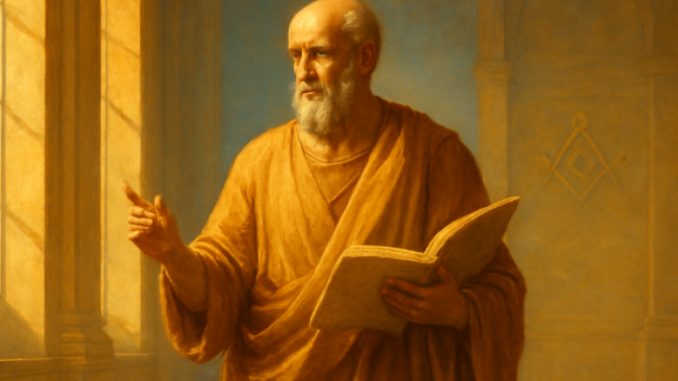
In the dim light of a lodge room, an elder brother pauses over an ancient text. The words are old, yet they resonate as though written yesterday. It is a letter from Lucius Annaeus Seneca to his student Lucilius — one in which the Roman philosopher grapples with a question that is at once simple and infinitely complex: what is real, and what is merely appearance? Letter 58, commonly known as “On the Nature of Things,” offers a fascinating exploration of the reality behind the visible world — a theme that continues to echo in the Freemason’s pursuit of deeper truth.
The Starting Point: Language and Reality
Seneca opens his letter with what appears to be a linguistic complaint. He laments the poverty of Latin compared to Greek when it comes to expressing philosophical concepts. But this is no pedantic grievance. Seneca uses it as a springboard toward a far deeper question: can words ever truly capture reality? The philosopher acknowledges that language is merely a symbol — a pointer toward something that lies hidden behind the words themselves. This realization forms the foundation for his broader argument about the difference between what we perceive and what truly exists.
For Seneca, the search for precise concepts is not an academic exercise but a spiritual necessity. Anyone who wishes to understand reality must first know the limitations of his tools. Language, however refined, remains a finger pointing at the moon — never the moon itself. This insight would resurface centuries later in the symbolic traditions of Western mysticism and philosophy, and it carries particular weight for those who work with symbols as their primary method of instruction.
Plato’s Shadow: The Theory of Forms
At the heart of Letter 58 lies Seneca’s exposition of Plato’s Theory of Forms. Though a Stoic himself, Seneca explains with admirable clarity how Plato distinguished between the transient things we perceive with our senses and the eternal, unchangeable Forms or Ideas that lie behind them. A horse we see in a field is mortal and subject to change, but the Idea of “horse” — the perfect Form from which all horses derive — exists beyond time and space.
Seneca presents a clear classification system. At the summit stands “Being” — that which truly exists. Beneath it fall various categories: the corporeal, the incorporeal, and even that which exists only in the imagination. This ordering is far more than philosophical hair-splitting. It offers a framework for thinking about what holds genuine value in life — what is lasting and what is merely temporary. It is a hierarchy of meaning that invites us to look beyond surface appearances and ask ourselves where true substance resides.
Behind every visible form lies an invisible truth, and the wise person continually seeks what is permanent amid the transient.
The Symbol as a Bridge to the Invisible
It is here that Seneca’s philosophy touches a central theme of Freemasonry: the use of symbols to convey invisible truths. When Seneca describes how the visible world points toward higher, unseen principles, he speaks a language every Freemason will recognize. The working tools of the lodge — the compasses, the square, the rough ashlar — are not ends in themselves. They are references to moral and spiritual truths that cannot be captured directly in words.
Seneca might well have described these symbols as belonging to Plato’s world of appearances, while the virtues they represent — integrity, temperance, brotherly love — belong to the world of Forms. The symbol functions as a bridge between both worlds, a gateway through which the seeking mind can travel from the visible to the invisible. This is precisely what happens in Masonic ritual: through tangible objects and enacted ceremony, the candidate is led toward intangible truths about human character and moral purpose.
This symbolic method is not a quaint tradition or a mere theatrical device. It reflects a deep philosophical conviction — one shared by Seneca and the Platonic tradition — that the most important realities cannot be communicated through literal instruction alone. They must be experienced, intuited, and gradually internalized through repeated engagement with meaningful symbols.
Impermanence and Consolation
Toward the end of his letter, Seneca takes a deeply personal turn. He speaks of his own aging and approaching death — not with fear, but with serene acceptance. If the world of the senses is merely a shadow of reality, then death is not a catastrophe but a return to the source. The body perishes, but that which truly “is” — the mind, the soul, the rational principle — remains connected to the eternal.
This consoling thought represents the ethical climax of the letter. For Seneca, philosophy is not an abstract intellectual exercise but a practical art of living. Understanding the nature of things must lead to peace of mind, to freedom from fear, to the courage to release what is transient and embrace what endures. There is a quiet heroism in this posture — an acknowledgment that mortality, rather than diminishing life’s meaning, actually clarifies it.
For Freemasons, this theme resonates with the symbolic presence of mortality throughout Masonic teaching. The memento mori is not a morbid preoccupation but a call to focus on what truly matters — on the quality of one’s character and the legacy of one’s deeds rather than the accumulation of perishable things.
Key Themes at a Glance
Seneca’s Letter 58 weaves together several powerful themes that deserve reflection. First, there is the recognition of the limitations of language as a tool for describing reality — a humbling reminder for anyone who believes that truth can be fully articulated. Second, there is the distinction between the transient sensory world and the eternal realm of Ideas — an insight that challenges us to look beyond appearances. Third, Seneca offers a hierarchical ordering of Being according to Platonic principles, providing a map for philosophical inquiry. Fourth, he implicitly affirms the value of symbols as bridges to higher truths — a practice at the very heart of Masonic work. And finally, he demonstrates philosophy’s power as a source of consolation in the face of impermanence and death.
What This Means for Today’s Reader
Letter 58 invites a fundamental reassessment of what we take to be real. In an age when the sensory world overwhelms us with stimulation — constant notifications, streaming images, relentless noise — Seneca reminds us that behind every surface lies a deeper layer waiting to be discovered. For Freemasons, this letter provides a philosophical foundation for their symbolic method: working with visible signs to cultivate invisible virtues.
The question Seneca leaves us with is timeless: do we direct our attention toward what fades, or toward what endures? The answer to that question determines not only our philosophy but our happiness. In a culture obsessed with the ephemeral, choosing to focus on lasting values is itself a radical act — one that both Stoic philosophy and Masonic teaching encourage in their own distinctive ways.
Seneca’s Letter 58 on the nature of things is far more than a philosophical treatise. It is an invitation to look beyond the surface — to recognize in symbols and apparent simplicity the references to eternal truths. For those willing to undertake this journey, a world opens up in which impermanence is not a threat but a reminder: the essential is indestructible. And in that realization lies true freedom.
Copyright text & image: devrijmetselaar.nl
Texts are based on the ideas and content of the author of devrijmetselaar.nl, reviewed, corrected, and supplemented with the assistance of OpenAI. Images are created based on the ideas of the author of devrijmetselaar.nl using OpenAI/DALL-E.

Be the first to comment