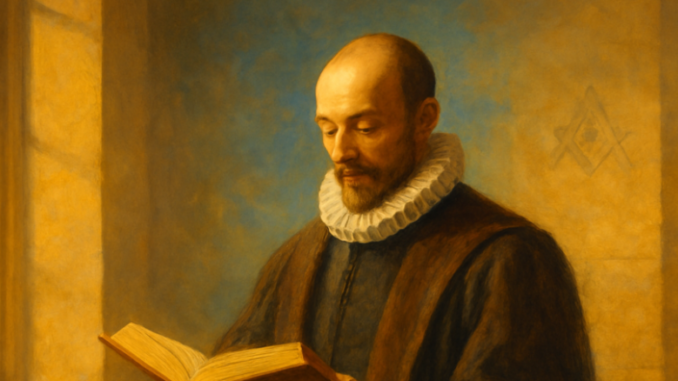
Can anyone speak honestly about themselves without first being honest about their sources? Michel de Montaigne posed that question with striking clarity in the tenth essay of his second book, commonly known as ‘On Books.’ Behind what appears to be a modest self-portrait lies a profound philosophical program. The traditions Montaigne wove together in this essay — from ancient skepticism to Renaissance humanism — form a vision of knowledge that still resonates today in every space where people gather to seek truth together, including the Masonic lodge.
Reading as a Philosophical Act
Here lies a paradox. In ‘On Books,’ Montaigne insists he is no scholar. He claims his memory is weak and that he reads merely for pleasure. Yet in the very same essay, he demonstrates astonishing erudition and a razor-sharp critical faculty. This apparent contradiction is not carelessness — it is a deliberate philosophical strategy. By foregrounding his own limitations, Montaigne frees himself from the obligation to claim authority. He does not read to prove himself right; he reads to question himself. In doing so, he places the act of reading within a tradition far older than the printing press.
Skepticism as Foundation: The Legacy of Sextus Empiricus
The most important philosophical undercurrent in ‘On Books’ is Pyrrhonian skepticism. Around 1576, a few years before working on this essay, Montaigne had studied the works of Sextus Empiricus intensively. This second-century Greek philosopher taught that human beings cannot achieve definitive knowledge and that the suspension of judgment — known as epoché — is the only intellectually honest posture available to us.
Montaigne translated this principle directly into his reading practice. He refused to surrender blindly to any author, however celebrated. Even Aristotle, whose authority in the scholastic tradition was considered virtually untouchable, did not escape Montaigne’s critical gaze. Skepticism gave him the freedom to judge books not by what tradition prescribed about them, but by what they actually did to his own thinking.
The Break from Dogmatic Thinking
This point deserves emphasis because it radically distinguishes Montaigne’s approach from the scholastic method that still dominated many universities in his time. Where scholasticism read a text to extract fixed truths, Montaigne read to make his own uncertainty productive. He was not searching for answers that end thought — he was searching for questions that set thought in motion again.
This is the same spirit that would later come to characterize the lodges of the Enlightenment: not the defense of dogma, but the collective examination of what is good, true, and beautiful. Freemasonry, at its best, invites the same open-ended inquiry that Montaigne practiced alone in his tower library.
Stoicism and Plutarch: The Moral Dimension of Reading
Alongside skepticism, Montaigne drew deeply from the Stoic tradition. In ‘On Books,’ he names Seneca and Plutarch as his most beloved authors and explains precisely why. Seneca attracts him through a direct, unpolished style that aims straight for the heart. Plutarch he values for the ability to make abstract virtues concrete through biographical narratives and comparisons.
Both writers represent a moral philosophy that refuses to remain trapped in abstraction and instead drives toward action. For the Stoics, philosophy was not an academic discipline but an art of living. Reading within that framework was never passive — it was an exercise in self-formation. Marcus Aurelius, who wrote his Meditations as personal notes to himself, is perhaps the most famous example. Montaigne places himself squarely in this lineage. Books, for him, are instruments of conscience, not of intellect alone.
Montaigne did not read to accumulate knowledge — he read to know himself. In this, he is a forerunner of every seeker who dares to confront the unknown within themselves, a journey that lies at the very heart of Masonic initiation.
Renaissance Humanism: Rediscovering the Human
Montaigne’s essay is unthinkable without the broader movement of Renaissance humanism. Thinkers such as Erasmus and Petrarch had ignited an intellectual revolution in the centuries before Montaigne by making the classical texts of Greece and Rome accessible once more. They believed that the study of the humanities — literature, rhetoric, and moral philosophy — could elevate the human spirit.
Montaigne inherited this conviction but added a critical layer. Where many humanists tended toward an almost religious veneration of the classics, Montaigne held fast to his right to doubt. He genuinely admired Virgil and Lucretius, but he was equally unashamed to confess that Plato sometimes bored him. Such honesty was unusual in his time — even provocative.
It is precisely this attitude that makes Montaigne a bridge figure between Renaissance humanism and the later Enlightenment. Voltaire and Rousseau, both deeply influenced by Montaigne’s work, would further develop the same combination of wide reading and intellectual independence. And it is no coincidence that these same Enlightenment thinkers were closely connected to the rise of modern Freemasonry in the eighteenth century.
Free Inquiry as a Shared Principle
What makes the philosophical background of ‘On Books’ so remarkable is the convergence of all these traditions into a single principle: free inquiry. Skepticism teaches us to accept no claim uncritically. Stoicism teaches us to connect knowledge with virtuous action. Humanism teaches us to treat classical sources as conversation partners, not as infallible authorities.
Together, these traditions form an intellectual ethic that closely mirrors the working method of the Masonic lodge, where Brothers and Sisters come together to reflect without prejudice — not to convince, but to seek together. James Anderson, who published the first constitutions of modern Freemasonry in 1723, enshrined a similar spirit of tolerance and open inquiry that Montaigne had championed more than a century earlier.
The lodge, like Montaigne’s library, is a space where authority is earned through sincerity rather than claimed through status. The rough ashlar is shaped not by certainty but by the willingness to keep questioning — precisely the disposition Montaigne cultivated every time he opened a book.
Montaigne’s ‘On Books’ is far more than a Renaissance reader’s memoir. It is a philosophical manifesto for intellectual humility, moral self-examination, and the courage to doubt. The traditions he drew upon — Pyrrhonian skepticism, Stoic ethics, and Renaissance humanism — converge in a practice of free inquiry that remains as vital today as it was in the sixteenth century. For Freemasons, Montaigne’s essay offers a powerful reminder that the search for Light begins not with answers, but with the honest acknowledgment of how much we do not yet know. Every book we open, every question we dare to ask in the lodge, is a step along that ancient and unfinished path.
Copyright text & image: devrijmetselaar.nl
Texts are based on the ideas and content of the author of devrijmetselaar.nl, reviewed, corrected, and supplemented with the assistance of OpenAI. Images are created based on the ideas of the author of devrijmetselaar.nl using OpenAI/DALL-E.
Frequently Asked Questions
What is the main philosophical approach Montaigne uses in his essay 'On Books'?
Montaigne employs Pyrrhonian skepticism as his primary philosophical approach. Influenced by the second-century Greek philosopher Sextus Empiricus, he practices epoché (suspension of judgment) rather than seeking definitive answers. This allows him to read critically and question himself rather than blindly accept authority, even that of celebrated authors like Aristotle.
How does Montaigne claim to read if he says he is not a scholar?
Montaigne deliberately presents himself as having a weak memory and reading merely for pleasure, claiming he is no scholar. However, this is a philosophical strategy—by foregrounding his own limitations, he frees himself from claiming authority and shifts his purpose from trying to prove himself right to questioning himself through reading.
How does Montaigne's method differ from the scholastic approach used in universities?
Where scholasticism read texts to extract fixed, unchangeable truths, Montaigne read to make uncertainty productive. Rather than searching for answers that end thought, he sought questions that stimulate further thinking. This represents a radical break from the dogmatic method that dominated many universities during his time.

Be the first to comment