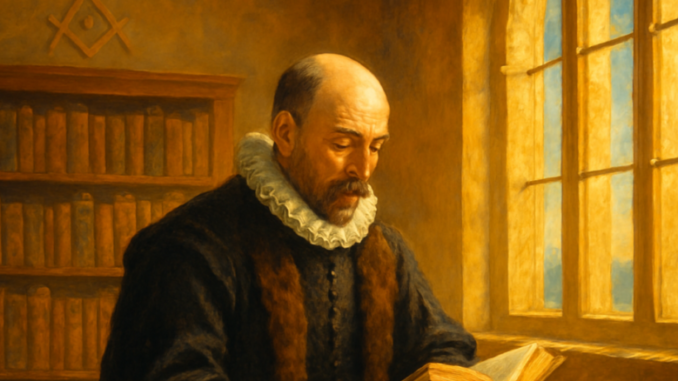
You have almost certainly experienced it: picking up a book that everyone raves about, only to set it down with a sigh after twenty pages. It simply does not move you. Does that feel like failure? Michel de Montaigne would say absolutely not. In his essay ‘On Books’ — the tenth essay of the second book of his famous Essays — he defends the right to put a book aside without guilt. More than that, he turns this kind of honesty into an art of living. What begins as a casual discussion of reading preferences unfolds into a profound argument for intellectual sincerity and self-knowledge, themes that also stand at the very heart of Freemasonry.
The Heart of the Essay: Honesty About One’s Own Judgment
‘On Books’ opens with a remarkable confession. Montaigne tells the reader that his judgments are personal and provisional. He claims no scholarly authority. What he writes about books is nothing more than a record of his own taste and experience. This candor is not false modesty — it is a deliberate choice. Montaigne refuses to hide behind the reputation of established works. If a book bores him, he says so plainly. If he does not understand something, he makes no attempt to cover it up. This radical honesty forms the backbone of the entire essay.
There is something deeply Masonic in this attitude. The work of self-improvement begins with the courage to acknowledge your own limitations. Montaigne does precisely that: he exposes his intellectual imperfections as a first step toward deeper insight. It is not the number of pages read that matters, but the honesty with which you reflect on what you read — and why it does or does not resonate with you.
Montaigne’s Reading Preferences: The Classics as Companions
Montaigne then guides us through his personal library, discussing three categories that shape his reading experience: the historians, the philosophers, and the poets. With each genre, he is refreshingly candid about whom he admires and whom he finds cold.
Among the historians, he particularly praises Plutarch and Seneca. Plutarch, the Greek author of the celebrated Parallel Lives, appeals to Montaigne because of his humane perspective on the great figures of antiquity. Seneca attracts him through his concise, powerful style and Stoic wisdom. For Montaigne, neither writer is a dusty authority — both are living conversation partners. He reads them the way you might talk with a good friend: searching for recognition and personal depth.
Among the poets, Montaigne shows an open preference for Virgil and his masterwork the Aeneid. Lucretius, the Roman poet-philosopher who gave poetic expression to the teachings of Epicurus in On the Nature of Things, also receives warm attention. What stands out is that Montaigne pays attention not only to content but to the experience of reading itself. A poem must stir him, surprise him, awaken something within. Poetry that is merely technically accomplished but fails to move him is dismissed.
What Montaigne Rejects: Pretense and Intellectual Display
Equally notable is what Montaigne explicitly does not value. He has little patience for authors who try to impress through obscure language or contrived reasoning. Cicero, however admired by contemporaries, receives Montaigne’s criticism for being at times too verbose and too ostentatiously rhetorical. This is not indifference but a principled stance: Montaigne seeks truth in books, not performance.
There is a clear parallel here with the way Freemasonry reflects on inner versus outer values. It is not the polished exterior that matters, but what truly lives beneath the surface. Just as a rough ashlar is not judged by its appearance but by the potential it contains, Montaigne judges a book not by its reputation but by the degree to which it conveys something essential.
Montaigne teaches us that honest reading is a form of honest living: whoever dares to admit what does not move them comes closer to discovering what truly does.
Reading as a Mirror: Self-Knowledge Through Books
The deeper theme of this essay is not so much which books you should read, but how you read and what that reveals about you. Montaigne uses his reading reflections as a mirror. By articulating what moves him and what leaves him unmoved, he discovers patterns in his own thinking — his preferences, his blind spots. The essay thus becomes an exercise in self-examination, disguised as literary criticism.
Here we hear the echo of the ancient Greek wisdom that Socrates held so dear: ‘Know thyself.’ This maxim, said to have been inscribed above the Temple of Apollo at Delphi, runs as a thread through Montaigne’s entire body of work. In ‘On Books,’ it finds a particularly practical application. You learn about yourself by observing how you respond to other people’s thoughts. Which sentences make you pause? Which arguments provoke resistance? These reactions reveal something about who you are — not merely about the book you happen to be reading.
Key Examples and References in the Essay
Montaigne draws richly from classical antiquity throughout this essay. The most important names and works he invokes include:
Plutarch, for his humane and narrative approach to history. Seneca, for his direct, Stoic life lessons. Virgil, for the poetic power of the Aeneid. Lucretius, for the philosophical depth of his didactic poem. Cicero, as an example of rhetorical style that Montaigne finds excessive. Julius Caesar, whose commentaries Montaigne values for their clarity and directness.
What all these references have in common is that Montaigne does not treat them as unassailable authorities. Instead, he enters into dialogue with the great minds of antiquity on equal footing — not out of arrogance, but from the conviction that only a free and open-minded judgment can lead to genuine understanding.
What This Essay Still Offers Us Today
In an age of information overload, reading lists, and social pressure to consume the “right” books, Montaigne’s essay feels remarkably contemporary. His message is simple yet liberating: read for yourself. Not to impress, not to accumulate knowledge as a trophy, but to genuinely encounter ideas and, through them, to encounter yourself.
For anyone on a Masonic path, this essay holds a particular resonance. The Lodge teaches that self-knowledge is not achieved through grand gestures but through patient, honest reflection. Montaigne’s approach to reading embodies this principle perfectly. Every book becomes a tool for inner work — not because of what it teaches you about the world, but because of what your response to it teaches you about yourself.
The rough stone is not shaped by reading alone, but by the willingness to honestly confront what that reading stirs within you. Montaigne understood this nearly five centuries ago. His invitation still stands: pick up a book, read with an open heart, and pay attention — not just to the words on the page, but to the reader holding it.
Montaigne’s ‘On Books’ is far more than a Renaissance reading list. It is a masterclass in intellectual honesty and a timeless guide to using literature as a mirror for self-discovery. His refusal to pretend, his insistence on personal judgment, and his understanding that how we read reveals who we are — these are insights that resonate deeply with the Masonic commitment to self-improvement and truth. In a world that often values appearance over substance, Montaigne reminds us that the most important book is the one that helps us read ourselves more clearly.
Copyright text & image: devrijmetselaar.nl
Texts are based on the ideas and content of the author of devrijmetselaar.nl, reviewed, corrected, and supplemented with the assistance of OpenAI. Images are created based on the ideas of the author of devrijmetselaar.nl using OpenAI/DALL-E.
Frequently Asked Questions
What is Montaigne's main argument about abandoning books in Essay 2.10?
Montaigne argues that there is no shame in putting down a book that does not resonate with you, even if it is widely praised. He defends the right to honest reading preferences and contends that intellectual sincerity matters more than completing every book or conforming to popular opinion.
How does Montaigne demonstrate intellectual honesty in his essay?
Montaigne openly admits that his judgments are personal and provisional, claiming no scholarly authority. He refuses to pretend understanding what confuses him or to hide his boredom with established works. This radical candor about his own limitations is presented as a deliberate choice and the foundation of honest self-reflection.
What connection does the article make between Montaigne's reading philosophy and Freemasonry?
The article suggests that Montaigne's emphasis on acknowledging intellectual limitations and pursuing self-knowledge through honest reflection mirrors core Masonic principles. Both traditions value self-improvement that begins with the courage to recognize and accept one's own imperfections as a pathway to deeper insight.


Be the first to comment